
|
A Complete Guide for Engineer What is Plug Valve?
A plug valve is a Quarter-turn rotary motion Valve that uses a tapered or cylindrical plug to stop or start the flow. The disk is in plug shape, which has a passage to pass the flow. This bored passage is in line with the flow in the open position. When the plug is turned 90° from the open position, the solid part of the plug blocks the flow. A plug valve is used in place of a gate valve where a quick operation is required. It is possible to use it in high-pressure temperature services.
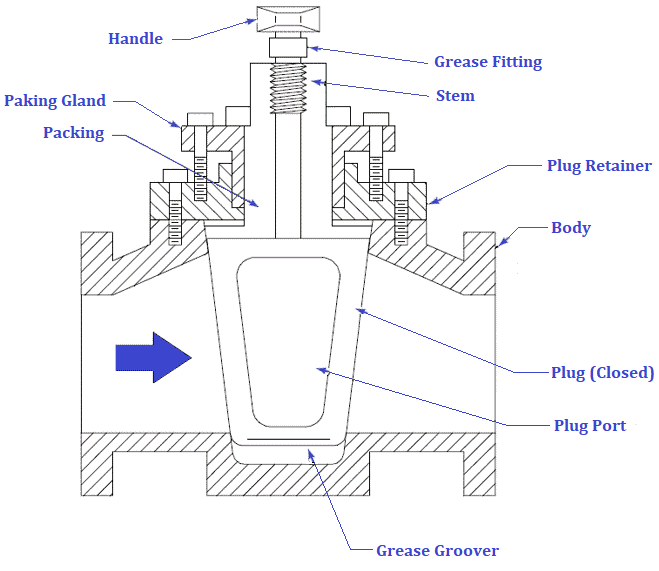
Plug Valve Parts A typical plug valve consists of a body, bonnet, stem and plug. The seat is an integral part of the body in the case of a lubricated plug valve. For a non-lubricated plug valve, a non-metallic seat is used to improve the leak tightness of the valve.
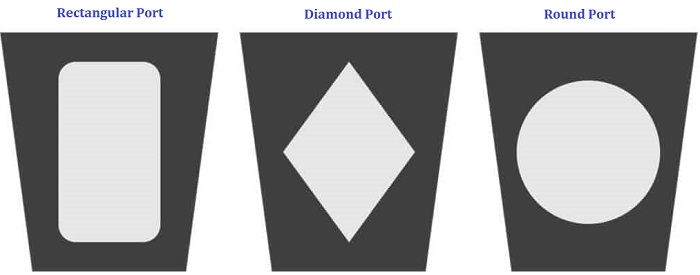
Plug valve disk: Plugs are either round or taper cylinders. They may have various types of port openings, each with a varying degree of the opening area. Plugs are available with
Here in the image, you can see the taper plug with Rectangular, Round, and Diamond Port designs.
Types of Plug Valves Plug valves are available in either a lubricated or non-lubricated design and with different styles of port openings through the plug. Lubricated Plug Valve The plug in lubricated plug valve has a cavity in the middle along its axis. You can see this in the image. The lubricant chamber at the bottom and the sealant injection fitting at the top ensure the supply of lubricant. A small check valve below the injection fitting prevents the sealant from flowing in the reverse direction once the sealant is injected into the cavity. Plug surface gets constantly lubricated by the sealant that moves from the centre cavity through radial holes into lubricant grooves on the plug surface. Now, why do we require all this? Many plug valves are of all-metal construction. The narrow gap around the plug may allow leakage, and if you reduce the gap further, it will increase the friction and the plug may get stuck inside the valve body.
The lubricant reduces the force required to open or close the valve and allows smooth movement of the plug. The lubricant also prevents corrosion of the plug. The lubricant material must be compatible with the fluid of the pipeline. It should not dissolve or wash away by the flow medium as this could contaminate the fluid, and damage the seal between the plug and the body, resulting in leakage. Also, the sealant used must be able to withstand the temperature of the flow medium. Lubricated plug valves are available in the large size range, and they are fit to work in high-pressure temperature services. These valves are subject to less wear and provide better corrosion resistance in some service environments.
Non-lubricated Plug Valves
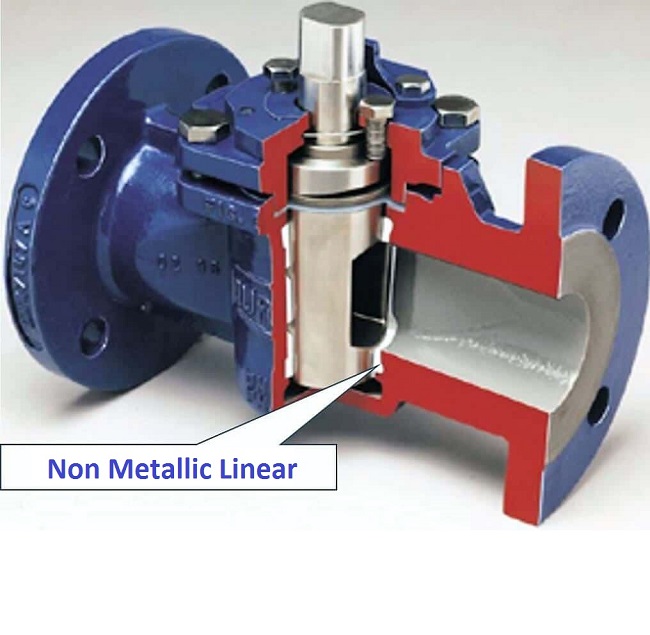
A non-metallic elastomeric sleeve or liner is used in this type of plug valve. This sleeve is installed in the body cavity of the valve. The polished tapered plug acts as a wedge and presses the sleeve against the body. This nonmetallic sleeve reduces the friction between the plug and the valve body. Non-lubricating plug valves required minimum maintenance. Due to the non-metallic seat, these valves are not used in high-temperature services. Lubricating and non-lubricating plug valves are capable of providing a bubble-tight shutoff and are of compact size.
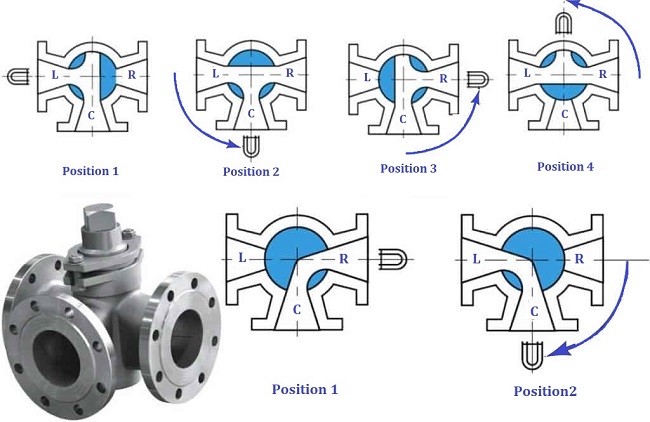
Multi-Port Plug Valves Here you can see the 3-way multiport plug valve. The top image is of 3-way 3-port design and the bottom is a 3-way 2-port design.
Multiport valves are used in transfer lines and for diverting services. A single multiport valve may serve the purpose of three or four gate valves or other types of the shutoff valve. However, sometimes multiport valve does not completely shut off flow. Great care should be taken in specifying the particular port arrangement for proper operation.
Plug Valve Application
Plug Valve Advantages
Disadvantages of Plug Valve
|



+(39) 347 051 5328
Italy - Kazakhstan


09.00am to 18.00pm
About
We offer the best and economical solutions, backed by 27+ years of experience and international standards knowledge, echnological changes, and industrial systems.
Our Services
Marketing Materials


Marketing Materials1


