
RTD Sensors Pt100 to Pt1000 Elements (PRT)IntroductionThe RTD element is a very important part of instrumentation, it is able to measure the temperature of industrial processing. Below are all the specifications and characteristics: A Resistance Temperature Detector (RTD) is a temperature sensor which contains a resistor, the resistance changes with temperature; this can then be correlated to provide a temperature reading. Detectors are most commonly made using platinum (Pt) because it follows a very linear resistance-temperature relationship in a repeatable manner over a large temperature range. They are also known as Platinum Resistance Thermometers (PRT). PRT sensors can be flat film for low-temperature applications or wire wounds for higher-temperature applications. The RTD Pt100 sensor is the most common and has a resistance of 100 ohms at 0°C whilst the Pt1000 sensor has a resistance of 1000 ohms at 0°C. As Pt1000s have a higher resolution they are considered to be more accurate, this is because sensitivity or uncertainty is reduced in basic 2-wire sensors, however, this uncertainty can be further reduced by using 3 or 4-wire RTD sensors (see RTD Circuits below).
Flat Film Detectors
Wire Wound Detectors
RTD Circuits An RTD sensor consists of more than just an element; the element is just part of a circuit that is made up of at least two and up to four lead wires, with any number of connectors and accessories. The circuit configuration can be dependent on a number of factors as shown below:
2-wire RTDs
3-wire RTDs
4-wire RTDs
There are different types of RTD all described below: RTDs Sterling Sensors manufacture Platinum RTD sensors (also known as PRT sensors) in accordance with IEC751 to Class A, B, 1/3 DIN, 1/5 DIN and 1/10 DIN. RTD probes can be supplied in Pt100, Pt500 & Pt1000 as a bare element only, fabricated construction and up to a more complex mineral insulated assembly with single or duplex elements. Whatever your needs, Sterling Sensors will be able to supply a product for your application. Wire RTDs Available in wire types and lengths to suit your needs, we manufacture a range of bare wire resistance thermometers in Pt100 and Pt1000 for temperature measurement applications such as test and measurement, temperature mapping and OEM applications. If you are looking for a low-cost general-purpose sensor with fast response, wire RTD sensors are an ideal starting point. Fabricated RTDs This range of resistance thermometers commonly uses a fabricated sheath to protect the RTD element. They are available with your choice of the detector from Pt100 to Pt1000 and precision options with a wide range of terminations, such as lead wires and plugs. Fabricated RTDs are also available with various types of Industrial head assemblies and safe area transmitters for an extensive range of applications. Surface Measurement RTDs Whether you require temporary or permanent surface measurement, we have a wide selection of surface RTDs available for use on many surfaces and applications including Research and Development, pipes and ducts. General Purpose RTDs Our general-purpose resistance thermometers include bayonet sensors for the plastics industry, load probes for Pharmaceutical and Autoclave applications, as well as oil seal probes for bearing housing temperature measurement. There are even options for internal and external ambient temperature measurement. This range also features RTDs with a "Lemo connector" termination, a universal connector widely recognised in the industry, designed for high accuracy and very fast interchange of sensors. (We also supply matching Lemo sockets) Mineral Insulated RTDs Mineral Insulated RTD probes are robust and can be shaped and formed to suit any application without affecting the sensor. These sensors are available in long lengths and with a broad range of diameters. They can be used at higher temperatures than fabricated RTDs and have better accuracy, repeatability and long-term stability than Mineral Insulated Thermocouples.
below step by step in order to get the right RTD sensor for your application:
Do you know the RTD element type you need? Such as Pt100 or Pt1000. If not, this is the first thing you need to consider. Whatever you are connecting the RTD sensor to normally determines this.
What is being measured? Is the RTD probe measuring a liquid, surface or gas? Does it have to sit in a pipe or a vessel or is it part of a machine or apparatus?
What considerations need to be thought about? E.g. Does it need to be chemically resistant, IP rated, ATEX approved, food use, and high vibration?
How is the RTD fixed to the application, such as; wall mounted, hand-held, outside or inside? Does it need a fitting to be held in place?
(E.g. 0 – 1000 Deg C) This is the main limiting factor when choosing RTD sensors as it determines the materials used in the construction.
What are the length, diameter and size requirements? Does it need to be bent or extremely long?
What is the RTD being connected to? Does it need a terminal head, connector, wire or transmitter? You also need to understand if you need 2 wire, 3 wire or 4 wire configuration. If you can answer these questions, then you should be able to determine the RTD you want. To help you, we have an easy to use questionnaire which can be completed and returned to us, or you can simply call or email us with your questions, we are here to help.
Benefits of Mineral-Insulated RTD SensorsRapid response The high density of the mineral powder promotes rapid heat transfer between the conductor and sheath. Highly flexible Mineral-insulated cable is highly flexible and can be formed into angles and shapes to ensure a perfect fit in the application. This also allows easy installation in locations where access is difficult. Wide temperature range Mineral-insulated sensors are a popular choice as they have a very wide temperature range. Fire-proof and can be exposed to considerably higher temperatures than synthetic sheath cables. Long life The construction of the cable guarantees a long conductor life, due to the sheath and insulating powder protecting them they are able to withstand environmental conditions such as corrosion.
Minimum Bend Radius of Mineral Insulated RTDs
Mineral Insulated Thermocouples can be bent in to many elaborate shapes. However, there is a minimum bend radius, which is 3 times the cable diameter. The above image shows a 3mm diameter MI cable at its minimum bend. To calculate the minimum bend radius you simply multiply the diameter of the cable by 3, therefore the minimum inside radius of a bend for 3mm cable must be 3 x 3 = 9mm. To calculate the circumference (18mm in fig 1) simply multiply the radius (9mm in fig 1) by 2. This is the minimum size of former you would have to use to form your MI cable in to shape. below the questionnaire for selecting the correct RTD
Resistance for Pt100 Sensors (Pt100 Resistance table)The table below can be used as a referencing tool to find the relationship between a range of temperatures and resistance for Pt100 RTD sensors. Temperatures in multiples of ten can be found down the left axis, whilst for more precise readings you must move along the horizontal axis between one and nine. For example the resistance of a Pt100 at 126°C is 148.32 Ohms.
www.bennypass.it |

 Flat film detectors are manufactured by placing a fine layer of platinum wire onto a ceramic substrate. The element is then coated in epoxy or glass which provides protection. They are a cheaper alternative to wire wound detectors and have a fast response time, however, they offer less stability and have a lower temperature range than their wire wound counterparts.
 Wire wound detectors consist of a length of fine-coiled platinum wire wrapped around a ceramic or glass core. They are relatively fragile and are often supplied with a sheath for protection. They have greater accuracy over a wider temperature range than flat film detectors, however, they are more expensive.
 2-wire RTDs are the least accurate of the three circuit types as there is no way of calculating or eliminating the lead wire resistance between the detector and the reading. This creates uncertainty in the reading, so these sensors are often only used with short lead wires where accuracy is not of great importance. 2-wire Pt1000s can be used to reduce sensitivity and uncertainty but still don’t provide a true accurate reading.
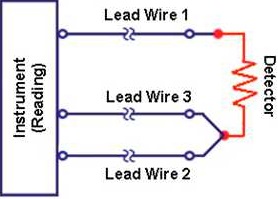 3-wire RTDs are the most commonly used RTD sensors. Assuming all three lead wires are the same the third lead wire calculates the average lead wire resistance throughout the circuit and removes it from the sensor measurement. This makes 3-wire RTDs more accurate than their 2-wire counterparts but less accurate than 4-wire configurations, however, in circuits with long lead wires where there are long distances between the detector and the reading, significant savings can be made by using a 3-wire construction.
 4- wire RTDs are used in applications where close accuracy is paramount. In a 4-wire RTD the actual resistance in each of the lead wires can be measured and eliminated leaving the exact resistance of the detector. The 4-wire circuit works by using the first two lead wires to power the circuit whilst the 3rd and 4th wires read the resistance in each lead wire compensating for any differences in lead wire resistance.



+(39) 347 051 5328
Italy - Kazakhstan


09.00am to 18.00pm
About
We offer the best and economical solutions, backed by 27+ years of experience and international standards knowledge, echnological changes, and industrial systems.
Our Services
Marketing Materials


Marketing Materials1


