
Hexadecimal tutorial Indroduction Hexadecimal – also known as hex or base 16 – is a system we can use to write and share numerical values. In that way it’s no different than the most famous of numeral systems (the one we use every day): decimal. Decimal is a base 10 number system (perfect for beings with 10 fingers), and it uses a collection of 10 unique digits, which can be combined to positionally represent numbers. Hex, like decimal, combines a set of digits to create large numbers. It just so happens that hex uses a set of 16 unique digits. Hex uses the standard 0-9, but it also incorporates six digits you wouldn’t usually expect to see creating numbers: A, B, C, D, E, and F.
NOTE: we have 4 BASE of the number system, below the descriptions: hexadecimal: 0,1,2,3,4,5,6,7,8,9,A,B,C,D,E,F (base 16) binary: 0,1 (base 2) decimal: 0,1,2,3,4,5,6,7,8,9 (base 10) octal: 0,1,2,3,4,5,6,7 (base 8) below from bit to the qword: 1= 1bit 0000 0000 = 1 byte (max decimal = 255, hex = FF) 0000 0000 0000 0000 = 1 word (max decimal = 65535, hex = FFFF) 0000 0000 0000 0000 0000 0000 0000 0000 = double word (max decimal = 4294967295, max hex = FFFFFFFF) 0000 0000 0000 0000 0000 0000 0000 0000 0000 0000 0000 0000 0000 0000 0000 0000 = Q word (max hex = FFFFFFFFFFFFFFFF) Bit 0/1 (yes/no) Byte 00010010 (8 bit) Kilobyte 210 = 1024 byte Megabyte 220 ~ 1.000.000 byte Gigabyte 230 ~ 1.000.000.000 byte
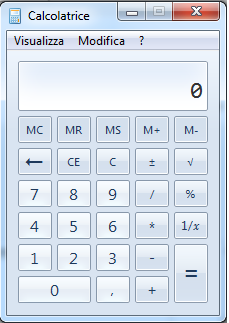
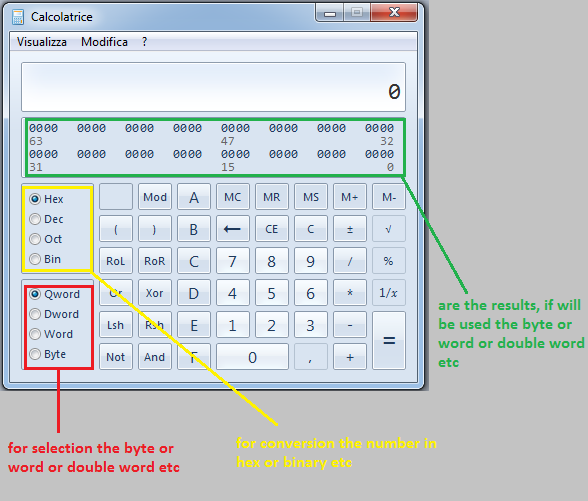
The windows calculator is already with the conversion with hex,dec or binary. See photo below:
first step: open windows calculator
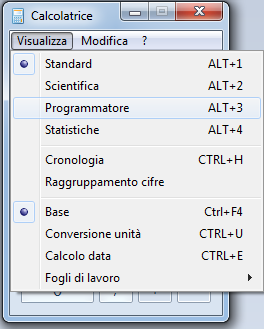
second step: select programmer
third step will open the calculator below:
Hexadecimal Number System Following are the characteristics of a hexadecimal number system.
Example Hexadecimal Number − 19FDE16 Calculating Decimal Equivalent :
Note − 19FDE16 is normally written as 19FDE.
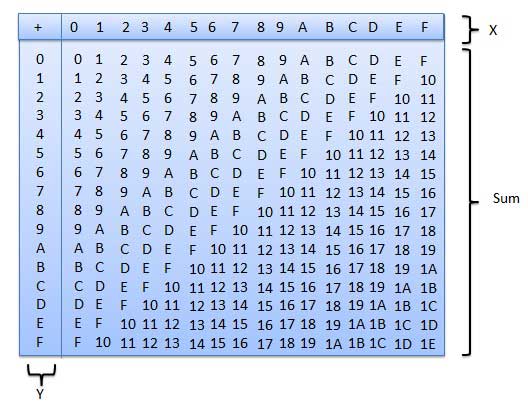
Hexadecimal Addition Following hexadecimal addition table will help you greatly to handle Hexadecimal addition.
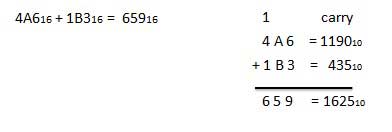
To use this table, simply follow the directions used in this example − Add A16 and 516. Locate A in the X column then locate the 5 in the Y column. The point in 'sum' area where these two columns intersect is the sum of two numbers. A16 + 516 = F16. Example − Addition
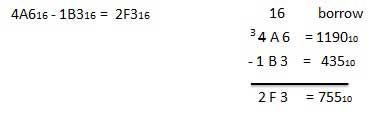
Hexadecimal Subtraction The subtraction of hexadecimal numbers follow the same rules as the subtraction of numbers in any other number system. The only variation is in borrowed number. In the decimal system, you borrow a group of 1010. In the binary system, you borrow a group of 210. In the hexadecimal system you borrow a group of 1610. Example - Subtraction
Hex Identifiers The table below the characters identifier that are used:
There are a variety of other prefixes and suffixes that are specific to certain programming languages. Assembly languagues, for example, might use an “H” or “h” suffix (e.g. 7Fh) or a “$” prefix ($6AD). Consult examples if you’re not sure which prefix or suffix to use with your programming language. The “0x” prefix is one you’ll see a lot, especially if you’re doing any microchip programming. We’ll use that from now on in this tutorial (I prefare the microchip), In summary: DECAF? A horrible abomination of coffee. 0xDECAF? A perfectly acceptable, 5-digit hexadecimal number.
www.bennypass.it |

+(39) 347 051 5328
Italy - Kazakhstan


09.00am to 18.00pm
About
We offer the best and economical solutions, backed by 27+ years of experience and international standards knowledge, echnological changes, and industrial systems.
Our Services
Marketing Materials


Marketing Materials1


