
The Capacitors Capacitor is one of mostly used component in electronic circuit design. It plays an important role in many of the embedded applications. It is available at different ratings. It consists of two metal plates separated by a non conducting substance, or dielectric. Comparisons between the different types of capacitors are generally made with regards to the dielectric used between the plates. Some capacitors look like tubes, small capacitors are often constructed from ceramic materials and then dipped into an epoxy resin to seal them. So here are a few of the more common types of capacitors available. Let’s see of them. When designing circuits or using capacitors in any way, it is often useful to have these capacitor conversions in mind as values transition from picofarads to nanofarads and then nanofarads to microfarads.
Below the Description of 4 types capacitors
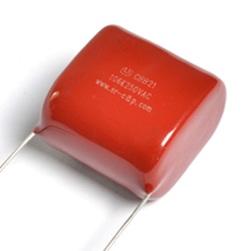
Film Capacitors are the most normally ready of numerous types of capacitors, comprising of a generally expansive group of capacitors with the distinction being in their dielectric properties. They are available in almost any value and voltages as high as 1500 volts. They come in any tolerance from 10% to 0.01%. Film capacitors additionally arrive in a combination of shapes and case styles. There are two types of film capacitors, radial lead type and axial lead type. The electrodes of film capacitors may be metalized aluminum or zinc, applied on one or both sides of the plastic film, resulting in metalized film capacitors called film capacitors. The film capacitor is shown in figure below:
Film Capacitors are sometimes called plastic capacitors because which use polystyrene, polycarbonate or Teflon as their dielectrics. These film sorts need a much thicker dielectric film to lessen the danger of tears or puncture in the film, and is therefore more suited to lower capacitance values and bigger case sizes. The film capacitors are physically larger and more expensive, they are not polarized, so they can be used in AC voltage applications, and they have much more stable electrical parameters. Dependence of capacitance and dissipation factor, they can be applied in frequency stable Class 1 applications, replacing Class 1 ceramic capacitors.
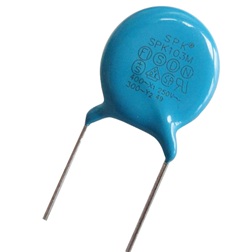
Ceramic capacitors are used in high frequency circuits such as audio to RF. They are also the best choice for high frequency compensation in audio circuits. These capacitors are also called as disc capacitors. Ceramic capacitors are made by coating two sides of a small porcelain or ceramic disc with silver and are then stacked together to make a capacitor. One can make both low capacitance and high capacitance in ceramic capacitors by changing the thickness of the ceramic disc used. The ceramic capacitor is shown in figure below:
They come in values from a few Pico farads to 1 microfarad. The voltage range is from a few volts up to many thousands of volts. Ceramics are inexpensive to manufacture and they come with several dielectric types. The tolerance of ceramics is not great but for their intended role in life they work just fine.
These are the most prevalently used capacitors which have a wide tolerance capacity. Electrolytic capacitors are available with working voltages up to about 500V, although the highest capacitance values are not available at high voltage and higher temperature units are available, but uncommon. There are two types of electrolytic capacitor, tantalum and aluminum in common. Tantalums capacitors have ordinarily better exhibition, higher value, and are ready just in a more limited extend of parameters. The dielectric properties of tantalum oxide is much superior to those of aluminum oxide giving an easier leakage current and better capacitance strength which makes them suitable for obstructing, decoupling, filtering applications. The thickness of the aluminum oxide film and heightened breakdown voltage gives the capacitors exceptionally elevated capacitance values for their size. In a capacitor the foil plates are anodized by a dc current thus setting of the extremity of plat material and confirming polarity of its side. The tantalum and aluminum capacitors are shown in figure below:
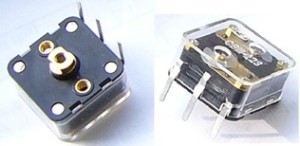
A Variable Capacitor is one whose capacitance may be intentionally and repeatedly changed mechanically. This type of capacitors utilized to set frequency of resonance in LC circuits, for instance, to adjust the radio for impedance matching in antenna tuner devices.
Applications of Capacitors Capacitors have applications in both electrical and electronics. They are used in filter applications, energy storage systems, motor starters and signal processing devices. How to Know the Value of Capacitors?
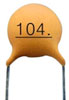
Capacitors are the essential components of an electronic circuit without which the circuit cannot be completed. Use of capacitors includes smoothing the ripples from AC in power supply, coupling and decoupling the signals, as buffers etc. Different types of capacitors like Electrolytic capacitor, Disc capacitor, Tantalum capacitor etc are used in circuits. Electrolytic capacitors have value printed on its body so that its pins can be easily identified. Usually the large pin is positive. The black band present near the negative terminal indicates the polarity. But in Disc capacitors, only a number is printed on its body so it is very difficult to determine its value in PF, KPF, uF, n etc. For some capacitors the value is printed in terms of uF, while in others a EIA code is used. 104. Let us see the methods to identify the capacitor and to calculate its value.
Conversion formula: n x 1000 = PF PF/1000 = n PF/1,000,000 = uF uF x 1,000,000 = PF uF x 1,000,000/1000 = n n=1/1,000,000,000F uF = 1/ 1000,0
Below colors for identification the capacitances
Capacitor conversion nomenclatureAlthough most modern circuits and component descriptions use the nomenclature of µF, nF and pF for detailing capacitor values, often older circuit diagrams, circuit descriptions and even the components themselves may use a host of non-standard abbreviations and it may not always be clear exactly what they mean. Although most modern circuits and component descriptions use the nomenclature of µF, nF and pF for detailing capacitor values, often older circuit diagrams, circuit descriptions and even the components themselves may use a host of non-standard abbreviations and it may not always be clear exactly what they mean. The main variations for the various capacitance sub-multiples are given below:
The standardisation of terminology has assisted in the conversion of values from one submultiple to the next. It has meant that there is considerably less room for misunderstanding. It is easier converting from µF to nF and pF. This is often useful when a circuit diagram may mention a capacitor value mentioned in one way, and the electronic components distributor lists may mention it in another.
The capacitance conversion chart is very useful because different electronic component manufacturers may mark components differently, sometimes labelling as multiple of nanofarad, whereas other manufacturers may mark their equivalent capacitors as a faction of a microfarad and so forth. Obviously the electronic components distributors and electronic component stores will tend to use the manufacturers nomenclature. Similarly circuit diagrams may mark components differently, often to keep commonality, etc. Accordingly it helps to be able to convert from picofarads to nanofarad and microfarads and vice versa. This can help identify components marked in values expressed in nanofarad when the bill of materials or parts list for the circuit may have values expressed in microfarads, µF and picofarads, pF. Often it is helpful to be able to use a capacitance conversion calculator like the one above, but often one becomes familiar with the conversions and the popular equivalents like 1000pF is a nanofarad and 100nF is 0.1µF. When using electronic components and undertaking electronic circuit design, these conversions quickly become second nature, but even so the capacitance conversion tables and calculators can often be very useful. These conversions are obviously useful for capacitors as well as other electronic components like inductors.
www.bennypass.it |




+(39) 347 051 5328
Italy - Kazakhstan


09.00am to 18.00pm
About
We offer the best and economical solutions, backed by 27+ years of experience and international standards knowledge, echnological changes, and industrial systems.
Our Services
Marketing Materials


Marketing Materials1


