
Rating and Feature of the A-lok series Tubings Introduction Compression fittings are one of the most common and versatile methods of connecting metal or hard plastic tubing. Particularly useful for their extreme temperature and pressure capabilities and their compatibility with aggressive fluids, compression fittings can be seen in systems varying from gas lines in refineries to the plumbing under your sink. Miniature compression fittings are found in applications ranging from chromatography and bomb detection instruments to medical devices and inkjet printing. Whether it’s the water heater in your home or a pipe transporting hazardous chemicals, all compression fitting applications have several traits in common: they require easy assembly, long life, and absolutely no leaks.
What is a compression fitting? Compression fitting assemblies vary in design from manufacturer to manufacturer (Parker, Swagelox, etc.), but working principles are almost the same with each other. There are three essential elements, a nut for the compression, one or more ferrules, and the fitting body. The operating principle of each component also remains more or less the same between designs. Let's see in three passages the working principle: Tubing is inserted into the end of the fitting, and the nut/screw is tightened, forcing the ferrule(s) into the fitting body. As the ferrule(s) moves axially into the fitting body, the body's angled shape radially compresses the end of the ferrule onto the outer diameter of the tubing. This radial compression creates the leak-tight seal between the fitting, ferrule, and tubing, giving the compression fitting its name. Figure 1 below shows all details, or click the guide here.
Figure 1 - Compression Fitting Many companies produce compression fittings; Figure 1 above shows an example. The most important companies are Parker and Swagelok. In this manual, we will use Parker, but the working principle is the same for all other companies which provide this kind of connection. The success of compression fittings in a given application can depend on several factors, which include the fitting, ferrule design, tubing selection, and installation procedure. Working pressure The compression fitting, like in Figure 1 above, can reach a maximum pressure of 720 bar, but all depend on tubing size, fittings size etc. The table below shows the tubing dimensions, including thickness with associated pressure. The tables below show all the various possibilities of tubing between inches and millimetres with the respective material characteristics, including its maximum working pressure.
Duplex and Super Duplex Stainless Steel and Carbon Steel Materials ( 316/316L) Carbon Steel: Carbon steel, also called plain carbon steel, is a malleable, iron-based metal containing carbon, small amounts of manganese, and other inherently present elements. It is the most widely used engineering material and accounts for approximately 85% of the annual steel production worldwide. Despite its relatively limited corrosion resistance, carbon steel is still used in large tonnages in numerous industrial applications. Applications
Stainless Steels 316/316L: are austenitic grades and two of the most used alloys in a variety of industrial applications. The molybdenum addition gives this grade good resistance to general corrosion and increases strength at elevated temperatures. The austenitic structure also gives these grades excellent toughness, even at cryogenic temperatures. Grade 316L, the low-carbon version of 316, minimizes harmful carbide precipitation due to welding. It is common for 316 and 316L to be stocked in ‘Dual Certified’ form. These items have chemical and mechanical properties complying with both 316 and 316L specifications. The corrosion resistance of stainless steel grades 316/316L is excellent in a wide range of atmospheric environments and many corrosive media. However, it is subjected to pitting and crevice corrosion in warm chloride environments and to stress corrosion cracking. Applications
Duplex Stainless Steel: Austenitic-Ferritic stainless steels, also called duplex stainless steels, were developed more than 70 years ago in Sweden for the paper industry in order to combat corrosion problems caused by chloride-bearing cooling waters and other aggressive chemical processes fluids. Due to the high content of chromium, nitrogen, and molybdenum, these steels offer good resistance to localised and uniform corrosion. The duplex microstructure contributes to the high mechanical strength, good abrasion, erosion and fatigue resistance. Duplex steels also possess good weldability properties. Applications
Super Duplex Stainless Steel: First used in the 1980s, Super- Duplex refers to highly alloyed, high-performance Duplex stainless steel with improved pitting and crevice corrosion resistance. Super duplex steels were designed for specific applications where both high mechanical strength and good corrosion resistance are required. Super Duplex Stainless Steel is noted for its high level of chromium, which gives the alloy excellent resistance to acid chlorides, acids, caustic solutions and other harsh environments. Applications
Tubing Specification: High Quality, Fully Annealed, Stainless Steel Tubing to ASTM A269 Grade 316/316L UNS S31600/S31603. Recommended Tube Hardness 80 HRB. Maximum Permissible Hardness 90 HRB. Figure 1 and 2 below shows all tubing sizes, including all other details (Imperial and Metric).
Alloy 400 Alloy 400, also known as Monel™, is a nickel-copper alloy resistant to sea water and steam at high temperatures as well as to salt and caustic solutions. The alloy possesses excellent corrosion resistance in a wide variety of media and is also characterized by good weldability and moderate to high strength. The alloy has been used in a variety of applications. It has excellent resistance to rapidly flowing brackish water or seawater. It is particularly resistant to hydrochloric and hydrofluoric acids when they are de-aerated. Indeed, it is one of the few metallic materials which can be used in contact with fluorine, hydrofluoric acid, hydrogen fluoride and their derivatives. The alloy is widely used in the chemical, oil and marine industries. Good mechanical properties from sub-zero temperatures up to 1020 °F. Applications
Tubing Specification: High Quality, Fully Annealed, Alloy 400 Tubing to ASTM B165 Grade UNS N04400. Recommended Tube Hardness 70 HRB. Maximum Permissible Hardness 75 HRB. Figure 3 and 4 below shows all tubing sizes, including all other details (Imperial and Metric).
Super Austenitic 6Mo Super austenitic stainless steel 6Mo is a high-performance alloy designed specifically for added corrosion resistance. It has the same structure as the common austenitic alloys and greater levels of elements such as chromium, nickel, molybdenum, copper, and nitrogen, which gives it enhanced strength and corrosion resistance. 6Mo is especially suited for high chloride environments such as brackish water, seawater, pulp mill bleach plants, and other high chloride process streams. It is often used as a replacement in critical components where alloy 316/316L has failed by pitting, crevice attack, or chloride stress corrosion cracking. In many applications, super austenitic stainless steels are a technically suitable and much more cost-effective alternative than nickel-base alloys. Applications
Tubing Specification: High Quality, Fully Annealed, Super Stainless Steel Tubing to ASTM A269/A213 Grade UNS S31254. Recommended Tube Hardness 80 HRB. Maximum Permissible Hardness 90 HRB. Figure 5 and 6 below shows all tubing sizes, including all other details (Imperial and Metric).
Alloy 825 Alloy 825 is a nickel-iron-chromium alloy with additions of molybdenum, copper, and titanium. The alloy is designed to provide exceptional resistance to many corrosive environments. Alloy 825 is resistant to corrosion in many acids and alkalis under oxidising and reducing conditions, including sulphuric, sulphurous, phosphoric, nitric and organic acids, alkalis such as sodium or potassium hydroxide, and aqueous chloride solutions. High nickel content gives the alloy virtual immunity to stress corrosion cracking and good resistance to pitting and crevice. Alloy 825 is a versatile general engineering alloy that exhibits good mechanical properties at room and elevated temperatures (over 1000 °F). Applications
Tubing Specification: High Quality, Fully Annealed, Alloy 825 Tubing to ASTM B163 or B423 Grade UNS N08825. Recommended Tube Hardness 80 HRB. Maximum Permissible Hardness 90 HRB. Figure 7 and 8 below shows all tubing sizes, including all other details (Imperial and Metric).
Alloy 625 This alloy has outstanding resistance to pitting and crevice corrosion and good resistance to intergranular attack. It also is almost totally resistant to chloride-induced stress corrosion cracking. With these properties, the alloy has extremely high resistance to attack by a wide range of media and environments, including nitric, phosphoric, sulphuric and hydrochloric acids, as well as alkalis and organic acids in both oxidising and reducing conditions. Alloy 625 has virtually no corrosive attack in marine and industrial atmospheres with excellent resistance to seawater, even at elevated temperatures. It is an excellent choice for applications that require high corrosion-fatigue strength or high tensile strength applications, creep and rupture strength and weldability. Applications
Alloy 625 is one of our best-seller materials. It is one of the preferred alloy in a wide range of sour gas applications. Tubing Specification: High Quality, Fully Annealed, Alloy 625 Tubing to ASTM B444 Grade 2 UNS N06625. Recommended Tube Hardness 85 HRB. Maximum Permissible Hardness 93 HRB. Figure 9 and 10 below shows all tubing sizes, including all other details (Imperial and Metric).
Alloy C276 Alloy C-276 is known for its excellent resistance to various chemical process environments, including strong oxidizers such as ferric and cupric chlorides, hot contaminated media, chlorine, formic and acetic acids, acetic anhydride, and seawater and brine solutions. Alloy C-276 alloy has excellent resistance to pitting and stress corrosion cracking. It is also one of the few materials that withstand the corrosive effects of wet chlorine gas, hypochlorite, and chlorine dioxide. Alloy C-276 can resist the formation of grain boundary precipitates in the weld heat-affected zone, making it also a common candidate for most chemical and petrochemical processing applications in the as-welded condition. This alloy might be used in any environment that requires resistance to heat and corrosion but where the mechanical properties of the metal must be retained. Applications
Tubing Specification: High Quality, Fully Annealed, Alloy C276 Tubing to ASTM B622 Grade UNS N10276. Recommended Tube Hardness 85 HRB. Maximum Permissible Hardness 93 HRB. Figure 11 and 12 below shows all tubing sizes, including all other details (Imperial and Metric
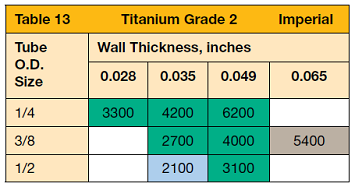
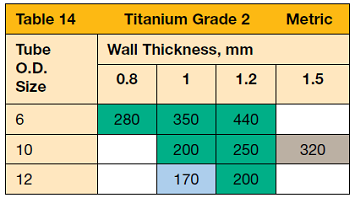
Titanium Grade 2 Titanium is virtually immune to environmental attack. It withstands urban pollution, marine environments, and the sulphur compounds of industrial areas and is failure-proof in even more aggressive environments. The uses for titanium in the industry are growing faster than ever before as more and more engineers are discovering it can reduce lifecycle costs across a broad range of equipment and processes. Titanium has an exceptionally high strength-to-weight ratio, allowing for lighter components or reduced wall thicknesses. Any remaining higher upfront costs are almost always recouped in multiple due to increased production time and reduced maintenance. Titanium forms a tenacious surface oxide layer, an outstanding corrosion inhibitor. It can outlast competing materials in many harsh environments as much as five times longer. Lower failure rates translate to less downtime, reduced maintenance, and lower cost. Applications
Tubing Specification: High Quality, Fully Annealed, Titanium Tubing to ASTM B338 Grade 2 UNS R50400. Recommended Tube Hardness 75 HRB. Maximum Permissible Hardness 85 HRB. Figure 13 and 14 below shows all tubing sizes, including all other details (Imperial and Metric).
As you can see from the tables above, between tubing and fittings, there are several available materials: Alloy C276, Alloy 625, Alloy 825,6Mo, Alloy 400, and 316/316L Stainless Steel. Each of these with own characteristics. A secure connection depends on all of this. A good connection always depends on these tables above. Choosing the suitable material, including tubing size, is the fundamental importance for the long life of the line. An essential thing to know is the difference between tubing in inches and tubing in millimetres. Several sizes look the same but, of course, are different. Let's make an example between 1/2" (Inch) and 12mm (millimetres) diameter tubing. At first sight, the tubings look similar, but it is not like this. The 1/2" tubing is a few millimetres larger if compared to the 12mm tubing. This type of confusion can lead to connection errors and consequently cause serious accidents, especially when working at the limit of the operating pressures. A good thing is always to have available the calliper to measure the tubing or should be available two sample tubing (Inch and mm) and always try them on the fitting. The 1/2" tubing does not enter into the fitting in mm, while the 12mm tubing enters in both fittings, mm and inch with the difference that with tubing in mm inserted in the fitting in inch, the tubing itself will have a visible internal space between fitting and tubing itself. Our team wanted to highlight this.
Recommendations
Note: FAILURE, IMPROPER SELECTION OR IMPROPER USE OF THE PRODUCTS AND/OR SYSTEMS DESCRIBED HEREIN, OR RELATED ITEMS CAN CAUSE DEATH, PERSONAL INJURY AND PROPERTY DAMAGE. Due to the variety of operating conditions and applications for these products or systems, the user, through its own analysis and testing must identify which is the correct fittings, valves, tubings, etc. If you are not sure, always please contact qualified people.
|
||||||||||||||||||||||||
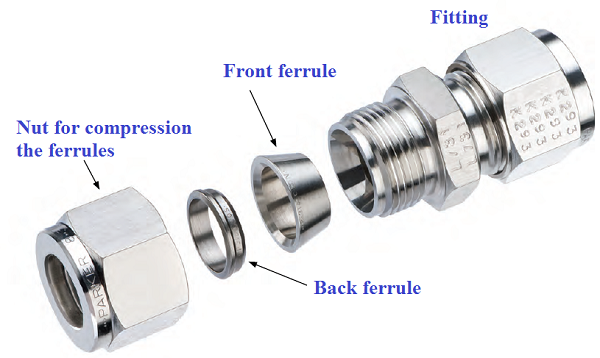
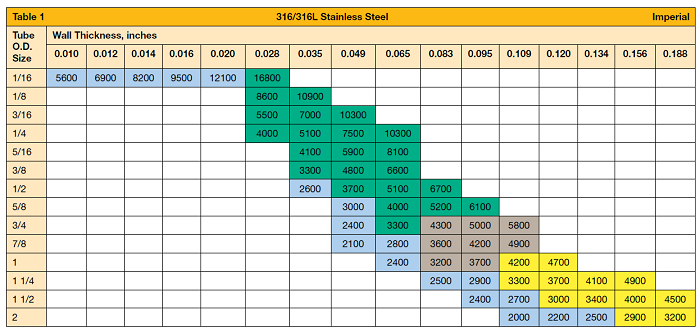
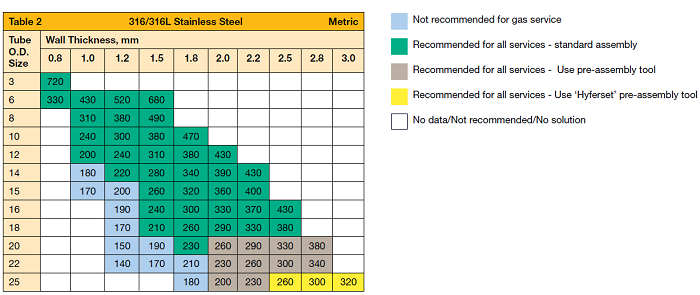
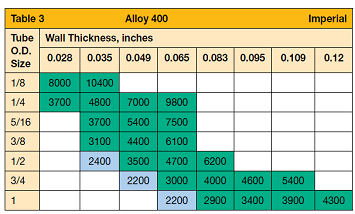
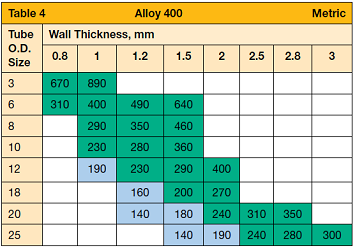
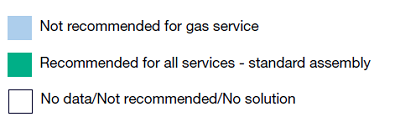
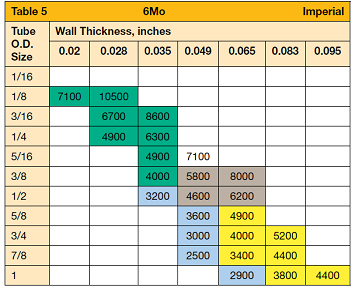
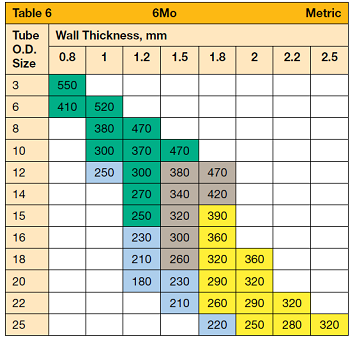
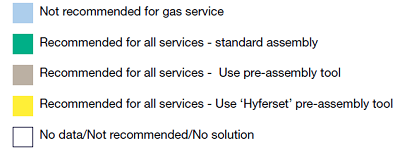
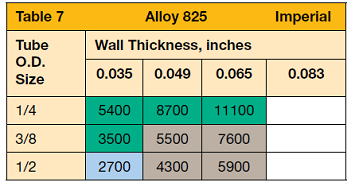
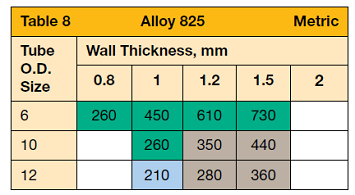
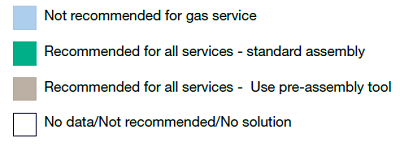
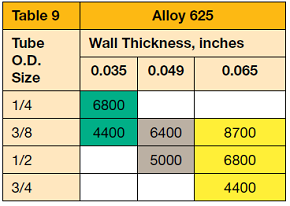
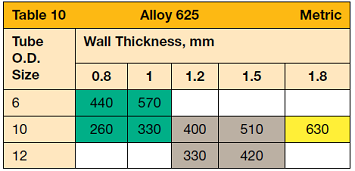
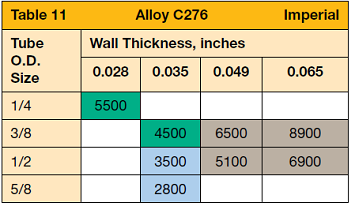 Figure 11 - Table 11 Inch Alloy C276 (WP psig)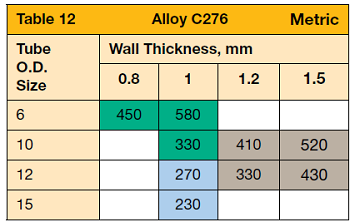


+(39) 347 051 5328
Italy - Kazakhstan


09.00am to 18.00pm
About
We offer the best and economical solutions, backed by 27+ years of experience and international standards knowledge, echnological changes, and industrial systems.
Our Services
Marketing Materials


Marketing Materials1


