|
SAE J1926-1 — SAE Straight Thread O-ring Port (ORB Fitting)
Introduction
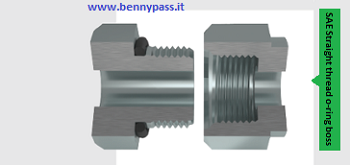
ORB, or (SAE Straight Thread O-ring Boss) fittings, incorporate a port connection as recommended by the National Fire Protection Association (N.F.P.A.) for leak prevention in medium and high pressure hydraulic systems. ORB connections are commonly manufactured in carbon, nickel plated carbon & stainless steel and typically use Buna-N or Viton, 90 Durometer O-rings. The male connection is a straight UNF thread with an O-ring. The female port has a straight thread and a machined surface to provide a smooth, flat, accurately located surface (minimum spotface), along with a chamfer where the O-ring seats. The seal is created when the O-ring is compressed into the chamfer when mating the male and female connection providing a leak-tight seal.
O-ring Ports are the preferred port connection for use in hydraulic systems on industrial equipment and commercial products. The adjustable O-ring fittings described in this section provide a variety of options for connections between tube, hose and pipe ends.
Specifications:
- Thread conforms to ISO 263 and ANSI B1.1 Unified
- Port conforms to ISO 11926 and SAE J1926
- Commonly called straight thread O-Ring fittings
- Pitch and diameter are measured in inches
- Threads are parallel and requires O-Ring for pressure tight connection
- Thread angle is 60°
Table Identification J1926-1 SAE Straight Thread O-ring Port
| SAE Dash Size |
Nominal Tube
OD (inch)
|
Thread Size |
37° Flared
Tube Ends (psi)
|
37° Female
Swivels (psi)
|
SAE BOSS
Studs (psi)
|
SAE Boss
Adjustable
Studs (psi)
|
| -02 |
1/8 |
5/16 24 UNF |
5,000 |
5,000 |
5,000 |
5,000 |
| -03 |
3/16 |
3/8 24 UNF |
5,000 |
5,000 |
5,000 |
5,000 |
| -04 |
1/4 |
7/16 20 UNF |
5,000 |
4,500 |
5,000 |
4,500 |
| -05 |
5/16 |
1/2 20 UNF |
5,000 |
4,000 |
5,000 |
4,000 |
| -06 |
3/8 |
9/16 18 UNF |
5,000 |
4,000 |
5,000 |
4,000 |
| -08 |
1/2 |
3/4 16 UNF |
4,500 |
4,000 |
4,500 |
4,000 |
| -10 |
5/8 |
7/8 14 UNF |
3,500 |
3,000 |
3,500 |
3,000 |
| -12 |
3/4 |
1-1/16 12 UN |
3,500 |
3,000 |
3,500 |
3,000 |
| -14 |
7/8 |
1-3/16 12 UN |
3,000 |
2,500 |
3,000 |
2,500 |
| -16 |
1 |
1-5/16 12 UN |
3,000 |
2,500 |
3,000 |
2,500 |
| -20 |
1-1/4 |
1-5/8 12 UN |
2,500 |
2,000 |
2,500 |
2,000 |
| -24 |
1-1/2 |
1-7/8 12 UN |
2,000 |
1,500 |
2,000 |
1,500 |
| -32 |
2 |
2-1/2 12 UN |
1,500 |
1,125 |
1,500 |
1,125 |
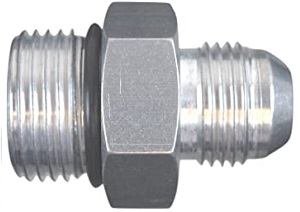
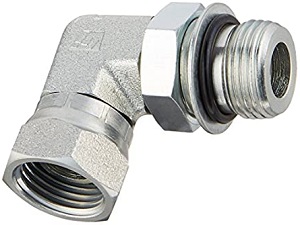
There are two type of O-ring boss fittings, see photos below:
| Non-adjustable O-ring Boss connectors |
The adjustable O-ring Boss connector |
 |
 |
- Non-adjustable O-ring Boss connectors. Non-adjustable o-ring fittings are usually plugs and straight connectors that are fitted into a port without the need for alignment
- The adjustable O-ring Boss connector utilizes a back-up washer which forces the O-ring into the cavity as the lock nut in tightened. Adjustable o-ring fittings are typically elbows or tees that are installed in a fixed direction, In many application are very confortable fittings
Options like these make ORB fitting orientation easier than some other fittings because the o-ring is the sealing factor and not the threads.
below the table to see the difference between NPT (National Pipe Thread USA) with J1926-1 SAE
| SAE Dash Size |
Nominal Pipe
OD (inch)
|
Thread Size
NPTF & NPSM
|
Fittings w/ NPTF
Pipe Threads (psi)
|
Fittings w/ NPSM
Female Swivel (psi)
|
| -02 |
1/8 |
1/8 27 |
5,000 |
5,000 |
| -04 |
1/4 |
1/4 18 |
4,000 |
5,000 |
| -06 |
3/8 |
3/8 18 |
3,000 |
4,000 |
| -08 |
1/2 |
1/2 14 |
3,000 |
3,500 |
| -12 |
3/4 |
3/4 14 |
2,500 |
2,250 |
| -16 |
1 |
1 11-1/2 |
2,000 |
2,000 |
| -20 |
1-1/4 |
1-1/4 11-1/2 |
1,150 |
1,625 |
| -24 |
1-1/2 |
1-1/2 11-1/2 |
1,000 |
1,250 |
| -32 |
2 |
2 11-1/2 |
1,000 |
1,125 |
below the table with standard torque setting of ORB fittings
| ead Size |
Assembly Torque
(in-lb) |
Assembly Torque
(ft-lb) |
| 2 |
85 – 95 |
7 – 8 |
| 3 |
160 – 180 |
13 – 15 |
| 4 |
205 – 235 |
17 – 19 |
| 5 |
245 – 275 |
21 – 23 |
| 6 |
300 – 340 |
25 – 29 |
| 8 |
545 – 595 |
46 – 50 |
| 10 |
1010 – 1100 |
85 – 95 |
| 12 |
1250 – 1350 |
105 – 115 |
| 14 |
1675 – 1825 |
139 – 151 |
| 16 |
1895 – 1945 |
154 – 166 |
| 20 |
2550 – 2850 |
213 – 237 |
| 24 |
2850 – 3150 |
238 – 262 |
| 32 |
3700 – 4100 |
310 – 340 |
Disadvantages of ORB Fittings
- The relevant temperature rating is limited by the O-Ring seal material making these fittings ineffective in high temperature applications
- The O-ring can be improperly installed resulting in a cut or pinch
- The fitting could be improperly torqued
- The threaded portion of the fitting may be longer than SAE specification resulting in the fitting bottoming out in a port before the O-Ring can be fully compressed
- Over tightening may damage washer
Advantages of ORB Fittings
- They’re readily available and offer a large variety of sizes, shapes, combinations and materials
- Provide optimal sealing performance in medium to high pressure systems
- The nature of ORB fittings resists complications associated with over-assembly
- The straight thread connection design coupled with the replaceability of the O-Ring makes these fittings reusable and easily maintainable
- Are either adjustable or non-adjustable
Note: ORB fittings can be confused with other connection systems, such as NPT or even JIC. For example, this straight thread connection uses the same threads as the JIC 37° fitting. However, the 37° flare has been removed and an O-Ring has been added. So, while threads of different connectors sometimes fit, ORB connections should never be used with any other type of connectors as leaks are likely. For these reasons care needs to be taken to properly identify the right connection to create a safe and leak resistant seal.
www.bennypass.it
|