
|
SAE J1453 ORFS (O-Ring Face Seal)
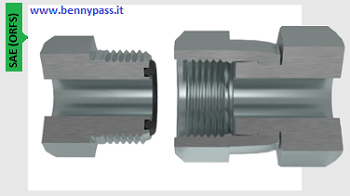
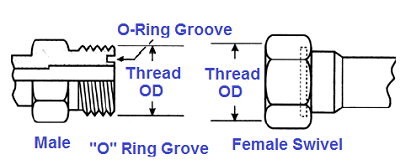
Introduction This connection offers the very best leakage control available today. The male connector has a straight thread and an O-Ring in the face. The female has a straight thread and a machined flat face. The seal takes place by compressing the O-Ring onto the flat face of the female, similar to the split flange type fitting. The threads hold the connection mechanically. O-ring face seal SAE J1453 fittings are popular in hydraulic lines onboard off road vehicles such as tractors, combines and other heavy equipment used in construction. Due to the frequent vibration and actuation of components in off-road vehicles, it is extremely important to reduce or eliminate the number of potential leak points and incidences of leakage. The SAE J1453 standard for ORFS fittings covers dimensions, threads, fitting and O-ring materials, and performance requirements of for use in hydraulic applications, as well as the interface of the O-ring face and nut portion of hose stem assembly.
Applications Fittings are intended for hydraulic systems where elastomeric seals are accepted to overcome leakage and leak resistance. This connection offers the very best leakage control.
Identification Male fitting has a straight thread and an O-Ring. Female has a straight thread and a machined flat face. The seal takes place by compressing the O-Ring onto An ORFS fitting, as most people know, has a replaceable elastomeric O-ring held in a groove in the face of the fitting. These fittings conform to SAE J1453 and ISO 8434-3 and can be used with inch or metric tube. Sealing is accomplished when the O-ring is compressed between the fitting body and the formed tube or flat face of an ORFS female fitting as the assembly is tightened. These fittings are assembled using the torque method. advantages
Disadvantages
Note: By comparison, 37° flare and 24° flareless fittings are harder to install because they do involve male/female interfaces, and therefore the need to maneuver tube assemblies into place. For 37° flare the tube needs to sit on the nose of the fitting, and for 24° flareless the tube needs to sit inside the cone of the fitting.
Conclusion: In most cases, there is no one right fitting type for any given application because there are numerous factors that need to be considered, some of which have been discussed here. The trend in the marketplace is to use fittings with replaceable seals due to many of the advantages discussed in this post.
|
|||||||||||||||||||||||||||||||||||||||||||||||||||||||||||||||||||||

+(39) 347 051 5328
Italy - Kazakhstan


09.00am to 18.00pm
About
We offer the best and economical solutions, backed by 27+ years of experience and international standards knowledge, echnological changes, and industrial systems.
Our Services
Marketing Materials


Marketing Materials1


