
3.5 NATURAL GAS SERVICE Demand for machines to compress natural gas to medium and high pressures has grown considerably in recent years as a result of development of some special services such as reinjection, transportation and gas liquefaction followed by regasification. The first two services basically originate from the fact that in the last ten years or so it has become more and more economical to recover gas that used to be flared at wellheads or that at any rate failed to be put to profitable use. These services are outlined herebelow and the machines most commonly used described.
3.5.1 Gas reinjection Natural gas reinjection has become widespread over the last ten years. It has several purposes chiefly depending on the nature of a field. In short, one can say that natural gas is reinjected for any of the following reasons:
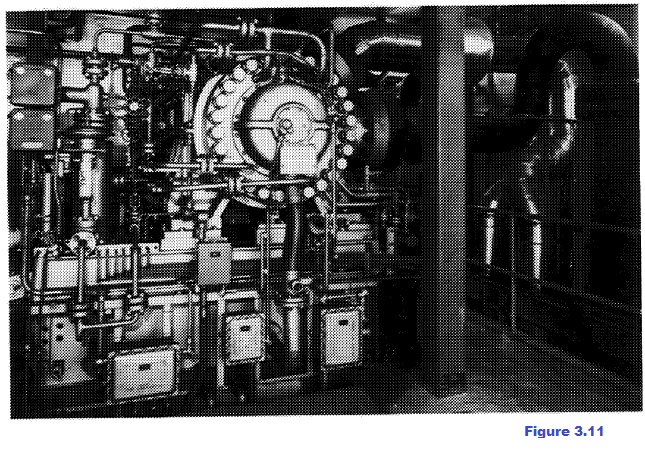
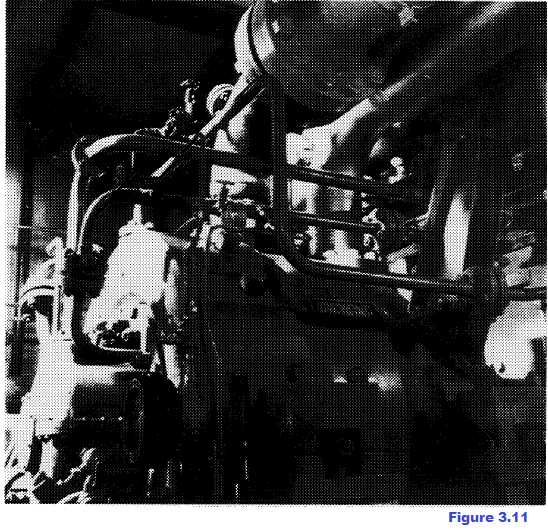
This is particularly advantageous from a saving point of view when there is a depleted natural reservoir in a highly industrialized area. The natural gas pipeline, in this case, can be sized for the average consumption in the area and during hot periods excess gas is stored in the reservoir (figure. 3.11). In cold weather the stored gas can be used for peak demand.
The condensates are separated in de-gasolining units and the dry gas can be reinjected into the field. The aim of this injection is to maintain pressure in the field and thanks to the injected dry gas to facilitate absorption of condensates in the gas. The end purpose is therefore that of producing gasoline with the gas acting as vector fluid. As regards the machines the main features may be summarized as follows:
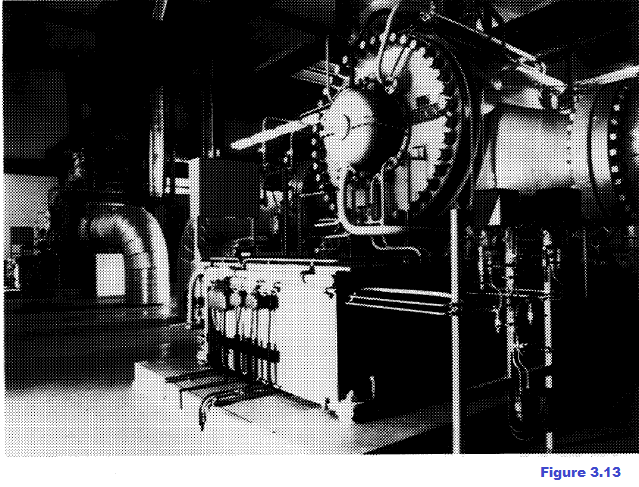
3.5.2 Gas transgortation The numerous compressor stations distributed along gas pipelines normally utilize PCL centrifugal compressors (figure. 3.13). These are machines with modest pressure ratios (r = 1.2 - 1.8) which are required to provide relatively high efficiency as they are usually driven
by gas turbines which burn a high quality fuel such as the very gas that is in the gas pipeline. Particular attention is therefore dedicated to the design and engineering to achieve high efficiencies. Three dimensional impellers are normally used and the configuration of the machine allows the impellers to be spaced out along the axis with gently curved return channels for good impeller inlet conditions.
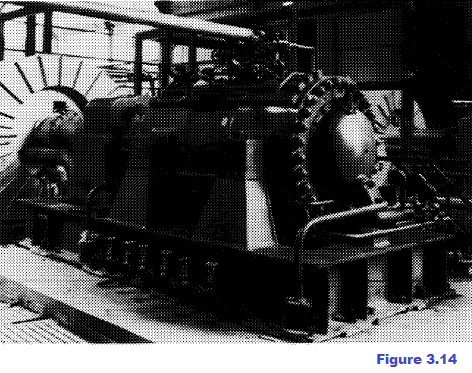
3.5.3 Liquefaction and regasification The growing demand for natural gas for use in industry and domestic heating makes it necessary to use the huge quantities of gas which are available also from fields such as those in Algeria or Libya from which gas is transported in liquid form. Among the equipment required for this technology centrifugal compressors in particular and rotary machines in general have proved to be very versatile being able to be used for gathering as well as in the later stages of transportation, liquefaction and regasification The gas that comes out of the wells is compressed by means of centrifugal compressors and put into a gas pipeline which takes it through a series of compression stations, previously described, to the liquefaction station located near the gas loading buoys. The gas is liquified in plants using centrifugal compressors whereas the ships are often driven by gas turbines fueled on part of the substance that changes from liquid to gaseous state during transport. The natural gas is stored at the port of arrival in liquid form in special tanks; it is then taken from these to be heated, vaporized and put into the gas pipeline again by centrifugal compressors. The mechanical energy required to compress the gas is provided by a gas turbine system and the thermal energy necessary for vaporizing the gas is recovered from the exhaust gases from the same system A typical reqasification station in Italy is the one at Panigaglia in the gulph of La Spezia (figure. 3.14).
www.bennypass.it |

+(39) 347 051 5328
Italy - Kazakhstan


09.00am to 18.00pm
About
We offer the best and economical solutions, backed by 27+ years of experience and international standards knowledge, echnological changes, and industrial systems.
Our Services
Marketing Materials


Marketing Materials1


