
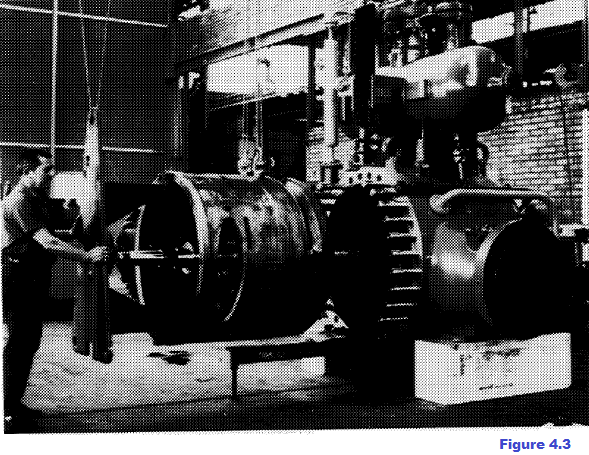
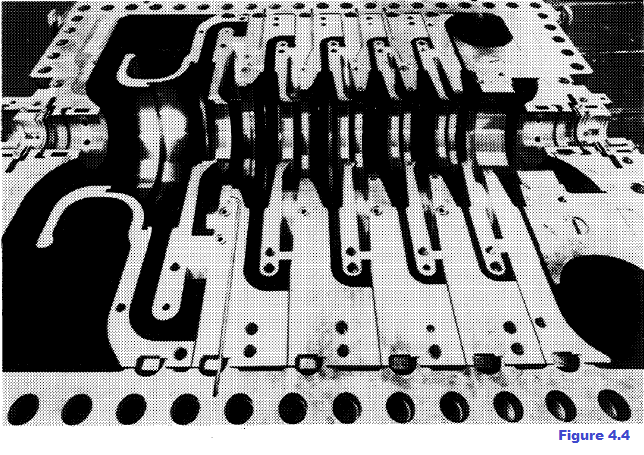
4. 2 DIAPHRAGMS The diaphragms form the flow-dynamic path of the gas inside the compressor's stator part. They are divided into four types: suction, intermediate, interstage and discharge diaphragms. The suction diaphragm conveys the gas to the first impeller inlet. It is supplied with adjustable vanes when the compressor control is performed by changing the inlet angle of gas to the impeller, operating outside the compressor. The intermediate diaphragms perform the double task of forming the diffuser where kinetic energy is converted to pressure energy and the return channel to lead gas to the next impeller inlet. The diffusers can be free-vortex type or vaned: these vanes while improving the conversion efficiency, reduce the flexibility of the machine. The discharge diaphragm forms the diffuser of the last impeller, as well as the discharge scroll. The interstage diaphragms separate the discharge sides of the two stages in the compressors with back-to-back impellers. Each diaphragm has labyrinth rings to make the inpeller shroud tight (to prevent gas at impeller outlet from returning to suction side) and on the spacer rings to cut out interstage leaks. The seal rings, split in half, can be easily removed For reasons of rotor installation the diaphragms are halved; whether they are mounted on barrels or on horizontally split casings, the difference is not so great; they only differ in their being housed in the casing. . In barrel—type compressors the diaphragm halves are kept together by tierods thus making up two separate bundles; after installing the rotor they are screwed each other: the resulting assembly (see pict. 4.3) is placed in the casing axially. In the horizontally-split compressors each diaphragm half is singly installed in the two casing hal- ves; that's why the outer surface on each diaphragm has a groove to combine with the corresponding relief on the casing. Each diaphragm is lowered onto the half-casinq (Figure. 4.4).
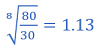
As concerns the designing criteria, a distinction must be made between sizing of the gas path, on the ground of thermodynamic requirements to guarantee the speed and gas angle requested, and the sizing of thickness which is based on the Ap established on the two faces of each diaphragm. In normal installations (in-line, low or medium pressure compressors) this Ap value is that produced by each impeller: hence it does not reach very high values. In a barrel compressor, e.g., with 8 impellers and 30 ata suc- tion and 80 ata discharge, we have approximately: single impellerfl = Therefore the max. Ap produced by the last impellers amounts to about 9.2 kg/cm2. For these installations the diaphragms are nearly always cast owing to their complicated structure. Generally Meehanite GD type or spheroidal cast iron is used, sometimes adding nickel percentages to improve its characteristic impact resistance at low temperature (1 to 1.5% Ni). If the operatinq,temperature'~ is below -100°C, ASTM A 352 steel is used in the four available grades or ASTM A 351, grade CF8. Under a certain size of the gas channels, casting is somewhat difficult, therefore diaphragms are manufactured in two parts, usually one cast and the other of metal sheet, screwed each other. Under severer conditions such as in high-pressure compressor diaphragms or interstaqe diaphragms in compressor with back-to-back impellers (undergoing the Ap of one whole stage) the design Ap of a diaphragm can reach very high values. In this instance it is necessary to use the most qualified materials such as forged carbon steels (ASTM A 182 F22) . Should very high pressures be involved, it is necessary to stiffen the diaphragm bundle structure; hence the solution consists in manufacturing the countercasing in forged steel (ASTM A 182 F22) made up of two half-casings where diaphragms are mounted like in the horizontally split compressors. This solution has the advantage beget diaphragms fitted at smaller diameters and hence the free length of deflection is reduced (see Figure 4.5 on the next page 4.3)
www.bennypass.it
|

+(39) 347 051 5328
Italy - Kazakhstan


09.00am to 18.00pm
About
We offer the best and economical solutions, backed by 27+ years of experience and international standards knowledge, echnological changes, and industrial systems.
Our Services
Marketing Materials


Marketing Materials1


