
9. INSTRUMENTATION The instrumentation installed on the centrifugal compressors is essential for checking their performance and for continuous surveillance over their operation. The most interesting information, both for maintenance and for operating purposes, normally relates to:
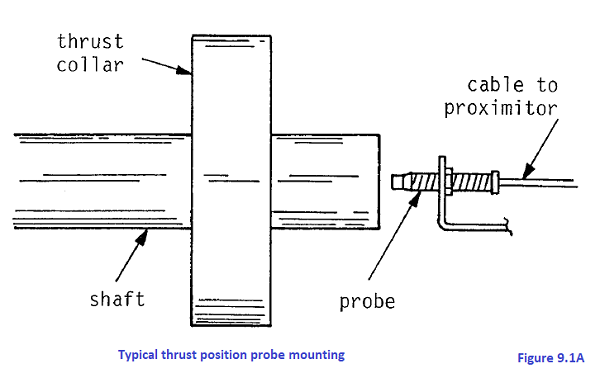
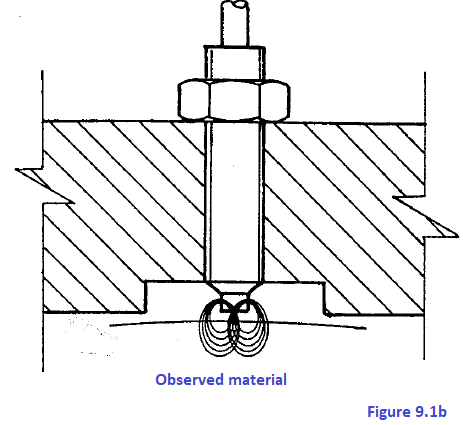
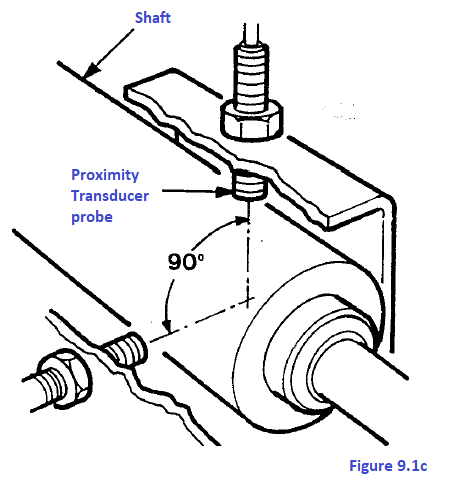
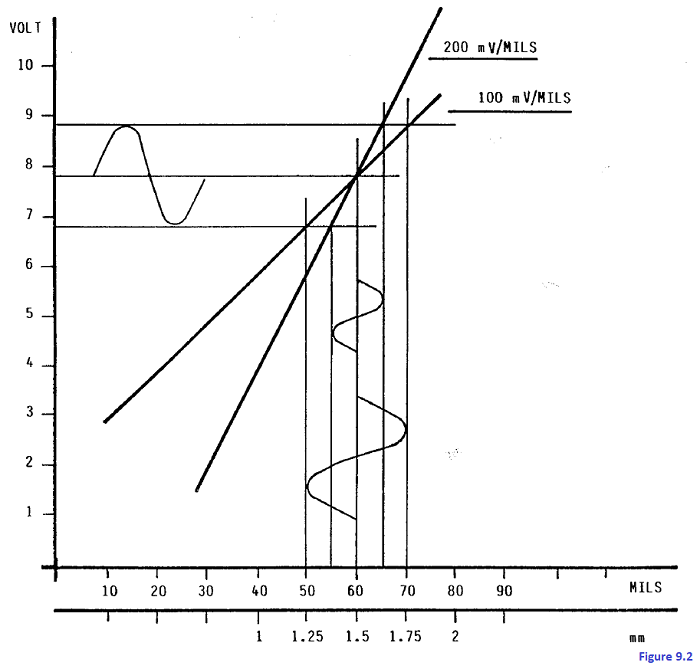
Proximity probes are normally used to detect vibrations and axial displacement of the rotor. As shown in figure. 9.1, they must be positioned about 1.5 mm from the shaft, after being firmly secured to the structure. The operating principle of these probes is based on the variation of a magnetic field generated between probe and shaft, due to variation in the shaft/probe distance. The reading is taken on a scale graduated in throusandths of a millimeter (microns) or in thousands of an inch (1 MIL = 0.0254 mm). The sensibility of the probes is around 200 mV output for each MIL of variation in the space between shaft and probe, corresponding to 8 mV per micron. See figure. 9.2.
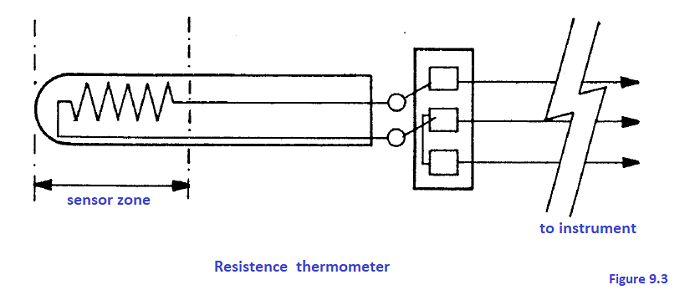
For reading axial displacement, the sensitivity is less (about half) to permit exploration of a greater space for the same signal variation. The vibration signal read on the analog indicator can be displayed on an oscilloscope and its component frequencies analyzed by means of a real-tinle analyser (F.F.T.= Fast Fourier Transformer). The oil pressure to the bearings is read on normal pressure gauges with a full-scale value of 2.5 kg/sq.cm, since the required pressure on the journals is about 0.8 - 1.2 kg/sq.cm, while for the thrust collar it is about 0.5 - 1 kg/sq.cm. These values are indicatives; the actual values will depend on the tuning of the system, which must take the running bearing temperature into account. This is measured by means of thermoelements, which may be resistance thermometers or thermocouples, depending on the read- out system used. Resistance thermometers provide their lead wire; with a resistance variation in OHMS (Ω) related to the variation in temperature. The normal type is the PT 100, composed of a platinum wire which at 0°C has a resistance value of 100 Ω. It has the drawback of being rather delicate and bulky and thus not very reliable over time. It must be connected to the readout instrument with three conductors to reduce the effect of line resistance (see figure. 9.3).
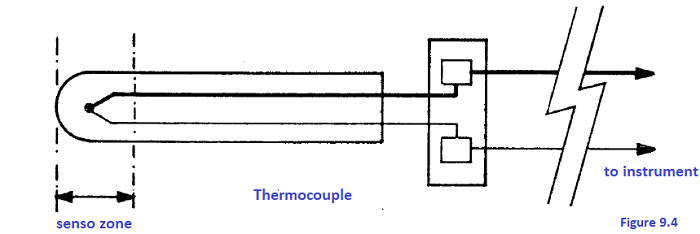
Thermocouples supply their lead wires with a voltage variation (in mV) related to temperature variation (see figure. 9.4); in this instance, the measurement system is composed of a millivoltmeter.
The voltage produced at the lead wires of the thermocouple derives from the junction of two different metals such as Fe-Const, Cu-Const, Cr-Alumel, NiCr-Ni, etc. The connection line must be of the same type of material as the thermocouple and the instrument must be provided with a "cold junction" to compensate for ambient temperature. Thermocouples are rather small and are not much affected by vibrations; in addition, they have a much broader readout range than resistance thermometers. The bearing temperature may be measured by inserting the thermoelement close to the babbit metal or by immersing it in the oil near the bearing discharge. The measurement field required of thermoelements for application on centrifugal compressors goes from zero to a maximum of 1500°C; this range easily falls into the characteristics of both the types of thermoelement described. Usually the readout instrument may also be provided with intervention thresholds to signal high temperature alarn and even to shut down the compressor
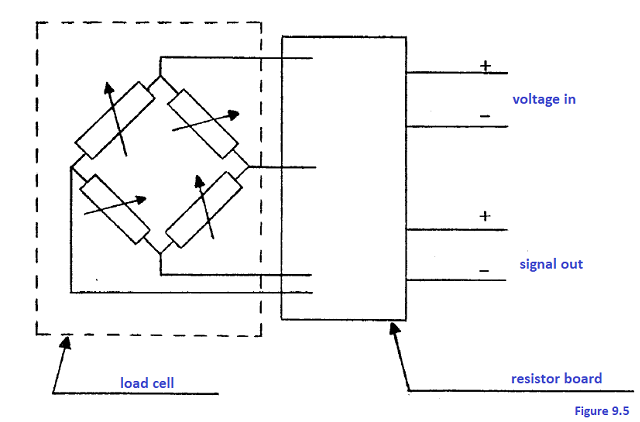
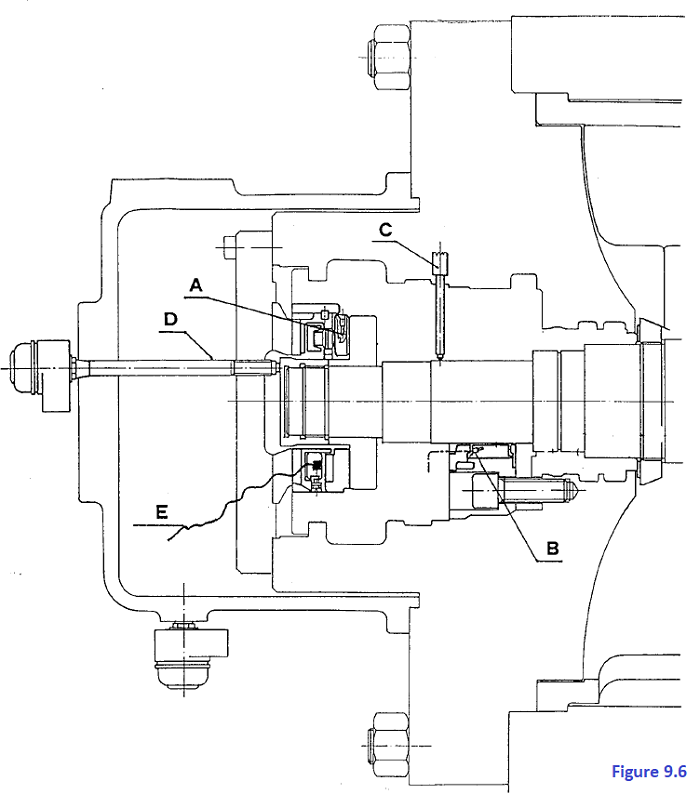
The Operating principle is based on the variation in ohmic resistance of the extensometers under the effects of the radial thrust of the rotor on the bearing. The extensometers, connected by Wheatstone bridge, create an extern al signal variation. The signal coming from the sensing element is on the order of mV and is amplified enough to drive a readout instrument and, in some cases, the alarm and shutdown circuits. Normally the residual thrust which acts on the thrust bearing is around 30-40% of its endurance load. The instrument scale is generally expressed in percentage (of load) . Thermoelements may also be used to measure the temperature of oil discharged from the Low Pressure seals, but local thermometers are more commonly employed. The instruments used to read differential pressures between seal oil and reference gas and between balancing gas and reference gas are differential pressure gauges which must be able to sustain a static pressure in some cases as high as 500 kg/sq.cm. Sometimes differential indicator pressure gauges may also be used, in the event one or more intervention thresholds are required. The selection of the type, quantity and manufacturer of the instrumentation which may be used on centrifugal compressors is discussed in each case with the customer, apart from certain basic guarantees that Nuovo Pignone requires to protect its machines. Figure. 9.6 shows a typical instrument layout installed on a centrifugal compressor.
www.bennypass.it |

+(39) 347 051 5328
Italy - Kazakhstan


09.00am to 18.00pm
About
We offer the best and economical solutions, backed by 27+ years of experience and international standards knowledge, echnological changes, and industrial systems.
Our Services
Marketing Materials


Marketing Materials1


