
10. 2 THERMODYNAMIC TESTS Since centrifugal compressors compress many different gases (air, methane, propane, Hydro-carbon mixtures, ammonia, oxygen, carbon dioxide, etc.), it would be very difficult and expensive to carry out tests with the worging gas in a closed loop. For this reason, air in open loop is normally used for testing or a limited number of gases in closed loop may be employed as we will see after-wards. Once gases different from the process one can be used, the need to carry out a meaningful test arises. To get this the following criteria of similitude must be satisfied. 10.2.1 Having similar velocity triangles and therefore the same speed ratios and equal angles between the velocity vectors, also when compressing different gases, thus resulting in performance curves similar in the head-capacity plane. 10.2.2 Having the same ratio of specific volumes between inlet and outlet of the compressor during the test as in normal operation. In fact, whilst for a pump similitude exists for all the points on the performance curve, for compressors this is not always true because account must be taken of the compressibility of the gas since the speed ratio between inlet and outlet are not always the same for different gases. For instance, making the comparison between the compression of air and hydrogen, between the "compression ratios of thetwo gases the following relation exists pa > pH2; considering equal velocity triangles at inlet, at outlet the triangles will be different since the specific volume of air in the compression is decreased more than that of hydrogen. Therefore the operating and the test gases should have the same ratios between the specific volumes at inlet and at outlet if if is required that the two gas flows reach the blades with the same incidence and be compressed with the same efficiency:
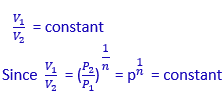
it may be deduced that the first mentioned condition can be substituted by one, in terms of the compression ratio and. the polytropic "n" constant; in particular, if the gases have the same "k" adiabatic index and the same'"n" (supposing an equal polytropic efficiency of compression) a valid test can be made with gas having the same compression ratio. These conditions must naturally be respected even if the test gas is equal to the operating gas but is sucked at a different temperature. In the case that the ratio of specific volumes of the two gases is not equal then it can be rendered so by varying the head and therefore the test speed.
10.2.3 Operating with the same Reynolds number
where:
The higher the Reynolds number, the better the compressor efficiency and the higher the head. Re is approximately proportional to the suction pressure, the power is proportional to the mass flow and therefore, also to the suction pressure, therefore, Re is about proportional to the power. In conclusion, it is possible to function at lower power with lower Re, and correct the head and efficiency with the Reynolds number. The ASME standards governing thermodynamic tests state these corrections in an approximately proportional way. This is an approximate solution since the influence of Re is not constant and is greater for lower values.
10.2.4 Operating at the same MACH number: where:
If Ma < 0.8 in any part of the gas path, tests can be made with Mach numbers completely different, since its influence is negligible; in centrifugal compressors, this is generally the case. If Ma > 0.8, that is if the transonic and supersonic range is entered, tests must be carried out with an Ma close to that of the design, in this case, however, the conditions to be satisfied are too many and it is difficult to carry out the tests. Generally, the tests are done with pure gases and not mixtures of gas, because these, in closed loop, could vary their composition, lose their characteristics and affect the tests. Toxic or flammable gases are never used for teSting,as they require costly equipment and an outdoor test facility. With a process gas having a molecular weight greater than air, tests must be carried out in closed loop with carbon dioxide or freon gas; otherwise, if running in open loop with air, higher speeds would be required with consequent higher temperature rises with danger to the compressor. With process gas having molecular weight legs than air the tests are normally done in similitude with air in open loop at lower speeds or with gas mixtures in a closed loop. It is better to avoid testing with air in a closed loop since Iexplosive air and oil fumes mixtures can occur Account is taken of the deviation between real gases and perfect gases by means of a compressibility factor "Z" which modifies the perfect gas formula: PV = ZRT During the thermodynamic tests the following readings are taken: pressure, temperature and capacity at suction, pressure and temperature at discharge and composition of the test gas. The external temperature of the case is measured to assess the irradiated heat which is negligible in a calculation of first approximation. The power absorbed by the compressor should be measured by means of a torque-meter but this measuring system is not completely reliable especially at high rotation speed. It is preferable to assess the power by means of the thermal balance of the lubricating oil, the seal oil and of the gas on the basis of the enthalpy drops The absorbed power is given by the sum of that stored by the gas (proportional to the mas flow and to the enthalpy drop between suction and discharge), by the oil (calculated on the basis of the capacity and ΔT in its passage across seals and bearings) and of that irradiated to the outside. The adiabatic or polytropic efficiency is obtained by dividing the adiabatic or polytropic heads, calculated using the forementioned thermodynamic formulas, by the real heads, which is the total power absorbed by the compressor for a unit of weight of compressed fluid. when there are intercoolers the best method is that of carrying out the test, stage by stage, and then reconstructing the whole. Thermodynamic tests are only carried out on specific rg quest of the Engineering department or of the customer.
www.bennypass.it
|



+(39) 347 051 5328
Italy - Kazakhstan


09.00am to 18.00pm
About
We offer the best and economical solutions, backed by 27+ years of experience and international standards knowledge, echnological changes, and industrial systems.
Our Services
Marketing Materials


Marketing Materials1


