
|
The piezoelectric sensor of vibration
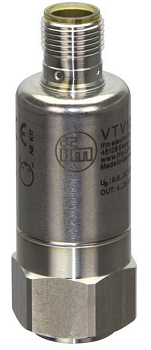
introduction The piezoelectric sensor works on the basis of the seismic principle and the piezoelectric effect. Here quartz crystal and piezo ceramic replace the spring used in a Seismometer. The piezo material is fixed to the vibrating object on one side and to the seismic mass on the other. Vibrations forces lead to strain and compression on the piezo material. The piezoelectric effect describes the occurrence of an electric charge due to the change in length of the polarised materials. This charge is proportional to the acting force and can be tapped. Since the force is a product of mass and acceleration it can be easily computed. The piezo materials are very rigid, therefore damping might be necessary. This can be achieved by adding stoppers or immersing the parts in oil. Vibration is the motion of a particle or a device or system of connected devices scattered around the balanced position. Most vibrations are undesirable in machines and equipment because they lead to increased loads, fatigue and energy loss, increased bearing loads, creating discomfort for passengers in vehicles and absorbing energy from the system. The rotating parts in machines must be carefully balanced to prevent vibration damage. Vibration is a response of the system to internal or external impact, which causes it to fluctuate or pulsate. Although it is commonly believed that vibrations do damage to the equipment and the machinery, they do not. Instead, the damage is done by dynamic loads, which lead to fatigue and dynamic loads are caused by vibration. If a vibrating object can be seen in slow motion, it will be found running in different directions. Each vibration has two measurable variables that help to determine the vibration characteristics, how far (magnitude or intensity) and how fast (frequency) the subject is moving. The parameters used to describe this movement are displacement, frequency, amplitude and acceleration.
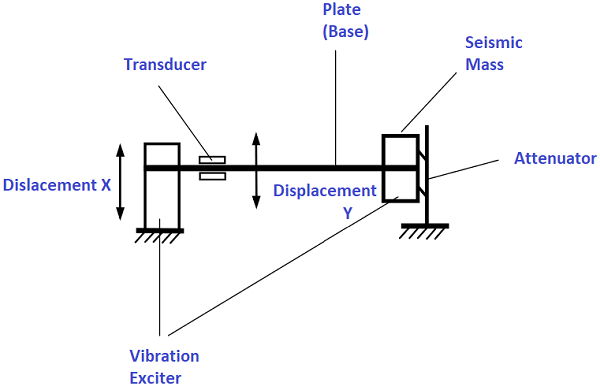
Working principle Piezoelectric Transducer Piezoelectric effect occurs in some crystalline substances - natural quartz, Rochelle salt, lithium sulphate, some ceramics and more. When such a crystal is placed in an electric field it changes its size synchronously with the changes of the field – opposite Piezoelectric effect (used to generate audible and ultrasonic signals). When the crystal is deformed in an appropriate direction an electric charge is generated (straight Piezoelectric effect). One of the commonly used structures for vibration measurement while controlling the state of the machine is shown in the Figure below. The Piezoelectric transducer is glued strongly at the one end of the bending under the forces of inertia plate and the free end is soldered seismic mass. Attenuation is achieved through the oil drops placed in the gap between the seismic mass and the attenuator. When the base is moving downside-up the inertia opposes and deforms the Piezoelectric transducer. This generates an electrical charge that is proportional to the acceleration. Typical values of the sensitivity of these sensors are 0,5-50 mVs2/m in the frequency range 0,1 Hz to 200 kHz.
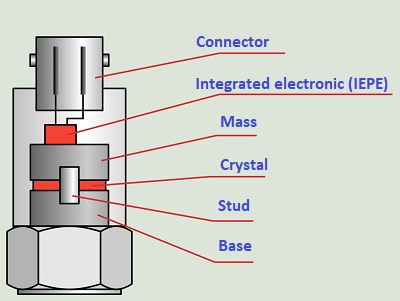
Below the Figure the internal components of the transducer
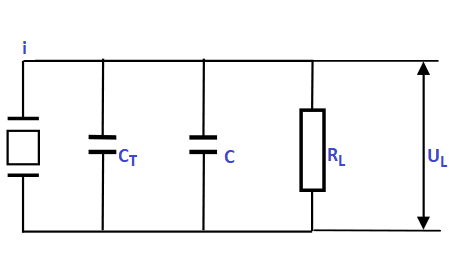
A piezoelectric vibration transducer generates an electrical charge that is proportional to the deflection of the piezoelectric transducer.
Advantages The piezo wafers are configured to undergo shear deformation from acceleration (i.e. the piezo wafers are perpendicular to the base). This has become the most popular configuration because the piezo wafers are isolated from the base which helps reduce the temperature sensitivity and susceptibility to base strain. But this configuration typically has a relatively low sensitivity-to-mass ratio which means that you'll need a charge amplifier. disadvantages
|

+(39) 347 051 5328
Italy - Kazakhstan


09.00am to 18.00pm
About
We offer the best and economical solutions, backed by 27+ years of experience and international standards knowledge, echnological changes, and industrial systems.
Our Services
Marketing Materials


Marketing Materials1


