
Solar Panels
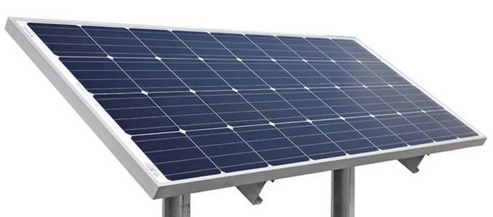
The most common watt of a photovoltaic panel is around 200 Wp at 32V. To obtain these results, it is usually necessary to use about 50 or 60 photovoltaic cells. The number of photovoltaic solar panels reaching the power of 3 kW, or 3 thousand watts, is generally between 11 and 15 panels. A 3 kW photovoltaic system can be installed on a house's roof and meet a family's energy needs. Depending on the installation area, it may produce between 3,300 kWh; all depend on the installation area. Dimensions of the solar panels How big is a photovoltaic panel? The answer depends on whether the photovoltaic system is installed on a pitched roof, or if it is installed on a flat roof, or with modules on the ground or the pavement. With the same power, the size of the solar panels will be smaller in the first case. Furthermore, their dimensions vary according to the devices' models, brands and technology. The most common crystalline silicon photovoltaic modules range from 0.5 m² to 1.5 m², reaching 2.5 m² in specimens for large systems. The approximate size is about 80 x 160 x 4.5 cm to get an idea of width, length, and height. In general, to get an idea, photovoltaic panels have, on average, these dimensions:
Generally, 180 - 190 Watt crystalline silicon panels are 10 - 15 cm lower and narrower than 230 - 240 Watt panels. The most popular photovoltaic panels generally have dimensions greater than 1 meter and 70 in height by 1 meter in width. This means that a surface rectangle, for example, on a classic pitched roof of 1 meter by 1.70, can produce an average peak power of about 230 W, which in watt-hours (amount of electricity that can generate) is at least 250-kilowatt hours/year. The amount of energy produced for each kW installed varies according to the place of installation and the technology used. In northern Italy, one KW produces an average of 1,100 kWh / year. In southern Italy, each kW of photovoltaics produces about 1,500 kWh / year. By comparing the above figures on the scale of hypothetical photovoltaic systems with 1 kW of peak power, we have the following dimensions:
Monocrystalline modules are the most efficient, and thin-film (and amorphous silicon) modules are the least efficient. But be careful what is meant the"efficiency". Efficiency is not understood here as a "quality index" of the technology but indicates the space needed to produce the same amount of energy. Thin-film modules, for example, have other advantages of use (they produce better with diffused light, without optimal orientation and inclination and with high temperatures). On the other hand, monocrystalline works better with direct light, with an optimal angle of incidence and with temperatures around 20-25 ° C. Let's take an example. Comparing the above figures on the scale of domestic photovoltaic systems and the annual consumption of a standard family, which is approximately 3,000 kWh per year, we need surfaces of this size:
These dimensions are indicative and assumed on coplanar panels to the support surface, such as those installed on pitched roofs and canopies. On flat roofs, in the case of installation on special mounting structures, the dimensions increase due to mutual shading. But be careful: to achieve a good level of energy autonomy (and savings!) With photovoltaics, having suitable surfaces on the roof and a well-sized system is not enough. It is also essential to know how to use the system to achieve optimal savings. More self-consumption is exploited, and more will be benefits. Below is a summary table on the dimensions of the photovoltaic panels
The operation of photovoltaic panels How does a photovoltaic panel work? Each photovoltaic module, on average 1 by 1 and a half meters large (and 2-3 cm thick), can produce at least 200 watts of electrical power. Each panel consists of solar cells connected in series. They are made of a special material, which is called solar-grade silicon. The electrification process takes place within them. The functioning of solar panels depends on them. These, struck by the sun's rays, generate a physical reaction using the differences of charges. Therefore, a direct current (DC) flows from each of them. It is converted into alternating (AC) through the inverter to be used in utilities. The video below shows the working principle.
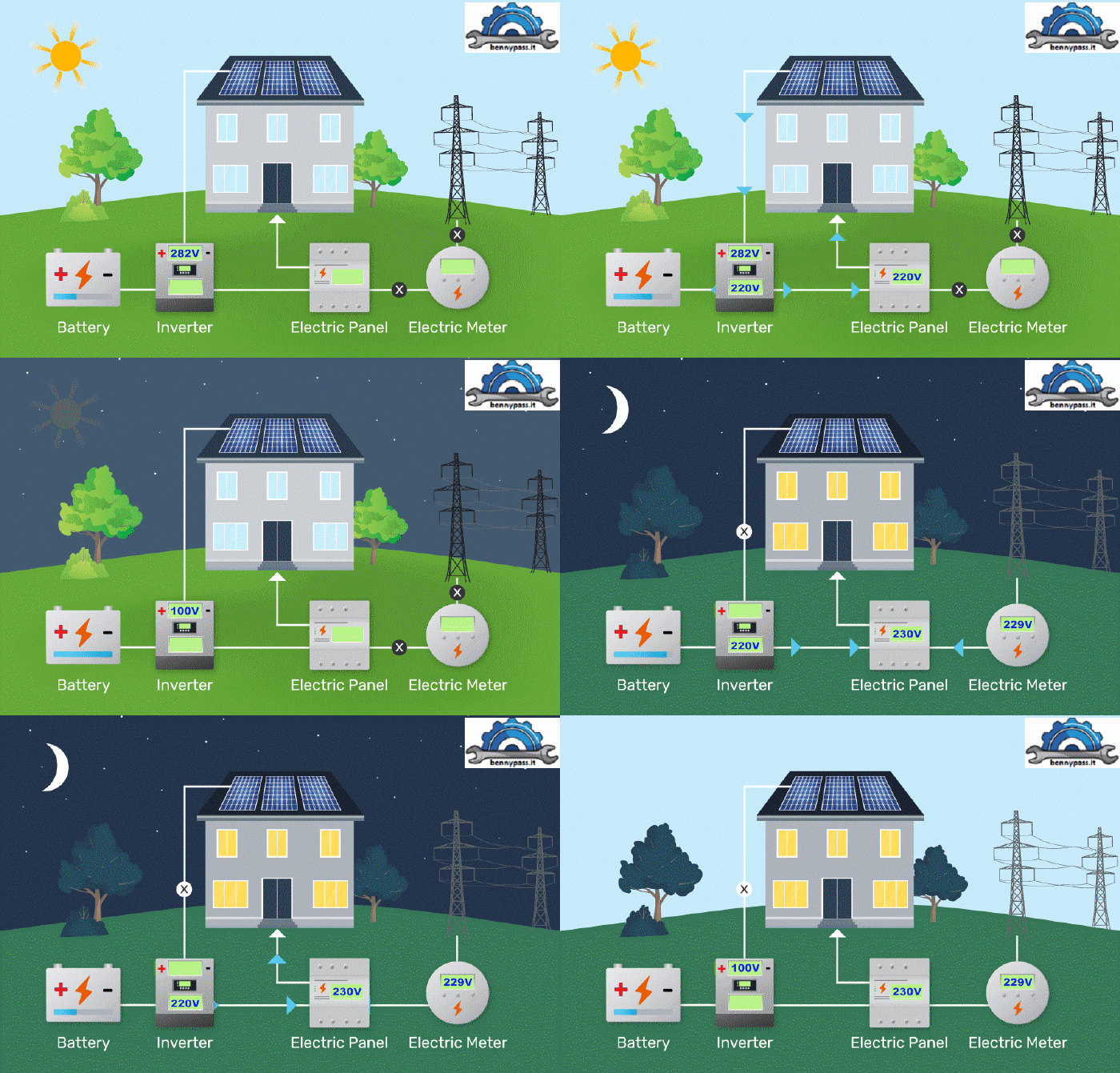
Video 1 - How solar energy generates power. To store energy from solar panels must be present the accumulators, including the power charge, an inverter that converts the DC to AC (220V or more)
Figure 1 - Typical Connection between Solar Energy and Power Inverter It’s easy to choose the wrong inverter that will reduce the yield of a Solar PV system. Voltage and current ranges vary from inverter to inverter. You may have one installed that appears to work fine; however, when either the voltage or current reaches extremes of light levels or temperature (this affects the solar panel’s voltage), your inverter may not be able to generate as much as it should. A good quality solar energy inverter is essential to your panel set-up. It’s an intelligent piece of kit that connects to your system and should be placed where you can quickly reach it. It has two important things:
There are different ways to achieve this and advantages for each approach. (We go into the technical detail below.) Most inverters now have internet connection capability, so you can keep an eye on your system using apps or web browsers, even when you’re away. The technology also raises awareness of your energy usage, encouraging you to be more sustainable, and save money. Inverters are often installed in lofts. This makes life easy for the installer staff but can dramatically upset system performance. We strongly recommend they are sited in a more excellent place. The extreme heat in a loft, especially on a day that you’re asking the inverter to work its hardest by further raising its operating temperature, with the consequence that will shorten the life of your inverter and reduce the amount of energy it can generate. Inverters also have a display on the front, letting you know if the system is working OK. If it’s hidden away in the loft, you may not realize what happens to your system. Like all electrical circuits, these types also have their protections from possible short circuits or even fires. Let's see all the protection components:
These components are of fundamental importance for the long life of a photovoltaic system. For additional information about Bypass and Blocking Diode, you can read more details here There are three types of circuits, and even if the panels are the same, the operating principle changes. It all depends on Inverter that will be used. So let's see the differences.
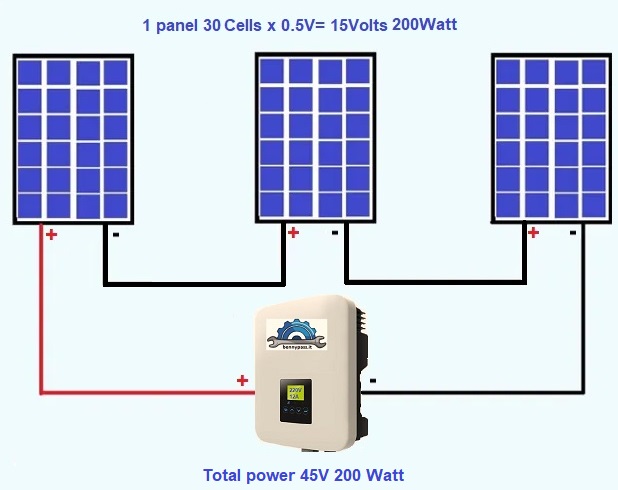
String inverters A string is a chain of panels connected together in series. This is the most basic inverter system. All the panels in a string must be at the same pitch and orientation; otherwise, the system will have inefficiencies. Many string inverters have 2 or even 3 MPPTs (Maximum Power-Point Tracking), which means that you can have a different string of panels on each MPPT. This could work well for an east/west set-up. A string inverter (also called a “central inverter”) is a standalone box that is typically installed close to your main service panel and electricity meter. There is typically only one single inverter, or possibly two string inverters, on each residential solar installation; it really depends on the overall solar power system size. A string inverter functions in a series circuit, with there usually being 6 to 12 individual solar panels which are known as a "series string." Figure 2 shows a simple series connection between the solar panel and the inverter.
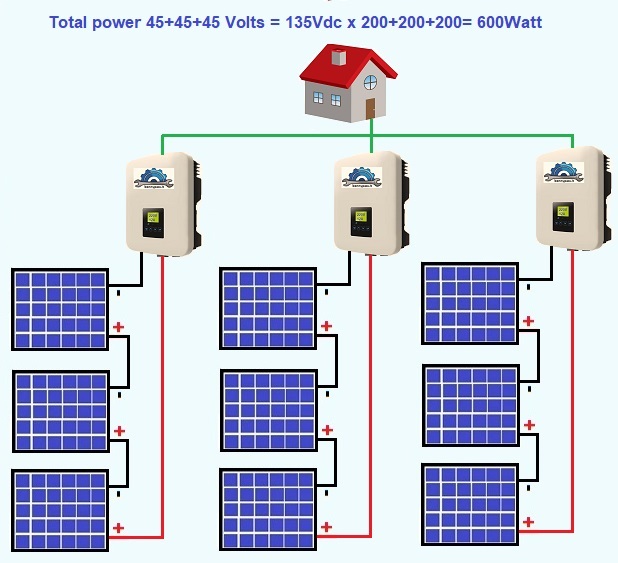
Figure 2 - Typical connection between Solar Panel and Inverter Figure 3 below shows typical connections parallel/series of the panels.
Figure 3 - Typical connection Series/Parallel between Solar Panel and Inverter Figure 3, even if it shows a parallel series connection, is always classified as String inverters. There is typically only one single inverter, or possibly two string inverters on each residential solar installation; it really depends on the overall solar power system size. A string is a chain of panels connected together in series. This is the most basic inverter system. All the panels in a string must be at the same pitch and orientation, otherwise, there will be inefficiencies in the system. Many string inverters have 2 or even 3 MPPTs (Maximum Power-Point Tracking), which means that you can have a different string of panels on each MPPT. This could work well for an east/west set-up. The main advantage of a string inverter is that you only need one of them to convert the DC electricity coming from your solar array to AC power. If anything is going to fail in a solar system, it is likely to be the inverter - making troubleshooting relatively easy when things go wrong. Installing a single-string inverter on a solar panel installation is cheaper than installing microinverters. Less labour hours are required, and string inverters are more affordable than many microinverters. Disadvantages of string inverters
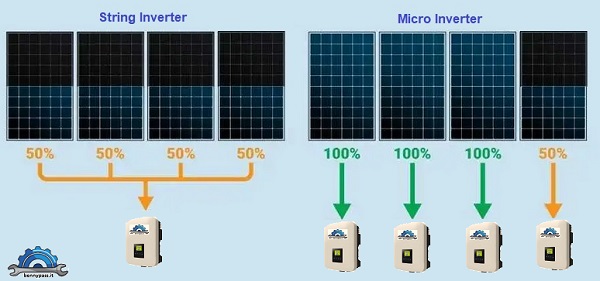
Microinverters Microinverters perform the same basic function as string inverters, except they are installed underneath each solar panel on your roof. Each of these microinverters is about the size of an internet router. The big difference between microinverters and string inverters is that a solar panel installation with microinverters will typically have the same number of microinverters as there are solar panels. (Note: some microinverters accept two or four solar panels). Figure 4 below shows the difference between string inverters and Microinverter.
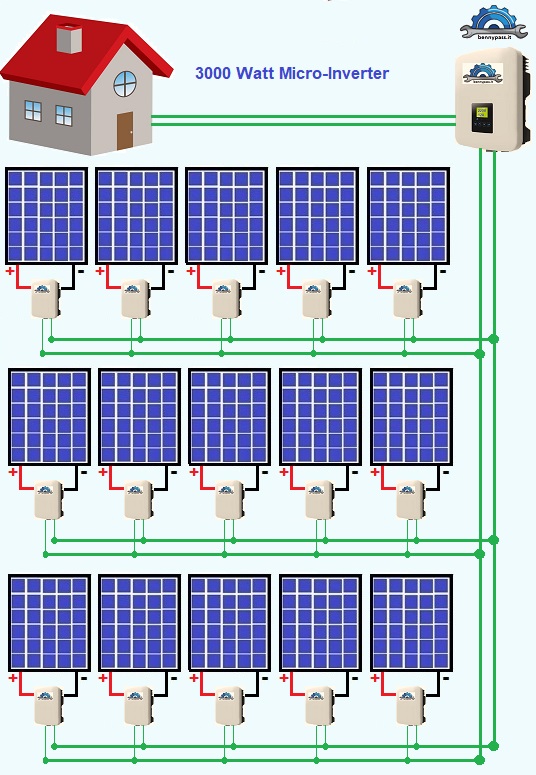
Figure 5 - String Inverter and Micro Inverter Figure 4 above shows what happens when a panel goes dark in both circuits. Microinverter continue to work even with a solar panel with 50% of capacity, while the string inverter all solar panels will be compromised. This is one of the most important substantial differences. Note: Microinverters can also make it easier to add more panels in the future. Figure 5 below shows a typical connection between Microinverter and solar panels.
Figure 5 - Typical connection between Microinverter and Solar Panels. As can be seen from Figure 5, every panel is independent of each other. Even if one panel is damaged, the system continues to work. Costly system but in a long time, it will bring a profit. The big difference between microinverters and string inverters is that a solar panel installation with microinverters will typically have the same number of microinverters as there are solar panels (Note: there are microinverters that accept two or four solar panels). While standard string inverters will cap the electricity production of each panel by the lowest-producing panel on your roof, microinverters don’t have this problem since they function in a parallel circuit. A microinverter will take full advantage of the production of each individual panel. It will convert the power generated by each panel to the grid voltage. Each solar panel and microinverter combination can “do their best” and contribute as much power as possible.
Advantages of Microinverters
Note: To sum it all up, microinverters are definitely a value-add, but are only recommended if you need to comply with rapid shutdown requirements, have panels facing multiple orientations or you have shading issues. Otherwise, the less expensive standard inverter is usually more cost-effective.
Disadvantages of microinverters
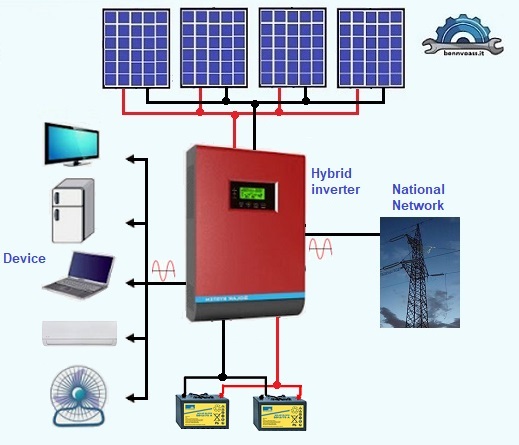
Hybrid inverter
A hybrid inverter is an "expanded" photovoltaic inverter that converts direct current into alternating current and manages and coordinates electricity flows from the photovoltaic, battery and national network. The management of this inverter is of the latest generation. It manages everything. Let's see it in detail by clicking here.
Conclusion Although microinverter manufacturers sell the ability to monitor each panel as a benefit (and it is), they don't include the monitoring that allows the customer to do this. They only allow the installer to see the panel-level data from your system and not you as a customer unless you agree to buy the higher level of monitoring as an upgrade. This means you, as a customer, only see system-wide monitoring information, not what is going on with each panel. A sceptic would say that they do this to protect themselves and their installers from support calls related to broken inverters. It isn't straightforward with only system-wide monitoring data to determine if only 1 or 2 inverters out of 25 or so have failed. Many installers don't honestly explain the problem with the microinverters or the solar panels; maybe they ask for extra money to do nothing or leave the system broken or not working at 100%, but having 100% knowledge of your system, these things cannot happen. Although microinverter manufacturers sell the ability to monitor each panel as a benefit (and it is), they don't include the monitoring that allows the customer to do this. They only will enable the installer to see the panel-level data from your system and not you as a customer. This means you as a customer only see system-wide monitoring information, not what is going on with each panel. Always ask for the supervisor level to verify all the systems, and the installer has to give support. It is not easy with only system-wide monitoring data to determine if only 1 or 2 inverters out of 25 or so have failed, but knowing your own system makes life much easier, and significantly you save money. Articles related
|
||||||||||||||||||||||||||||||||||||||||


+(39) 347 051 5328
Italy - Kazakhstan


09.00am to 18.00pm
About
We offer the best and economical solutions, backed by 27+ years of experience and international standards knowledge, echnological changes, and industrial systems.
Our Services
Marketing Materials


Marketing Materials1


