
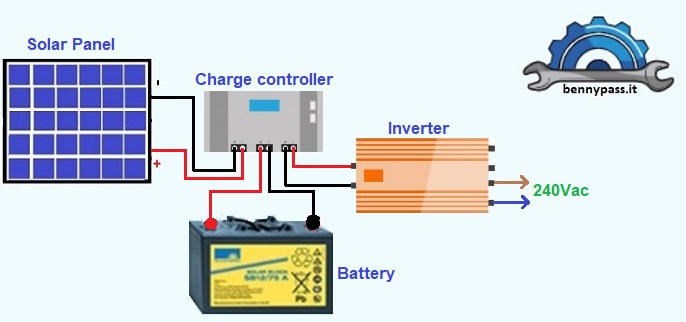
The fundamental basis for the knowledge of a photovoltaic system A photovoltaic system not connected to the electricity grid is called: Off Grid or on Island, and not being connected to the public grid, the surplus of energy produced by the system can accumulate in the battery pack and use it when needed, for example, when the photovoltaic does not generate energy. It has been shown that if 100% self-consumption can be reached, the convenience of an off-grid photovoltaic system is higher than that of a system connected to the electricity grid (on the grid), which injects energy into the network. Principle of operation of a photovoltaic system An off-grid photovoltaic system usually comprises one or more solar panels, a charge controller, batteries, and an inverter. Figure 1 below shows the basic drawing of a photovoltaic system.
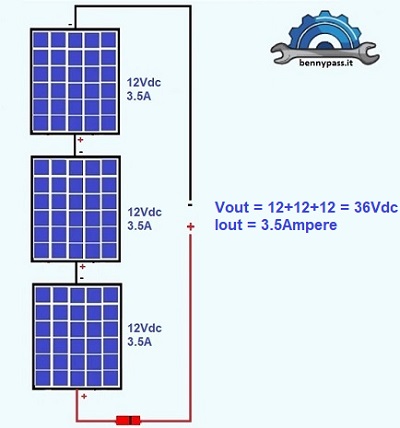
Solar Panel Connections The Photovoltaic Generator is a set of Solar Panels, and they can be connected in series, in parallel, or series/parallel. Series Connection
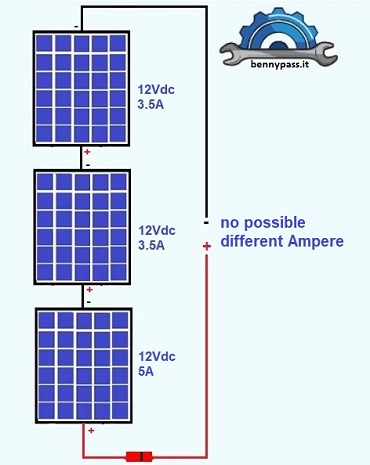
Remember: If we have solar panels with the same voltage and different currents, we cannot connect them in series, but we can do it in parallel. For more details, see Figure 3 below.
Figure 3 - Wrong Installation with the series Connection
Parallel Connection
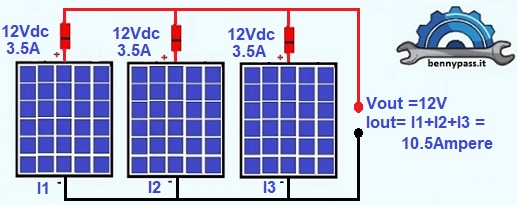
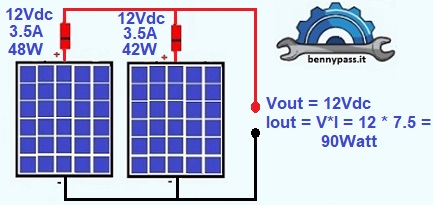
Parallel connection of panels with different parameters Two solar panels can be connected in parallel if they have the same voltage and different currents. The power will be given by the voltage (which remains the same) for the sum of the current of the two branches. The formula of the power is P = V * I. For more details, see Figure 5 below.
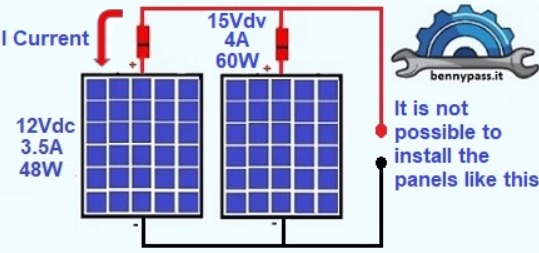
If the two panels had both voltages the same and the currents were different, it would not be possible to connect them in parallel. The panel with the lowest voltage would behave like a load, absorbing current instead of generating it. Figure 6 below shows the differences.
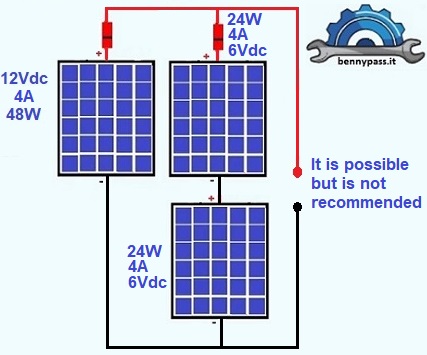
If we had 12 Volt and two 6 Volt photovoltaic panels, it would be possible to connect them by putting the 6 Volt ones in series and parallel the one with 12 Volt, even if the efficiency would not be ideal. So when we connect the panels in parallel, we always check the voltage.
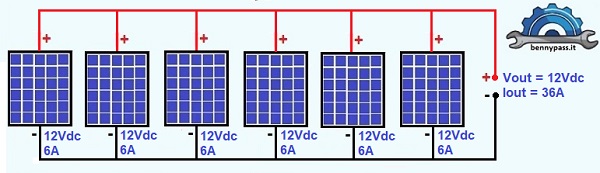
An important note: if you put the panels in series or in parallel, the Power is always the same (Power: P = V * I if the voltage increases, the current will decrease and vice versa). For this reason, we will connect the panels in series to obtain the desired voltage in parallel to increase the current and thus reach the preset power of the system. For this reason, we will connect the panels in series to obtain the desired voltage in parallel to increase the current and thus reach the desiderate power of the system. Note: In parallel connections must be paid attention to the current, which could become too high. If it exceeds 70 Amperes, it could damage the panels and system. One way to avoid this problem is to connect them in series/parallel. Series / Parallel connection In most photovoltaic systems, a combination of series/parallel connections is used in order to increase both voltage and current. In practice is used one or more strings of panels parallel/series in order to increase the output voltage, and if these strings are connected to each other in parallel, they will increase the current and consequently the output power in Watts. If, for example, we wanted to connect six solar panels in parallel with a voltage of 12 Volts and 6 Amps each, we would have the same voltage but a current of 36 Amps: relatively high. Figure 8 below shows solar panels in parallel.
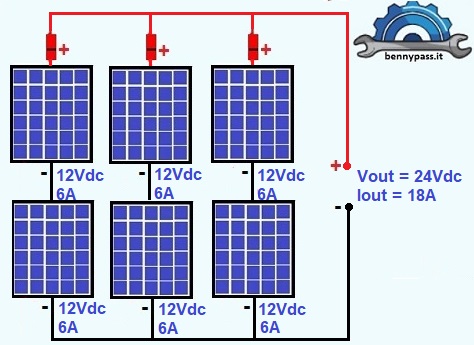
To solve the current problem, one could make three strings of two panels in series and then put them in parallel. By doing so, the current is lowered to 18 Amperes. Figure 9 below shows this.
The calculation is done in this way: total current is given by the addition of the current that passes through each string (being the modules of the string in series, it is the same: 6 A): and are I1 + I2 + I3 = 6 x 3 = 18 A, the total voltage of the photovoltaic field is equivalent to the voltage generated by a single string which is equivalent of 24 V (the voltage of the two photovoltaic panels is added: 12 + 12 = 24 V). The total theoretical power of the photovoltaic system is equal to the full voltage of the photovoltaic system multiplied by the total current (P = Vout * Iout = (24 * 18 = 432 Watts).
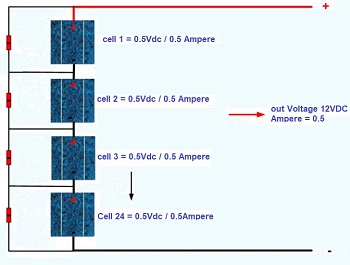
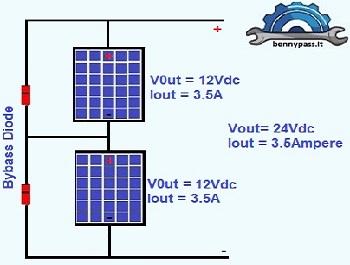
BYPASS DIODE The photovoltaic panel is made up of many solar cells in series. The bypass diodes are used both inside the individual solar cells and between the other panels in order to pass the current in each string of solar cells, even in the presence of a cell or to a module that is not affected by sunlight, thus avoiding the loss of energy and preventing the reverse current from damaging the cell itself. Figures 10 and 11 show the internal diode of cells bypass.
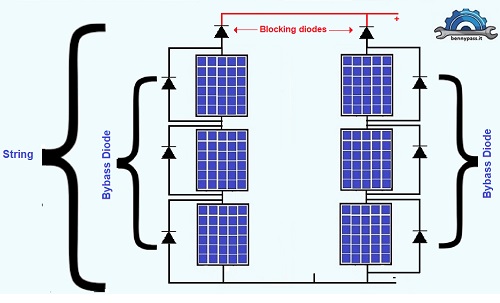
BLOCKING DIODE The Block or String Diode does not perform the same task as the By-Pass diode but serves to prevent the “damaged” string from being crossed by reverse current. Figure 12 below shows the Diode.
As you can see, there are also protections on Solar Panels which must never be underestimated. The blocking diode and the bypass diode are essential for the life of a solar panel system.
|


+(39) 347 051 5328
Italy - Kazakhstan


09.00am to 18.00pm
About
We offer the best and economical solutions, backed by 27+ years of experience and international standards knowledge, echnological changes, and industrial systems.
Our Services
Marketing Materials


Marketing Materials1


