
How to calculate energy consumption In order to design a Photovoltaic system, the following parameters must be consider Note: Before any installation, the inspection for ensures that there is an area available is mandatory. This is for the installation of the PV system and that there are no shading phenomena such as trees, houses, poles, etc. below is the list with all details which are considered.
Daily energy requirement When you want to build an off-grid photovoltaic system, the first parameter to keep in mind is the average energy requirement in kilowatt-hours (kWh) per day. First, I clarify what means Power and Energy.
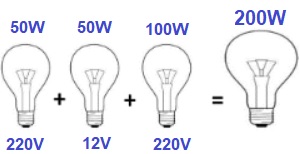
To calculate the Energy consumed daily, I need to know the consumption in Watts of each device that I want to power with the photovoltaic (the power in Watts can be found on the label placed under the device or in the instruction booklet) and multiply each value with time that I intend to use it, then making the sum. For example, a 70 Watt light bulb kept on for 2 hours will consume 140 Watt-hours (Wh), and a laptop that consumes 30 watts, if I keep it on for 6 hours I will have used 180 Watt-hours. The total will be daily requirement will be given by the sum of the 140 Wh of the light bulb, plus the 180 Wh of the computer, for a total of 320 Wh. To make it easier to calculate consumption, we can add the Powers in Watts regardless of the supply voltage. In summary: we can add the power of a 50 Watt light bulb + one always of 50 Watt + one of 100 Watt, and the result will be a total power of 200 Watts, regardless if powered at 220 V or 12 V. Figure 1 shows exactly this.
Figure 1 - Bulb Lamps To learn more: Difference between Power and Energy, and between kilowatts and kilowatt-hours.
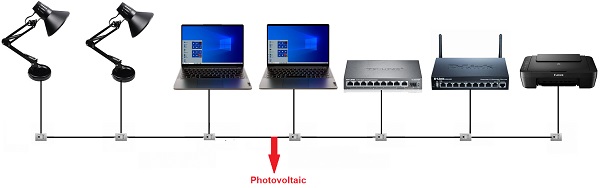
SIZING EXAMPLE For the sizing of the photovoltaic system not connected to the electricity grid, it is a good idea to respect a general rule: the energy produced must be greater than that consumed. For example, to create a workstation for two people connected to the Internet as smart working, not connected to the electricity grid but powered only by photovoltaics, should be available: 2 Laptops, 1 Router, 1 printer, 1 Switch, 2 led lamps. To calculate the daily energy needed to power the workstation, we will have to add up the various powers in Watts that I find written on the label under the device or in the instruction book. Then, we will multiply them by the hours of use (see Figure 2 below)
Let's calculate the theoretical consumption:
The total simultaneous power for their operation is 375 Watts, and the absolute energy requirement is 1660 Watt-hours which we approximate to 1700 Watt-hours (1.7 kWh).
CALCULATION PHOTOVOLTAIC POWER
First, you need to establish the period of use:
After that, consult the tables or use the ENEA, PVGIS simulator ( or others) to check the irradiation in kWh / m² year and obtain the equivalent daily sunshine hours (hse / g).
|


+(39) 347 051 5328
Italy - Kazakhstan


09.00am to 18.00pm
About
We offer the best and economical solutions, backed by 27+ years of experience and international standards knowledge, echnological changes, and industrial systems.
Our Services
Marketing Materials


Marketing Materials1


