
Solar Irradiance calculation Irradiance is a crucial phase that must be studied to understand the maximum range a photovoltaic system can generate. So understanding this means designing a perfect system based on the power sun receives, and according to the various geographic area, I behave accordingly. Sometimes, it is impossible to install the photovoltaic because the performance in that area is very low. This is why before doing anything, knowing the irradiance (power of the sun in that area) is the most important thing. The examples below show the various parts of Italy from north to south as the irradiance changes.
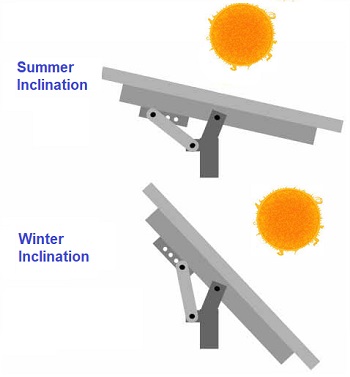
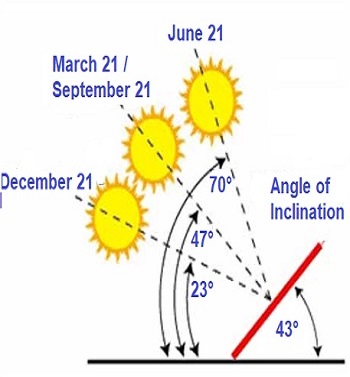
In conclusion: the average daily sunshine hours (hse / d) in the north will be 3.85; in the centre, 4.53; in the south, 4.75. The photovoltaic panels must be facing SOUTH and positioned to receive solar radiance for as long as possible. The inclination concerning the ground is also of fundamental importance (to calculate the inclination according to the position, see the formula), for example: with an inclination of 60 °, the sun's rays are better exploited in winter, and with 20 ° in the summer period; an average that is valid throughout the year is about 30 °. Of course, if it were possible to vary the inclination depending on the season, it would be the best. Motorized panels are also included in our projects, where they self-adjust according to our program. Figures 1 and 2 below show all details.
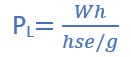
The Nominal Power of the Photovoltaic (Wp) gross of system losses will be given by the required daily energy divided by the sun hours. The rule is as follows: In our case, we will take as an example a plant installed in the north:
As previously said from the Theoretical Power (PL), it is necessary to remove the system losses:
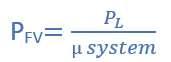
Total Losses = 36% The total efficiency will be 100% - 36% = 64%. Therefore the Effective Power of the Photovoltaic (PFV) must be increased to recover the power losses (36%), which in this case it will be:
where: PFV = photovoltaic power, unit of measurement Wp; PL = gross power; system = effective efficiency (64%). In our case, it will be:
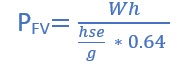
For the total power calculation, use this simple rule:
PFV = Effective power of the photovoltaic in Wp; Wh = watt-hours used; hse / g = average daily hours of sunshine; 0.64 = is the actual efficiency of the panel (64%) and is given by the system losses (36%). In our case, it will be:
E= P * hours of sunshine where: E = Total photovoltaic energy (Wh); P = photovoltaic power. Therefore, the daily energy production of the plant of your project will be: E = 700Watt * 3.85 = 2700Wh day (2.7KWh). In this step, we will verify that the daily electricity consumption is lower than the production in Wh of the photovoltaic panels. In our case, consumption is 1700 Wh (1.7 kWh) so the energy supplied by the photovoltaic, of 2700 Wh, is higher, so it is correct. But the calculation was made with the irradiance of 3.85 hours of sunshine which is an annual average if we want to be sure that our stand-alone photovoltaic system can provide the necessary energy even in the worst conditions, which is winter, and the plant is located in Milan, we will have to consult the Milan irradiance table in the period of December, January, February, where the average daily hours of sunshine are: 1.20-1, 53-2.38 for which the average over the three months will be 1.7 ((1.20 + 1.53 + 2.38) / 3 = 1.7)). Repeating the calculations with winter irradiance, it appears that the daily photovoltaic production will be: 700 Watt * 1.7 hours of sunshine = 1190 Wh; This is not enough, so one solution is to install an extra panel to increase the power to 1000 Watts. The result will be: 1000 Watt * 1.7 = 1700 Wh, These are exactly those used by the users (Photovoltaic production 1700 Wh = to the electrical consumption of 1700 Wh). In summary: if the photovoltaic system is used only in spring/summer/autumn, a power of 700 W is sufficient. If it is to be used throughout the year, a capacity of 1000 W (1 kW) is required.
|





+(39) 347 051 5328
Italy - Kazakhstan


09.00am to 18.00pm
About
We offer the best and economical solutions, backed by 27+ years of experience and international standards knowledge, echnological changes, and industrial systems.
Our Services
Marketing Materials


Marketing Materials1


