
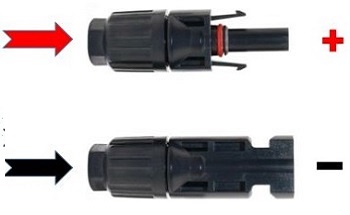
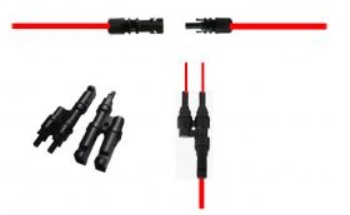
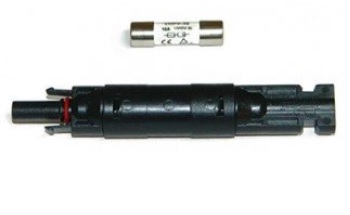
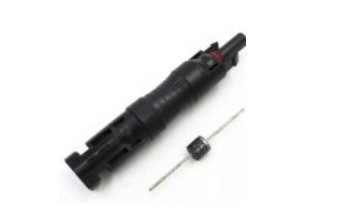
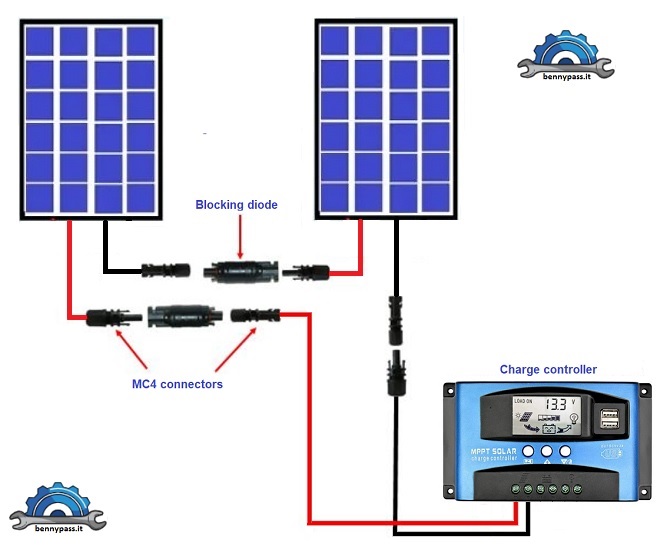
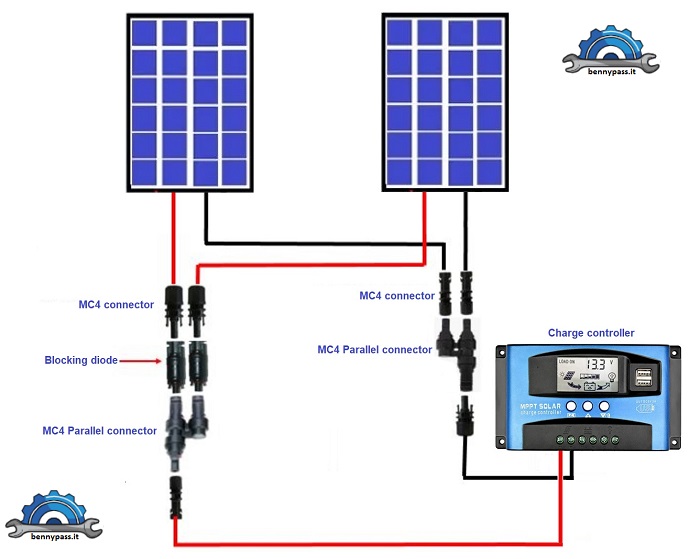
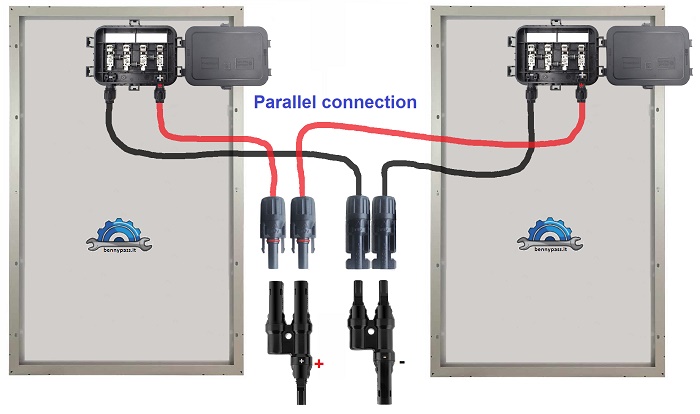
MC4 connectors, blocking and Bypass Diode Parallel connectors (Y) are used for connections of photovoltaic panels in parallel. Including the connectors with blocking or string diodes. Figure 1,2,3,4 below shows all the information about MC4 Connectors.
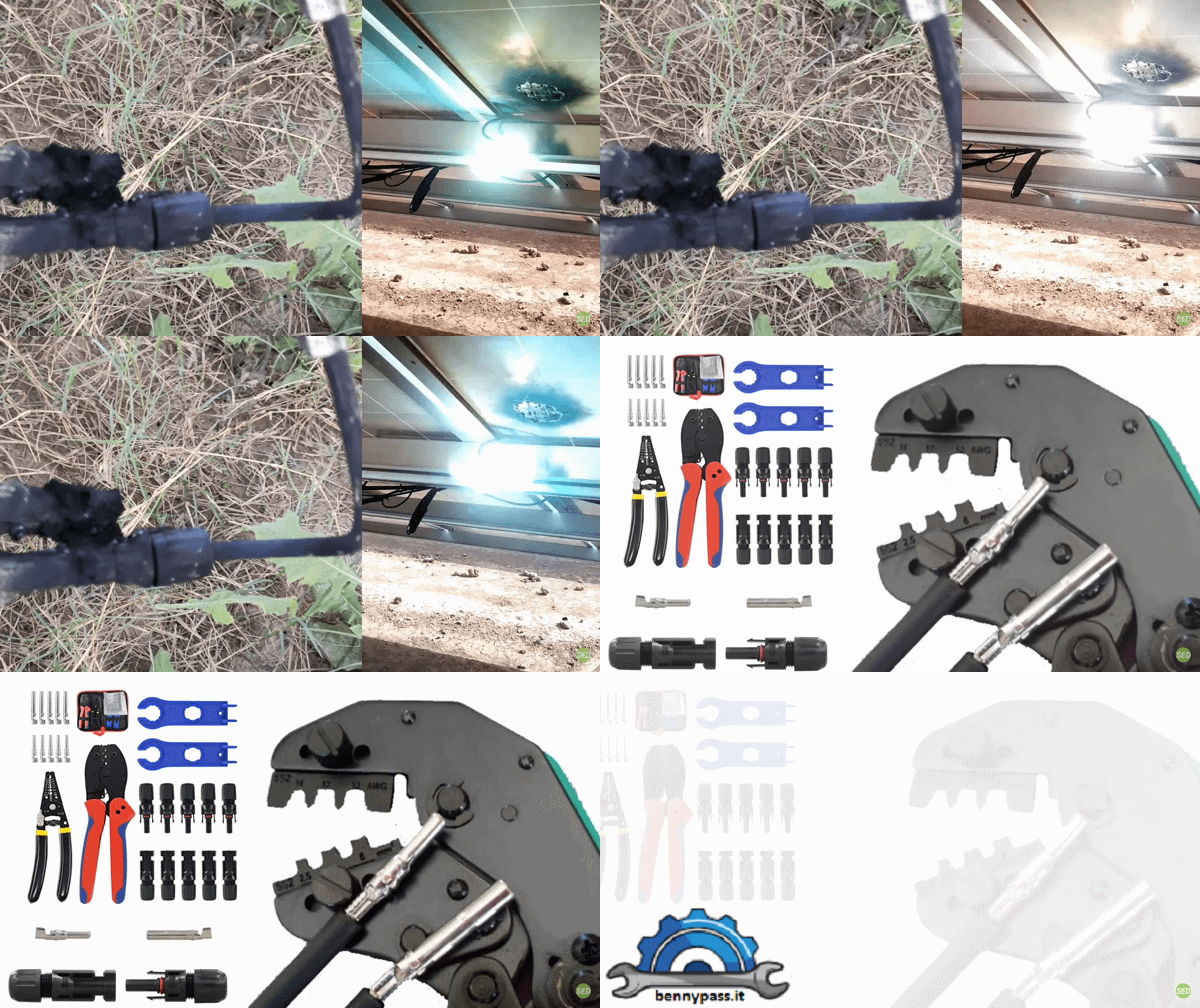
The video below shows how to install MC4 connectors properly
As you can see from the video, it is essential to prepare the connectors carefully. Its internal O-Rings, the tightening of the gland, crimping and soldering cable, are of fundamental importance. One of these mistakes could be fatal. Figure 5 below shows the complete tools needed to assemble the MC4 connector. You can order direct from Iwiss or here on the website
Figure 5 - Special Tools You can order direct from Iwiss, or here on the website. Iwiss is a leader in this.
Blocking Diode and Bypass Diode for solar panels Figure 6 below shows photovoltaic panels connected in series with blocking diodes.
Figure 6 - Solar Panel with blocking Diode Figure 7 below shows photovoltaic panels connected in parallel with blocking diodes.
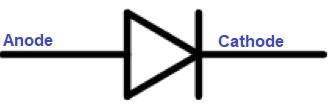
In simplest terms, a diode can be understood as a two-terminal electronic device which allows electrical current to pass in one direction. Diodes are made of a semiconductor material, usually silicon, although materials like selenium and germanium are sometimes used in their construction. A diode only allows a unidirectional flow of current. This is because it offers low (ideally zero) resistance to the current in one direction and, at the same time, offers high (ideally infinite) resistance to the current in the opposite direction. This property of a diode is extensively used in the photovoltaic industry. Figure 8 below shows the most common symbol for a diode found in many circuit diagrams. However, there could be variants. Electrical diagram bypass diode used for solar panel
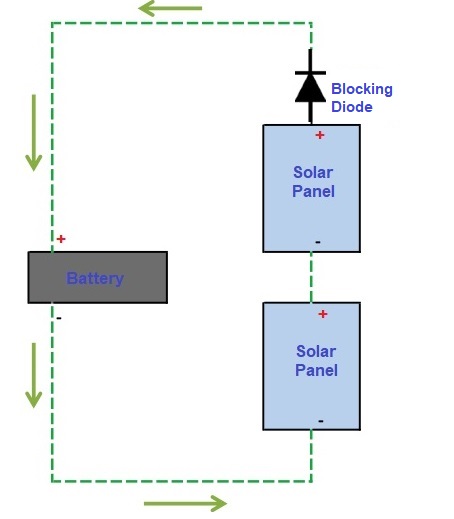
How are blocking diodes and bypass diodes used in solar installations? Diodes are extensively used in solar panel installations. Since they prevent the backflow of current (unidirectional flow of current), they are used as blocking devices. They are also used as bypass devices to maintain the reliability of the entire solar power system in the event of a solar panel failure. Therefore, the two main types of diodes used in a solar system are Blocking Diode: A blocking diode allows the flow of current from a solar panel to the battery but prevents/blocks the flow of current from the battery to the solar panel thereby preventing the battery from discharging. Bypass Diode: A bypass diode is used in case one of the panels of a multi-panel string is faulty. It bypasses the faulty panel by providing current an alternative path to flow and thereby maintains the continuity of power production. Blocking diode configuration Figure 9 below shows a connection with the blocking diode
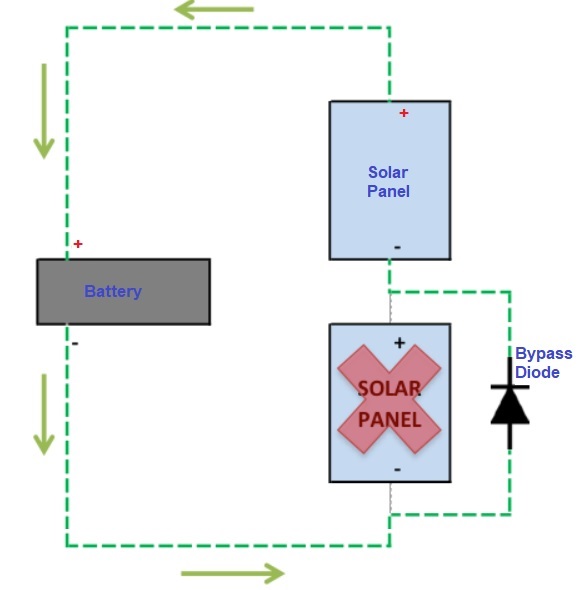
In this setup, during the day, the solar panel (at high potential) produces electricity and charges the battery (at low potential). During the night the battery is at a higher potential when the panel is not producing any electricity (low potential). The current can flow from the battery to the solar panel, thereby discharging the battery overnight. To prevent this from happening, a blocking diode is installed. It allows the current to flow from the panel to the battery but blocks the flow in opposite direction. It is always installed in series with solar panels. This is the reason why the blocking diode is very important. Bypass diode configuration Figure 10 shows the simple working of a bypass diode. In this setup, one of the solar panels is faulty and is not producing any current.
The bypass diode, in this case, provides an alternate path for the current to flow and complete the circuit. It also prevents the current from other working panels (at high potential) from flowing back to the faulty panel (at low potential). Thus even when a panel is faulty, the bypass diode still makes the whole solar system run and produce electricity at a lower rate. The bypass diodes should be installed in parallel to the panel. The bypass diodes are connected directly to the solar panel via an electrical box called a PV junction. The PV junction box is glued together with the backboard of the components by silica gel, and the outgoing wires in the components are connected with the internal wires in the junction box, and the internal wires are connected with the external cables to make the components and external cables conduct. The diode in the junction box ensures that the components can work normally when they are blocked from light. Click here for more details. Figure 11 below shows a typical connection between the PV junction and MC4 connectors.
Usually, the bypass diodes are supplied directly by the panel manufacturer, where the correct diode (PV Junction) has been calculated based on the panel size. Regarding blocking the diode, the story is different. Diode sizing is essential for the current and reverse voltage. You must search for the maximum current value that will pass through the diode. Depending on this value, choose a device whose direct current is great than that value. Pay attention also to the temperature. Check the datasheet to which temperature value will reach the junction with that current value to establish the sizing for a possible heatsink. For the reverse peak voltage: Check the maximum theoretical voltage that should block the diode or, better, what the full potential difference will be across the diode and choose one with a much higher reverse voltage. For example: If the string has a minimum voltage of 0v and on the other side of the diode you can have voltages <= 200v you will have to choose a diode with reverse voltage> 250v (more or less). You can write an email here on the website if you have any questions.
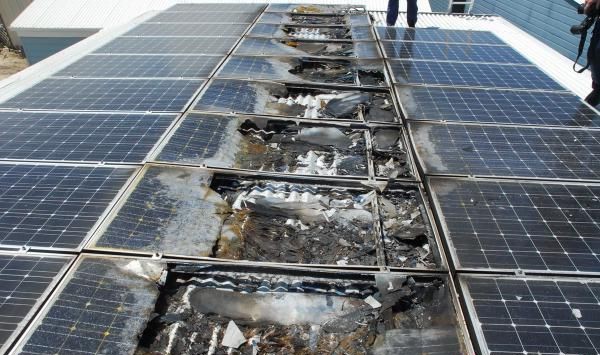
Recommendations These connectors are critical; they close the connection tightly. Even if they are perfect, they are very delicate, the closure is interlocking, and if the interlocking is damaged, the connector must replace fully (this is mandatory). Most of the incidents happen from these connections when water (or dirt) infiltrates inside the connector (internal O-ring damaged) and causes tripping of the electrical breaker (when you are lucky). Sometimes it happens that poor connections, such as not using the special tools and then the internal connection pins not touching well (the loose connection between male/female) and cause the overheat of the connector with the risk of fire itself. If it goes well, the fire remains limited only to that panel. If it goes wrong, the fire can touch other panels, or even in the worst-case scenario, the total fire of the building if the roof is wooden. MC4 connectors should not be ignored absolutely. Always use the special tools supplied and always follow the detailed instructions. For any questions, you can contact our support service directly, and our expert will try to help you. Also, he can suggest to you which type of MC4 connectors is suitable for your system. Preventive maintenance must be mandatory every year by your installer. Figure 12 and 13 below shows what happens if a connection goes wrong.
Solar panels cannot start a fire independently, as they are made up of photovoltaic cells. Solar PV installations can become flammable, however, if they malfunction. Fires caused by solar panels have been associated with the following issues such as panels that are poorly installed solar panel system sensors and junction boxes with defective connections. Poor installation of solar panel collectors is the most common cause of solar panel fires. For instance, incorrect seaming of connectors can cause electrical arcing, which results in a significant amount of heat being released. The result may be overheating and fire if this occurs. A professional must therefore install solar panels, following the instructions and using the appropriate equipment. A defective junction box overheating is the main component that causes fire outbreaks. The junction box is located where electrical cables connect to the solar panel. If the wiring is not properly done, or the junction box is not of good quality, it can overheat and cause a fire. Solar panels should be regularly checked and maintained to prevent fires.
|



+(39) 347 051 5328
Italy - Kazakhstan


09.00am to 18.00pm
About
We offer the best and economical solutions, backed by 27+ years of experience and international standards knowledge, echnological changes, and industrial systems.
Our Services
Marketing Materials


Marketing Materials1


