
Charge Controller The output voltage from the solar panel is not regular and can also be high. For this reason, a charge controller is required.
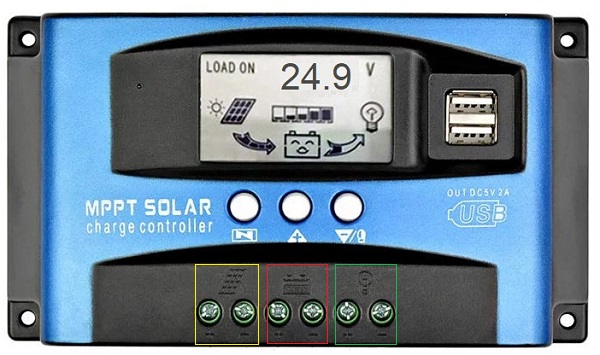
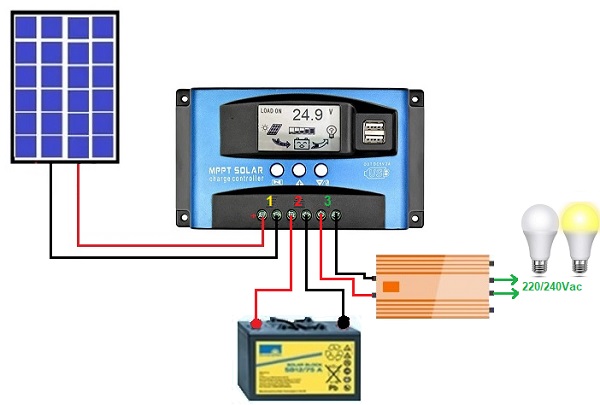
The regulator usually has three connections, as shown in Figure 2 below:
It is essential that a charge controller is inserted between the solar panel and the battery, and it is necessary for photovoltaic systems with storage. The solar panel's voltage is not as stable as a national network. The solar panel during the day can vary in continuation, and not a few volts. The charge control will stop sending the electric current to the battery once it is charged or exclude the load connected if it is in deep discharge. Sizing The sizing depends on the type of device we intend to use: PWM or MPPT: If you use the PWM charge controller, you must check the total short-circuit current of the modules, or the module (Isc) that you find in the datasheet, which must always be lower than the maximum current (A) of the charge controller (The Isc current in the series panels remains the same, while in parallel they are added).
If you used an MPPT-type charge controller, the flow rate is calculated by the maximum power (Watt) of the photovoltaic, and the voltage (V) of the batteries. Therefore, the current (Ampere) must be equal to or less than the maximum MPPT capacity shown in the specifications.
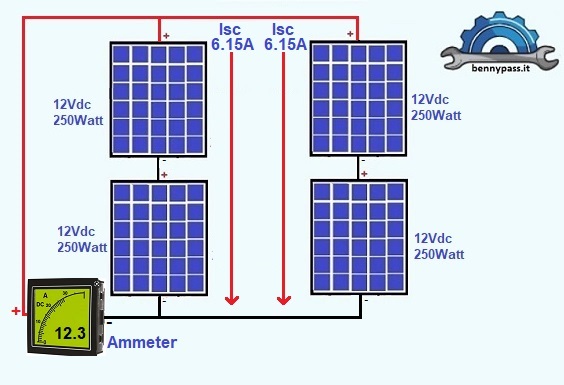
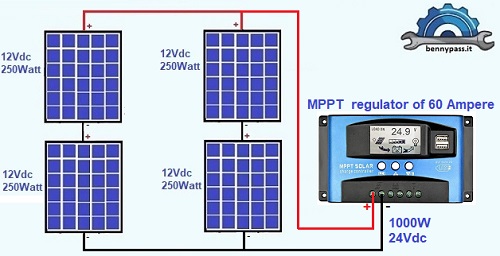
For example: if we were to connect a photovoltaic system with maximum power (Wp) of 360 Watt to the MPPT charge controller and the battery pack voltage is 12 Volt, the MPPT must support at least a current of 30 Ampere (I = P / V = 360/12 = 30A). Notes: This information is essential and must be discussed before any investment. Send an email here on the website for any questions. Choice of regulator The choice of PWM or MPPT technology depends on the type of panels used, and on the battery bank. The Cost of PWM is lower, including some limitations if compared with MPPT. The most important limitation is that: the MPPT uses full power from the photovoltaic panel by using voltages higher than the battery bank, while in PWM, connecting a 24 Volt photovoltaic system with 12 Volt batteries is not possible. Therefore, it is advisable to use PWM when the photovoltaic voltage is slightly higher than the battery (for example a 12 Volt panel made up of 30 cells and 12 Volt batteries). PWM regulator In our project, having two strings in parallel and each string having two panels in series, we will add the Short Circuit Currents (Isc) of each string, indicated in the datasheet, which is 6.15 Ampere. So the added is 6.15 x 2 = 12.3 A, and to be sure, we will use one higher than 25% to compensate for the voltage peaks that can occur on cold and sunny days. Figure 5 below shows this. The photovoltaic panel is the only electrical generator that when short-circuited is not damaged but delivers the maximum current that the cells can generate. One thing to keep in mind: never short-circuit batteries or other electric generators. MPPT regulator The capacity of an MPPT regulator is calculated by the photovoltaic power (Watt) and the voltage (V) of the batteries. Therefore, the current (Ampere) must be equal to or less than the maximum MPPT capacity shown in the specifications (Honestly I prefer lower and not equal). Our project's photovoltaic power is 1000 watts, and the battery pack is 24Volt. Using this rule, we will find the value: Imax = photovoltaic P (Watt) / Battery voltage (Volt) = 1000/24 = 42 Ampere To compensate for the voltage peaks that can occur on cold and sunny days, we will increase the range by 25% so that it would become: I(A)=(P/V) * 1,25= (1000/24) *1,25 = 52 A Where: I = maximum input current to the charge control; P = total photovoltaic power; V = battery pack voltage; 1.25 = 25% increase For our system, I will choose a 60 Ampere MPPT Regulator. Figure 6 below shows this.
Two limits must not be exceeded when dimensioning an MPPT regulator:
These two values must not exceed the plate imposed by the manufacturer, which you find in the technical datasheet. In our case, the maximum open-circuit voltage will be given by the Voc value for the panels placed in series in the string. Voc = 49.40 * 2 = 98.8 Volts which we will increase by 25% = 98.8 * 1.25 = 124 Volts, so it's okay as the plate limits are 150 Volts. Recommendations When you buy a charge controller, you must do it according to the type of battery you want to install. So do not connect a lead-acid battery to a charge controller designed only for lithium batteries. This could compromise the safety and longevity of the batteries as the charging algorithms, and voltage settings are different. Some of the regulators can be used for lead-acid and lithium batteries by appropriately setting the regulator itself. This is another reason why knowing the complete photovoltaic system is very important.
|


+(39) 347 051 5328
Italy - Kazakhstan


09.00am to 18.00pm
About
We offer the best and economical solutions, backed by 27+ years of experience and international standards knowledge, echnological changes, and industrial systems.
Our Services
Marketing Materials


Marketing Materials1


