
Isc, Voc, STC,VPM
STC (Standard Test Condition) In order to have identical references for all manufacturers, the power of the photovoltaic panels is calculated under the STC conditions (Standard Test Condition), i.e. an irradiance of 1000W / m², with a temperature of 25 ° C, spectral distribution = 1.5. VOC (Voltage with Open Circuit) This means the maximum voltage of a device under certain light and temperature conditions, corresponding to the maximum potential voltage (when the circuit is open). ISC (Short-circuit current) This means the maximum current produced by a device under certain light and temperature conditions. VPM (Voltage at maximum power) This means voltage which translates into maximum power under certain light and temperature conditions. The Maximum Power in a photovoltaic system is given by: Pmax = Imp x Vmp (Wp) Where: Imp = Current resulting at maximum power; Vmp = the Voltage which translates into Maximum Power.
Characteristics of a photovoltaic cell In general, the characteristics of a photovoltaic cell depend on three variables:
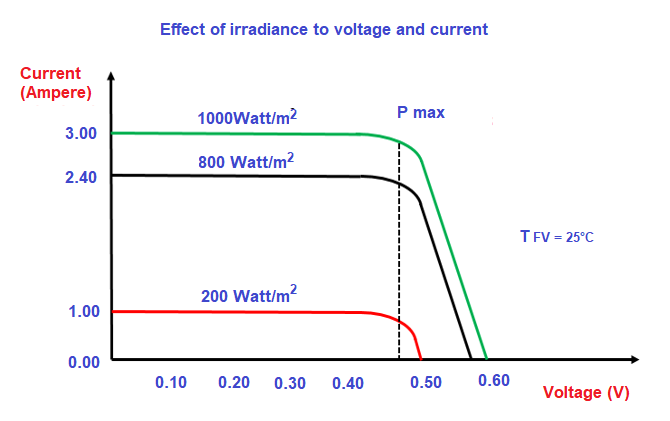
Irradiance The incidence of irradiance on voltage and current, as seen in the graphic (the figure represents a photovoltaic cell at a constant of the temperature of 25º with 1000 Watt / m² and with direct irradiation with clear skies and 200 Watt / m² when cloudy skies) it does not greatly affect the value of the no-load voltage, while the short-circuit current varies proportionally as the intensity of the irradiation varies. Effect of irradiance on voltage and current
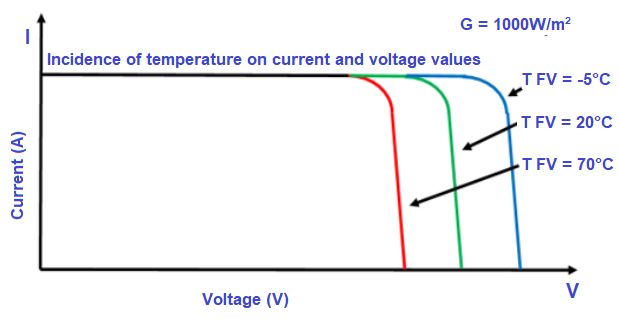
Figure 1 From this, the Irradiance can be measured as a function of the Short Circuit Current (Isc) of a sample cell at a temperature of 25º. Irr. Meas.= Irr0 x ( Isc Meas/Isc0) The Measured Irradiation (Irr Measu.) Is equal to the known Irradiation (Irr 0) multiplied by the Short Circuit Current (Isc Meas.) and the known Short Circuit Current (Isc 0). Example: a monocrystalline silicon cell with an area equal to 100 cm², can deliver at irradiation of 1000Watt / m², a Short Circuit Current (Isc) of 3 Ampere, so it will be with irradiation of 800 Watt / m², of 2, 4 Ampere. Irradiance: the global average horizontal value found on the ground. For example, Central Italy is 180 W / m², 160 W / m² in the North, and 200 W / m² in the South. Temperature Temperature does not significantly affect the value of the short-circuit current (Isc), but there is a proportionality between Temperature and Voltage without load, see Figure 2 below. From the trend, it can be deduced that the voltage decreases as the temperature increases. Figure 2
Cell area The cell area does not affect the voltage value but exists a proportionality between it and the available current, so increasing the cell area increases the current and, therefore the power. In summary: the temperature affects the voltage, while the irradiation determines the voltage of the photovoltaic system. Physical Greatness Physical Greatness is:
The maximum power of the device is determined by the product of voltage and current (P = V * I). In short circuit conditions, the generated current is maximum (Isc) while the voltage is maximum with the open circuit (Voc). Therefore, in the open or short circuit conditions, the power is zero, as P = Vx I the current in the first case and the voltage in the second will be zero. In summary, once the operating voltage and current values are known, it is possible to know the power which delivers the generator by using the equation P = V (Volt) * I (Ampere) = Watt
Nominal, or maximum, or peak, or power plate of a photovoltaic panel The Nominal, or Maximum, or Peak, or Plate Power (Wp) of the photovoltaic system is the system's electrical power, determined by adding the individual nominal, or maximum, or peak, or plate powers of each photovoltaic module belonging to the same system, measured under Standard Conditions (temperature equal to 25 ° C and radiation equal to 1,000 W / m², and with Air Mas AM1). AM - Air Mass: The solar radiation, which reaches the earth's ground, must pass through an atmospheric air mass that is minimal when the sun is at its Zenith and as it increases as the sun lowers on the horizon. AM0 (Air Mass 0) is the density of solar radiation beyond the atmosphere (1.353kW / m²). AM1 is the density of solar radiation on the earth's soil at noon, at perfectly clear day (1kW / m2). AM1.5 indicates the radiation density in the STC tests (Standard Test Condition). In order to have identical references for all manufacturers, the power of the photovoltaic panels is calculated at the STC conditions (Standard Test Condition), which means irradiation of 1000W / m², the temperature of 25 ° C, AM1 = 1.5. The Nominal or Maximum, or Peak, or plate Power, is the point of maximum power, which we will indicate with Pmax = Imp x Vmp (Wp) where: Imp = Current resulting at maximum power; Vmp = the voltage at maximum power. The Nominal or Maximum, or Peak, or plate Power is in Watt peak (Wp) can also be calculated: Pmax = Voc x Isc x FF The Nominal or Maximum Power, or Peak (measured in Wp), at SCT conditions is difficult to achieve in real operating conditions, so is measured in the laboratory. Fill factor The Filling Factor (FF) is defined as the ratio between the maximum extractable power from the cell and the product between Voc and Isc FF = Pmax/Pt = Imp * Vmp/Isc * Voc
Efficiency The efficiency of the photovoltaic cell (Efficiency is the yield of a photovoltaic panel per meter²), defines, in percentage, the ability to transform the incident solar energy into electricity. In order to have identical references for all manufacturers, the power of the photovoltaic panels is calculated under STC conditions (Standard Test Condition), that is irradiation of 1000W / m², the temperature of 25 ° C, AM1 = 1.5. Calculating the efficiency of a photovoltaic panel is relatively simple, knowing the peak power and the dimensions (the maximum size of the module). For the simplified calculation, the following formula can be used: Efficiency% = (Power / Surface / 1000) * 100 By power means the peak power Wp expressed in Watts, the surface is the panel's surface in m² including the frame (base * height), 1000 is the irradiation of 1000W / m², 100 is used to obtain the efficiency in percentage. The dimensions and the peak power can be found on the technical datasheets of the panels or on the labels of the same. Eg. If the Power of a module is 300W Peak, and the surface is: 0.992 x 1.64 m = 1.63 m², the Yield / Efficiency will be: Efficiency = (300 / 1.63 / 1000) * 100 = 18% We are only talking about the peak efficiency at STC conditions (Standard Test Condition) and how to calculate it; we are not talking about the productivity of photovoltaic systems, which depends on more complex calculations. We can also say that if there are no space problems, the panel's efficiency is essential data. At the same time, it must be considered in a much more important way when it is necessary to create systems with the maximum possible power on the available surface. In this case, the peak power per unit area cannot be neglected. Technically, the power conversion efficiency of a solar cell is given by the ratio between the maximum electrical power of the cell and the power provided by the incident sunlight. The standard value is taken as a reference to indicate solar radiation is 1000 Watt / m². η = ((Im*Vm)/Pin) * 100 Where: Im = Maximum current; Vm = Maximum voltage; Pin = Input power. The conversion efficiency η can also be expressed as a function of the fill factor FF: η = (Voc * Isc * FF/ Pin) * 100 Where: η (%) = efficiency of the photovoltaic cell in STC conditions which vary according to the different types; FF = fill factor; Voc = Open circuit voltage; Isc = Short circuit current; Pin = Input power.
Performance as a function of meteorological data The manufacturers of photovoltaic panels provide the characteristics referred to the voltage and current in STC conditions, also called standard requirements, while the power is called "Nominal or Peak Power". Assuming a solar panel has the:
To calculate the power of the photovoltaic panel, the following formula can be used: P = Vm x Im = 36.78 x 8.70 = 320 Watt; which is exactly the one provided by the manufacturer. Now let's calculate the Power with non-standard climatic conditions, for example, with irradiation of 800 W / m² and a temperature of 65 ° C; for the calculation, we will have to consider that the currents are proportional to the irradiation. At the same time, the voltages are reduced by about 4% for each 10 ° C increase in temperature. Since the difference is 40 ° C, the voltage reduction is 16%. Therefore, since the currents are proportional to the irradiation, we will have: Icc = 9,15 x 800/1000 = 7,32 A Imp= 8,70 x 800/1000 = 6,96 A For voltages, on the other hand, we will have to take into account the difference in temperature Vmp = (1- 0,16) * 36,78 = 30,89 V Voc = (1 - 0,16) * 8,70 = 7,3 V The power of our solar panel in the new climatic conditions will be: P = Vm x Im = 30.89 * 6.96 = 215 Watt In summary: if the temperature increases, the power decreases. Production of a photovoltaic panel The factors that affect the production efficiency of a photovoltaic system are basically two:
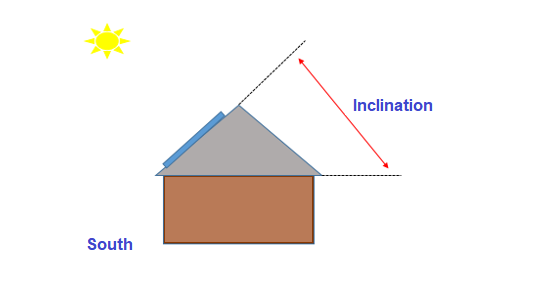
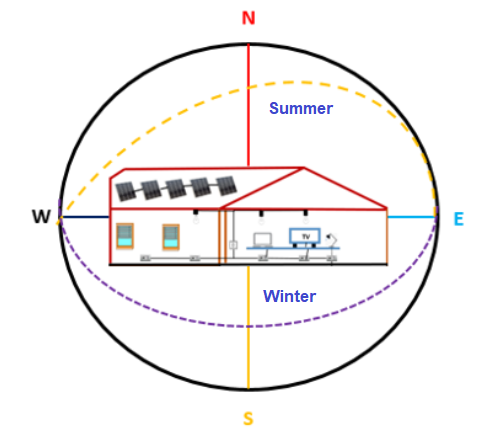
External factors The inclination, or Tilt, of the photovoltaic modules, is the best angle of a preference concerning the ground and allows you to capture the irradiation better. At our latitudes, the optimal tendency is around 30/35 degrees. For example: with an inclination of 60 °, the sun's rays are better exploited in the winter, and with 20 ° in the summer, an average that is valid throughout the year is about 30 °. The formula for the inclination that does not consider the changes that should be made in the months of the year, but is an average, reliable, between winter and summer production is this: Optimal inclination = 3.7 + (0.69 x Latitude) For Eg, Milan has a latitude of 41.89º. Tilt = 3.7 + (0.69 x 41.89) = 32.6º Eg Palermo: latitude 38º. Tilt = 3.7 + (0.69 x 38) = 30º Figure 3 shows this
If you think that the higher the temperature, the greater the energy production: it is wrong. Solar panels perform better with a temperature around 25 ° C; the higher it is, the lower the performance, see Figure 5
Cleaning and Shading. Dust and dirt can cover the cells and prevent the absorption of sunlight, such as the presence of shadows such as trees, chimneys, etc., which reduce its productivity.
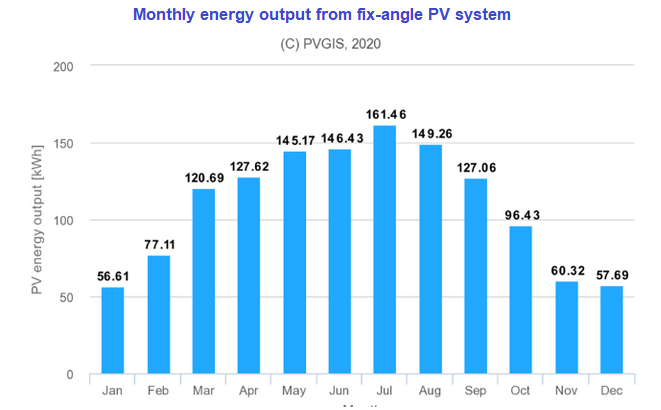
External factors The internal factors are none other than the installed products that make up the photovoltaic system. If they are not managed correctly, they generate the so-called system losses due to the inverter, cables, charge controller, etc. In practice, the internal factors can be expressed in the quality of the components, which is fundamental. And in the years of life, which with the passage of time the devices suffer a decline in performance, for this reason, it is good to choose a photovoltaic panel certified up to at least 25 years of operation. Tool for calculating the production of the photovoltaic system To calculate the production of the photovoltaic system, an online simulator PVGIS (Photovoltaic Geographical Information System) could be used. With this calculator, we can obtain the monthly photovoltaic production in Kwh in relation to the monthly irradiation of the place chosen for all months of the year, and the daily irradiance of the place chosen.
www.bennypass.it |

+(39) 347 051 5328
Italy - Kazakhstan


09.00am to 18.00pm
About
We offer the best and economical solutions, backed by 27+ years of experience and international standards knowledge, echnological changes, and industrial systems.
Our Services
Marketing Materials


Marketing Materials1


