
Irradiance
Irradiance The sun is the primary source of energy that the earth can receive, it is made up of 80% hydrogen, 19% helium, and 1% are unknown elements.
The energy radiated by the sun comes from a thermonuclear reaction that converts mass into energy. The summary is in the famous relation: E = mc² (energy equal to mass times the speed of light squared). So the sun radiates energy to the outside which propagates in the form of radiation and 99% of this has a wavelength between 0.4 and 0.74 µm.
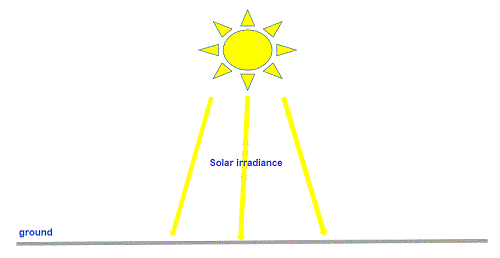
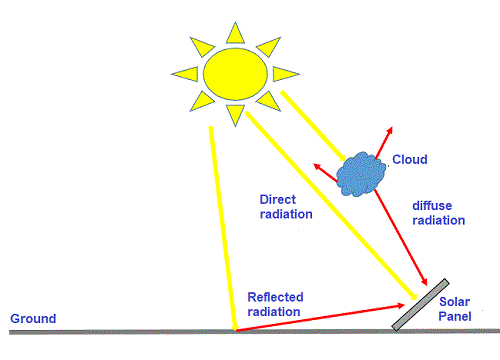
Between irradiance and radiation Irradiance is the power per unit of the surface coming from the sun (W / m²) which can be in the order of hundreds of W / m², in practice it expresses the density of solar radiation, and reaches a maximum value around 1,000 W / m² which is lower than the solar constant (1,350 kW / m²), due to the phenomena of absorption and reflection from the atmosphere. Therefore the solar radiation or irradiance that reaches the earth's soil is divided into:
Conclusion: the Global Radiation is given by the sum of: Direct Radiation + Reflected Radiation + Diffuse Radiation. RG = RD + RR + RD = 1000 W / m² (Theoretical) Eg. With a clear sky the global radiation is 1000W / m²; Fog = 600W / m²; Cloudy = 500W / m²; Barely perceptible sun = 200 W / m²; Dense fog = 100 W / m²; Covered sky = 50 W / m². Irradiance Irradiation is the Energy per unit area from the sun (kWh / m²) which varies point by point. Data on irradiation and, consequently, orientation is essential for designing a photovoltaic system whose cells use sunlight to generate electricity. The solar radiation on the ground is affected by the following factors:
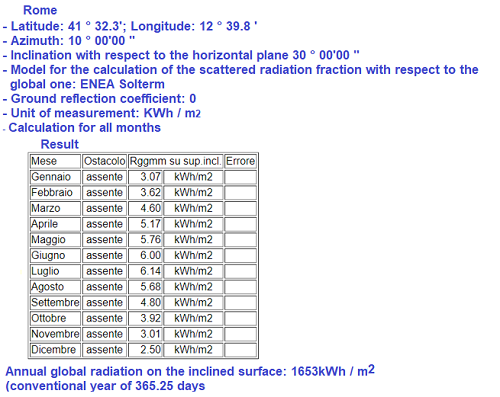
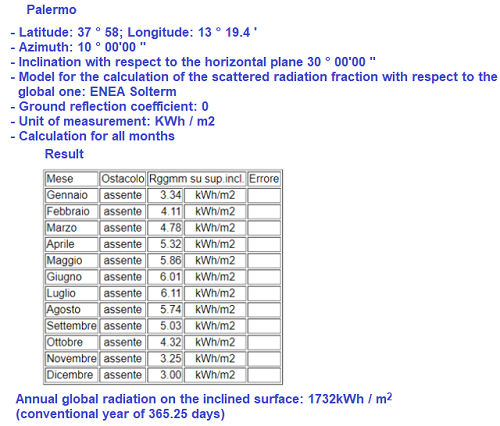
Example:
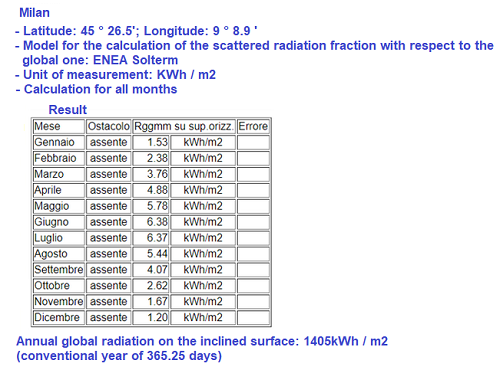
Below table reference of Italy Irradiation
www.bennypass.it
|

+(39) 347 051 5328
Italy - Kazakhstan


09.00am to 18.00pm
About
We offer the best and economical solutions, backed by 27+ years of experience and international standards knowledge, echnological changes, and industrial systems.
Our Services
Marketing Materials


Marketing Materials1


