
Battery storage capacity The battery is essential if we don't want to waste the energy that the photovoltaic system produces and have it available even when it does not come from the solar panel. It is the most critical element of the system as it is the only part that needs maintenance. The duration is about 7/8 years and depends on the number of charge/discharge cycles and the reduced self-discharge. In my opinion, the most suitable batteries for photovoltaic systems (stationary) are the lead gel, ideal for working with limited currents for prolonged charging and discharging. Also the price it's normal. Lithium batteries, which represent the latest generation, have a high charge and discharge cycle (about 6000 cycles), but on the other hand, their cost is too high. It would be good when connecting the batteries in series or in parallel that they are the same (twins), that they have the same degree of charge, and that the electric cables used for the connection are of adequate size and as short as possible. How to calculate the battery capacity The capacity of a battery is the measure of the amount of electrical energy it can store and is expressed in Ampere-hours (abbreviated to Ah). For most cycles of batteries, it is good practice to discharge them to 50% of the nominal capacity in the case of lead-acid batteries or to 80% in the case of lithium batteries. Calculation of the storage capacity in Ah If the battery will be used only in the summer period, it is sufficient to keep the charge for 3 or 4 days. If needed, also in winter, it is appropriate to double the days. To calculate the capacity when the batteries are lead-acid or lead gel and discharge at 50%, the efficiency will be 92% of the nominal capacity. You can use the automatic calculator for the storage capacity or use this rule:
Calculation of the storage capacity in Ah If you use it only for the summer period, it is sufficient for the battery to keep the charge for 3 or 4 days. If you need it even in winter, it is appropriate to double the days. To calculate the capacity, when the batteries are lead-acid or lead gel and which we will discharge at 50%, with an efficiency of 92% of the nominal capacity, you can use the automatic calculator for the storage capacity or use this rule:
Where: CB = battery capacity in Ah; Et = energy consumption in Wh; Nd = the number of days of use; VFV = Photovoltaic voltage; 0.5 = depth of discharge; 0.92 = efficiency. To calculate the capacity when the batteries are lithium, and we discharge to 80% (in this case we will not take into account the efficiency) you can use the automatic calculator for the storage capacity or use this rule:
Where: CB = battery capacity in Ah; Et = energy consumption in Wh; Nd = the number of days of use; VFV = Photovoltaic voltage; 0.8 = depth of discharge. Calculation of capacity with the values of our project Et = 1700 Wh; Nd = 6 days; VFV = 24 Volt. If we use lithium batteries, I will discharge them to 80%, and the result will be:
If we use lead acid or lead gel, batteries I will discharge them to 50% and the result will be:
See also: Charging and discharging time of a battery Connecting the batteries Batteries can be connected in Series, Parallel, or Series / Parallel. In Series, the Voltage is added, and the capacity in Ampere-hours (Ah) remains unchanged. (see Figure 2 below)
In Parallel the capacities in Ampere-hours are added, and the Voltage remains unchanged (see Figure 3 below)
In Series / Parallel, the Voltage adds up to the series branch, and Ampere adds up to the parallel branch.
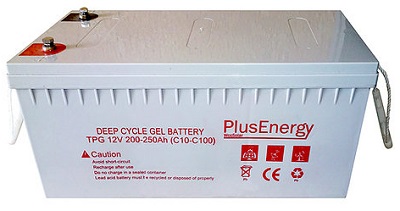
The capacity of the batteries on the market (single or battery bank) are for example these:
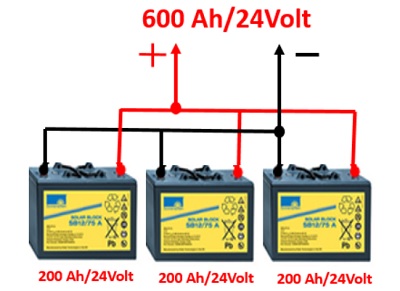
For our project, we could use 3 batteries (Lithium) of 200 Ah, 24 Volts in parallel, with the discharge at 80% of its nominal capacity (See Figure 5 below)
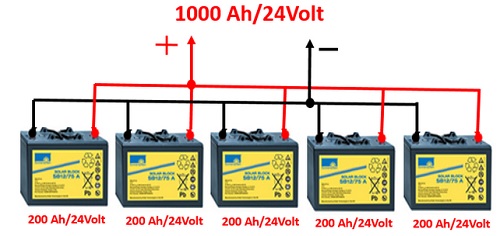
Or we can use 5 batteries with 200Ah and 24 Volt lead gel in parallel, with the discharge at 50% of its nominal capacity. We will use own these batteries in this project (See Figure 6 below)
Batteries connection diagram
Photovoltaic batteries to buy on Amazon or here on the website
|








+(39) 347 051 5328
Italy - Kazakhstan


09.00am to 18.00pm
About
We offer the best and economical solutions, backed by 27+ years of experience and international standards knowledge, echnological changes, and industrial systems.
Our Services
Marketing Materials


Marketing Materials1


