
Battery
A battery could be any device that stores energy for later use. The word battery identifies an electrochemical apparatus that converts chemical energy into electrical energy through the use of a galvanic cell.
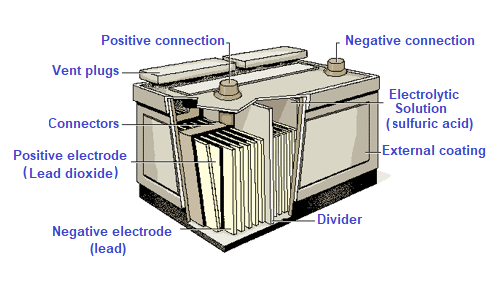
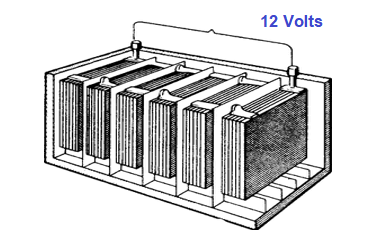
The purpose of batteries is not to produce electricity but to accumulate or store electricity. The chemical reactions inside the batteries vary depending on whether the electrical energy is stored or released. In rechargeable batteries such as lead-acid batteries, the process can be repeated over and over again. Typically, batteries do not offer 100% efficiency but are at lower values. This means that some energy is lost in the form of heat during the chemical reactions of charge and discharge. The batteries used for photovoltaic systems are usually lead-based, but can also be lithium-based; let's see the differences: Lead-acid batteries This type of battery is reliable and economical, but also bulky and heavy. To get many charges and discharges, they must be discharged up to 50% of nominal storage capacity; therefore, the useful capacity is reduced by half. Due to producing hydrogen gas, it is also necessary to consider the place where they are installed, so if they are in a closed room the place must be well ventilated.
Figure 1 Lead batteries have constructive differences depending on they are used. For example, the cars are built to ensure a high starting current, while photovoltaics must guarantee a high number of charges and discharges. Battery AGM (Absorbent Glass Mata)
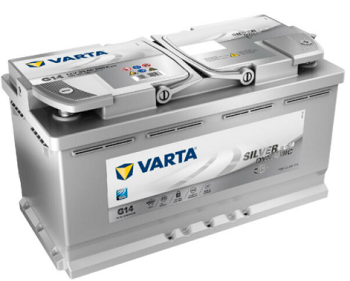
Figure 2 AGM battery, also known as VRLA battery, is a sealed valve-regulated lead-acid battery with AGM material as the separator. There are mainly three types. One is used as a starter battery for automotive due to its high current performance. One is focused on deep cycle performance, used in solar & renewable energy, UPS backup power, telecom base stations, CCTV, and other BESS(Battery Energy Storage System). The 3rd type is focused on higher current discharge as for motive power. Deep cycle AGM battery is a type of VRLA battery focused on deep cycle performance. Sealed, maintenance-free, the biggest advantage, excellent deep cycle life, achieve more than 1000 cycles at 50% DOD. AGM battery is very sensitive to overcharge and over-discharge, improper charging and discharging will lead to the reduction of battery life. So the proper charging process is very important. The charge voltage includes cycle charge voltage and float charge voltage, fast charge voltage. In general, the float charge voltage is used for daily floating charges, the lowest. Cycle charge voltage is used for recharging after discharged to a certain depth, it is higher. Fast charge is the voltage of rapid full charge under an emergency condition, the highest, not commonly used.
On a regular basis at 25°C for 12V deep cycle AGM batteries, float charge voltage is 13.5V~13.8V, and cycle charging voltage is 14.4V~15.0V. Some batteries are marked with charge voltages on the label or print, including float charge voltage and cycle charge voltage. The float voltage is 13.5V~13.8V, and the cycle charge voltage is 14.4V~14.9V. You can use the charge voltage directly. Or you can also choose the safer intermediate value or minimum value. The highest value of the cycle charge voltage (15.0V) could be considered as the fast charge voltage, which is always considered to cause damage to the battery. Temperature compensation is -30mV/°C for cycle charge voltage, -20mV/°C for float charge voltage At low temperatures, the charge voltage may be slightly higher. When the temperature is high, it is extremely important to be careful of overcharging due to high voltage. If the charge voltage is not indicated on the battery, the reasonable cycle charge voltage can be estimated according to the open-circuit voltage (OCV) when the battery is fully charged. Generally, the open-circuit voltage of the 12V battery when fully charged plus 1~1.5V is a reasonable cycle charge voltage. There are several ways to know this value: First, use a DC voltmeter to measure the voltage of the battery that remains more than one hour after fully charged, and the value is directly obtained. Second, get from the documents. The value will not be printed on the battery, but usually, we can get it from the manufacturer’s operating instructions or MSDS. The charge current is related to the rated capacity of the battery. It is generally 0.1C~0.4C, which is 1/10 to 4/10 of the rated capacity. Attention: During any stage of charging, if you feel the battery is warm to your touch, it is normal, no need to worry. But if you feel it is very hot, even like burning, you have to stop charging immediately or reduce the charging voltage or current, or both. Lead / Gel batteries
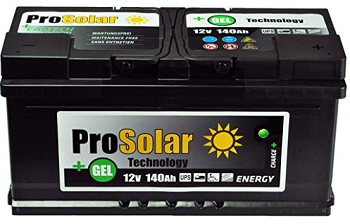
Figure 3 Lead / Gel batteries are the most common, cheap and reliable. They can be discharged up to a maximum of 50% of their nominal charge and exhausts their function after about 2000/2500 charge/discharge cycles. And if we use it every day, we can estimate the duration of about 6/7 years. One thing to keep in mind is that lead-acid batteries weigh and are bulky and should be placed in a ventilated area as they produce hydrogen gas in the charge (very dangerous). The gel battery has the advantage of reduced wear on the electrodes, resulting in a longer duration of use than a conventional lead-acid battery. Lead-acid gel batteries
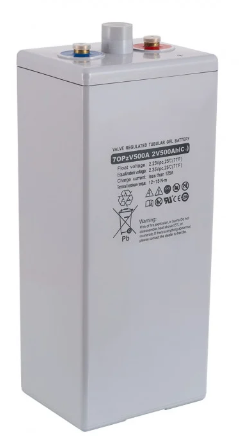
Figure 4 OPzV stationary batteries are lead-acid gel batteries that, being sealed it does not require periodic maintenance. They are ideal for solar installations, emergency lights, fire systems, telecommunications, irrigation systems, etc. The battery comes in a compact size to make it easier to install and transport. These batteries are composed of tubular cells and are characterized by their excellent deep cycle behaviour, high efficiency and level of reliability. On a technical level, the main advantage of the OPzV is that they integrate a control valve that allows the repeated and lasting discharge of the cells and this allows their operation both in vertical and horizontal positions. The battery offers high performance to deep and repeated discharge cycles, which its estimated duration is over 2400 cycles at an average depth of 60% discharge with an average life of more than 18 years at 25ºC. Lithium batteries
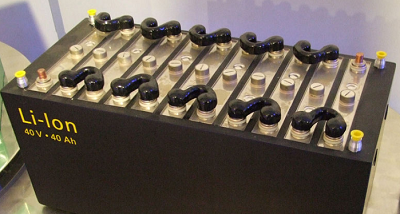
Figure 5 Lithium batteries have the advantage of being light, compact, and recharging quickly. For photovoltaics, companies have mostly adopted two types: NMC (Nickel Manganese Cobalt: Li-NMC)
Figure 6
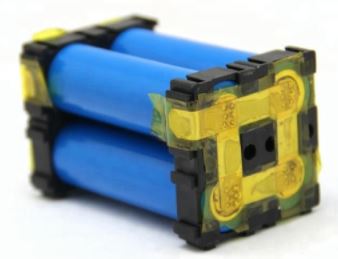
NMC (Nickel Manganese Cobalt: Li-NMC), which due to its particular composition of elements, has a high energetic mass, so it can accumulate large amounts of energy without the weight increasing in proportion. For this reason, they are mainly used for electric cars. Even are perfect, NMC batteries have significant problems as in the event of a short circuit or damage, they can fire and are difficult to extinguish. Considering that batteries of this type contain 600 to 1000 cells, a chain reaction could endanger the home. Lithium Iron Phosphate (LFP: Li-FePO₄)
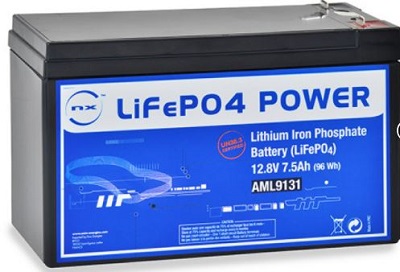
Figure 7 The market has focused on this type of Lithium Iron Phosphate (LFP: Li-FePO₄) accumulator, improving its performance, such as duration, clearing the memory effect, energy density. Today, we can detect excellent performance with a moderate temperature increase, without smoke or explosions. The cells structured in this way better resist high cell voltages applied for a long time, but have a nominal voltage of only 3.2 Volts, reducing their specific energy. What can be attributed is that this technology has a higher self-discharge current, which can cause battery balance problems with ageing. Can control the problem with special electronic devices; of course, the cost will increase. It also suffers from humidity, so it must be carefully protected. The accumulator can withstand about 10,000 discharge/charge cycles, eventually maintaining 70% of its original capacity. The cost is about 1000/1200 euros per kWh, but the prices are constantly decreasing thanks to their diffusion and technology improvement. Lithium-ion storage batteries allow them to optimize self-consumption at the highest levels:
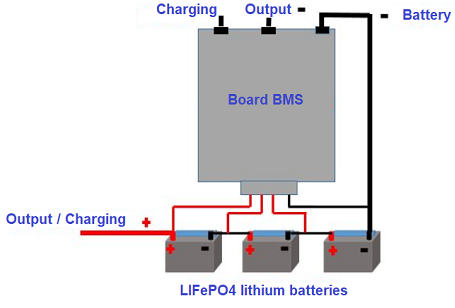
Composition of the lithium iron phosphate battery It comprises hundreds of individual cells connected to each other to obtain the capacity necessary to power the equipment in our home with the energy stored through photovoltaics. These cells are composed of two electrodes; one is in graphite while the other is in lithium-iron-phosphate (Li-FePO₄). The size is slightly larger than different types but has more excellent heat resistance. BMS (Battery Management System) The battery pack contains the cells connected in series/parallel and are usually connected to a device called BMS (Battery Management System), which allows to increase the life of the batteries and to protect them in situations that would damage them and could create dangerous situations. The BMS protects the battery from overcharging by disconnecting the cells from the charger when they reach the maximum charge voltage, maximum current, and short circuit. In these cases, they disconnect the cells from the load when one of the three conditions occurs. Consider thermal protection, which disconnects the cells when a specific temperature is exceeded, and the balance of the electric charge.
The type of BMS to use depends on both the current and the number of cells connected in series. To indicate the number of cells connected in series, enter the number followed by the letter S (1S = one cell, 2 S = 2 cells, etc.). However, the BMS is usually already included in the LIFePO4 battery pack. Differences with other lithium batteries Those that are used in computers, electric cars, smartphones are different from those used for photovoltaics. In fact, in these cases, a battery electrode is made up of Nickel or Cobalt. It is a mixture of lithium-cobalt such as nickel-manganese cobalt (NMC) or nickel-cobalt-aluminium (NCA). The performance of the latter is lower than LiFePo4 (lithium-iron-phosphate) but are still used more as they occupy less surface and are relatively light. Main features for choosing the type of battery
The need to power, for example, the microwave oven, air conditioning, etc. requires ever-higher power and the need to connect more and more powerful inverters, lithium batteries easily withstand high discharges while lead batteries, if continuously stressed, shorten their life. If you want advice on which type of battery or manufacture is better, you can contact me here on the website.
www.bennypass.it
|

+(39) 347 051 5328
Italy - Kazakhstan


09.00am to 18.00pm
About
We offer the best and economical solutions, backed by 27+ years of experience and international standards knowledge, echnological changes, and industrial systems.
Our Services
Marketing Materials


Marketing Materials1


