
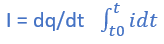
Coulomb Electric Current is the amount of electric charge that crosses a given surface in a unit of time.
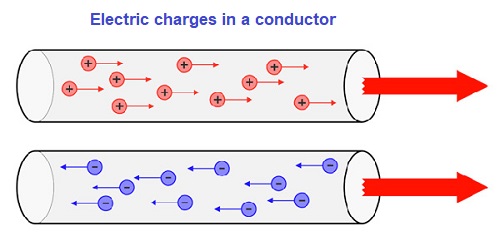
Figure 1 Figure 1 illustrates the motion of electric charges, positive (+) or negative (-), the electrons, in a conductor. By convention, the direction of the current is that of positive charges, and therefore opposite to the direction of the motion of the electrons. The intensity of the electric current is indicated with the symbol "I" and its unit of measurement is the Ampere (A). From it, we obtain the unit of measure of electric charge: the Coulomb, which corresponds to the electric charge carried from a current of one Ampere per unit of time. One Ampere corresponds to the charge of 6 billion of billion electrons (1 Coulomb) that pass through a conductor wire in 1 second 1A = 1C / 1s
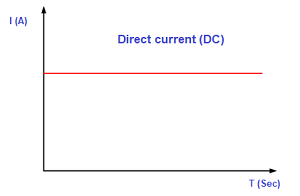
There are two types of current: The direct current whose curve is constant in time (DC: Direct Current)
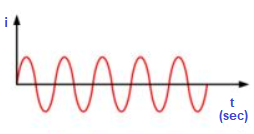
An alternating current (AC) consists of an elementary sinusoid with a specific oscillation frequency in a particular time.
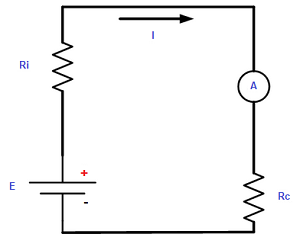
The current intensity is measured with an ammeter.
The diagram refers to an electrical circuit where an ammeter (A) is included to measure the current flowing in a circuit branch. When the current is used for the power supply of electrical devices, it is used in two possible ways: direct current, which has a constant intensity in time and has a single direction, and alternating current, which has a periodically variable intensity in the time and does not have a single direction. For calculations see Ohm law here.
www.bennypass.it
|

+(39) 347 051 5328
Italy - Kazakhstan


09.00am to 18.00pm
About
We offer the best and economical solutions, backed by 27+ years of experience and international standards knowledge, echnological changes, and industrial systems.
Our Services
Marketing Materials


Marketing Materials1


