
Short circuit and overload protection When designing a photovoltaic system, it is necessary to provide disconnection and protection devices for all installed products, even if some already have protections inside, such as the inverter and charge controller. The International Electrotechnical Commission (IEC) acknowledges that the protection of photovoltaic systems is different from standard electrical installations. This is highlighted in the IEC 60269-6 document, which defines the specific characteristics which must have available in the fuse to protect photovoltaic systems.
In general, to select fuses, for example, for string protection, even if all parameters should be considered and studied, the following criteria can be used:
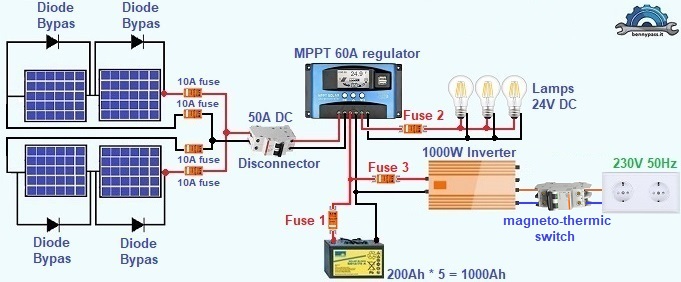
The values obtained cover most of the variations in system current and voltage. Usually, for all photovoltaic systems that have three or more strings in parallel, it is recommended for each string to protect cables and modules from faults due to overcurrent. Suppose the fuse is reduced (less ampere) according to the maximum current which can generate the module. In that case, the current itself cannot damage the modules in case of failure or short circuits (including the overload). We suggest putting them equally on both wires (positive and negative). For safety, in addition to the fuse, a disconnector is also useful that allows you to work peacefully downstream of the panels in the event of a fault.
Fuse Specifications If the strings in parallel are less than or equal to three, it could be enough for the cable size that can withstand a current at least equal to: 1.56 x Isc (Short circuit current), but as previously said, for our projects we apply the fuse for each string, which must have the following requirements:
The same requirements apply if the strings are greater than three. In our project the Isc = 6.15 A, Voc = 49.40 Volts. Therefore the fuse must have the following characteristics:
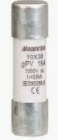
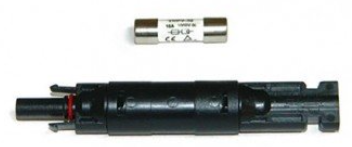
Fuses can be plugged into MP4 connectors, as the Figure 2 below
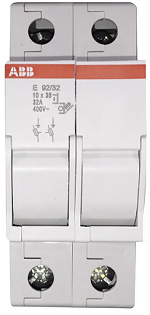
or in the fuse holder as the Figure 3 below
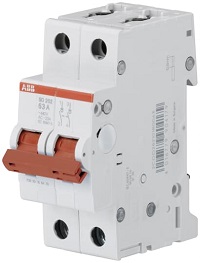
The disconnector divides the electrical system's upstream and downstream parts without the risk of unintentional re-energization and allows maintenance without risk to the installer. Consider also further protection of the equipment from overvoltages or short circuits. In our case, it is 50 A.
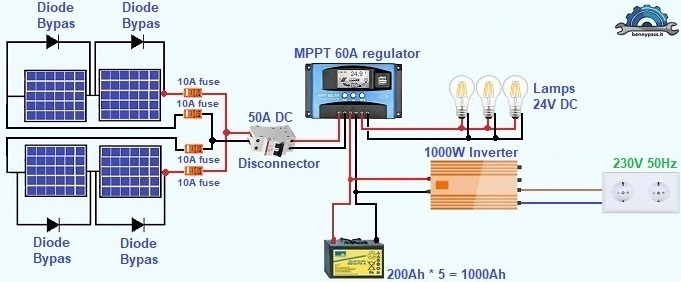
Photovoltaic generator protections As previously said, if the strings in parallel are less than or equal to three, it could be enough that the cable is sized appropriately. For safety, in our project, we would put a fuse in each string on both wires (positive and negative), which in this case they are 10 A each (see Figure 5 below)
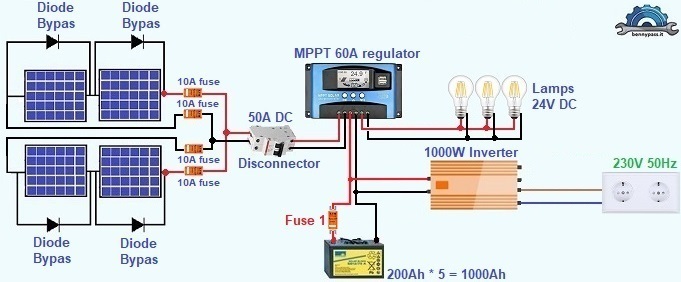
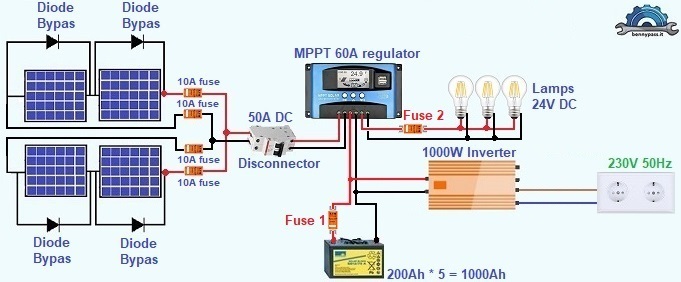
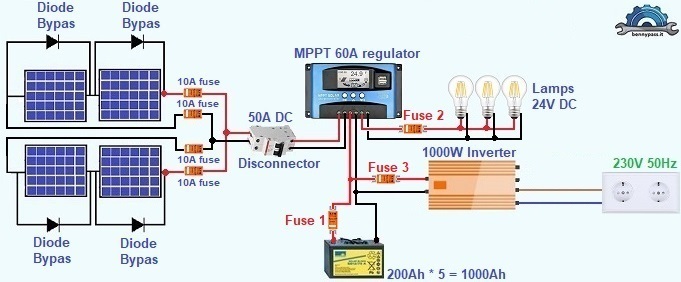
In our case, the current produced by photovoltaics is calculated using Ohm (Ω) law: I = P / V = 1000 / 24 = 41A, which we will get to 50A (see Figure 6 below)
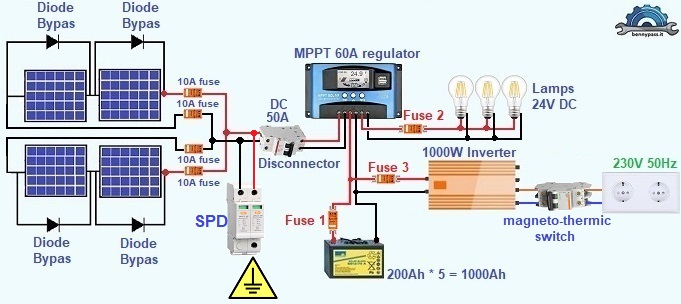
Surge arresters for medium-sized photovoltaic generators The solar panels of photovoltaic systems occupy a space proportional to the power that can be obtained. When the occupied area becomes significant, the systems are more subject to the effects of lightning strikes, especially indirect ones. Installing surge arresters for each polarity closest to the strings would be a good idea to avoid breakups. The choice of the voltage of the SPD (Surge Protection Device) on the DC side systems, which are isolated from the ground, can be calculated using the following formula: VC (SPD) = VOC STC * K In our case, the open-circuit voltage (VOC) is 49.40 Volts which multiplied by K (1.20) results in the VC (SPD) being equal to 60 Volts, and we could use the OVR PV arresters (for more details see Figure 10 below)
Note: in many photovoltaic systems, the SPD (Surge Protection Device) is not considered, or it is not calculated correctly to protect the system fully. In my opinion, the SPD is very important to protect the system fully, our projects are included more than one (for each string). For any questions, you can contact our expert here.
|


+(39) 347 051 5328
Italy - Kazakhstan


09.00am to 18.00pm
About
We offer the best and economical solutions, backed by 27+ years of experience and international standards knowledge, echnological changes, and industrial systems.
Our Services
Marketing Materials


Marketing Materials1


