
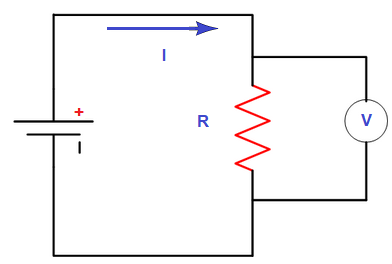
Ohm LAW (Direct Current) At constant temperature, the potential difference (V) applied to two ends of a metal conductor is directly proportional to the intensity of the current (I) which flows through the conductor.
According to Ohm's law, if R is the resistance of the conductor, V is the potential difference at the extremes of the resistance and I is the intensity of the current: the following relationships apply.
Summary table P = POWER (Watt) P = V * I (W) if I replace V with R * I we will have P = R * I² if I replace I in the formula with V / R we will have P = V² / R
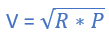
V = VOLTAGE (Volt) V = R * I (Volt) if I replace I with P / V we would have V² = R * P =
If I replace R with V / I in the formula, we will have that V = V / I * I = P / I since P = V * I
R = Resistance (OHM = Ω) R = V / I if I replace V with P / I we will have R = P / I² if instead I replace I with P / V we will have R = V / P / V and finally R = V² / P I = Current (Ampere) I = V / R if I replace R with V / I we will have V / V / I and since V * I = P we will have I = P / V; if I replace the V with R * I in the formula I = P / V we will have that: I² = P / R so:
Alternating Current (AC) For alternating current, if we use the symbolic method (which is used when dealing with sinusoidal quantities) as it is immediate and has the characteristic of formalizing the laws of alternating current circuits, and can be considered similar to those already views for direct current circuits. definitely, thanks to the use of symbolic notation, the relationship between current and voltage remains analogous to Ohm law in the direct current: V = R * I www.bennypass.it
|


+(39) 347 051 5328
Italy - Kazakhstan


09.00am to 18.00pm
About
We offer the best and economical solutions, backed by 27+ years of experience and international standards knowledge, echnological changes, and industrial systems.
Our Services
Marketing Materials


Marketing Materials1


