
Characteristics of electrical cables Choosing the right section is essential because the passage of current in the cable produces heat, and if this is not well dimensioned, it could overheat. The characteristics of the cables used for photovoltaic systems must comply with CEI 20-91.
The core of the cable is made of copper and covered with an insulation sheath and must withstand temperatures ranging from -40 degrees to +120 degrees. The wires must have a nominal voltage of 1000 Volts for AC and 1,500 Volts for DC. The cable certification is stamped on the sheath; for example, the abbreviation “PV20” certifies that the cable has a life of 20,000 hours at 120 °C. The minimum section must not be less than 0.25 mm² / A for cables up to 50 meters in length (UNEL 35023 standard). Generally, we can say that the current should not exceed 4 A / mm². So if it absorbs 40 Ampere, you need a conductor of at least 10 mm² (40/4 = 10). When designing a photovoltaic system, the standard that requires a minimum cable section of 1.5 mm² must be mandatory. In general, now let's try to understand how to get to the most suitable cable section starting from the basic concepts: Ohm's law is a fundamental electronic principle that ties together these three items of voltage: Voltage (Volt), Current (Ampere), and Resistance (Ohm) with the following formula: V = R * I By fixing a current intensity (I), we can also say that an electric cable produces a voltage drop directly proportional to the resistance R. Therefore, the greater the cable resistance, the more significant the voltage drop. Since the voltage drop is an undesirable effect, it will be our task to try to reduce the resistance of the cable to a minimum. Therefore, cable resistance increases with its length and decreases as its section increases. Below is the formula: R = K * L/S Where: K is the specific resistivity of the cable, which in Copper is equal to: 0.0175 Ohm * meter; L is the length of the cable, which is calculated in meters (m); and S is the size in mm². While the voltage drop is calculated with the following formula: dV = (K * I * Lc) / S Where: dV is the voltage drop; K is the specific resistivity of the cable, which in Copper is equal to: 0.0175 Ohm * meter; I is the current flowing through it, Lc is the overall length of the cable (outward and return) expressed in meters (m); S is the size in mm². For example, we apply the formula to a copper cable with a section of 1 mm², which flows a direct current; we will have a resistance of 0.0175 Ohm for each meter of length. So assuming you have a 1-meter long cable with a section of 1 mm², you will have a resistance of 0.0175 Ohm (0.0175 * 1/1 = 0.0175). Now let's see how to calculate the voltage drop, like our project, a 1000 Watt inverter and a 24 Volt battery bank, and a 1-meter long cable with a size of 1 mm². First, we calculate the current circulating with the formula: I = W / V = 1000/24 = 41.6 Ampere Then we calculate the Voltage: V = I x R = 41.6 x 0.0175 = 0.728 Volt (voltage drop) The power with the voltage drop will be: W = V x I = 0.728 x 41.6 = 30.28 Watt (which is the power loss), so with a copper cable of 1 meter long and a section of 1 mm², I will have a loss of 30 Watts of power. If we increase the cable size to double, the loss of power will be half (15W). Note: This parameter is essential for the design of the photovoltaic system. There are two solutions to reduce the voltage drop: either increase the section of the cables or decrease the length. In summary, to calculate the section of a cable, knowing its total length, the current flowing through it, and fixing the desired voltage drop, the following formula is applied:
Where: K is the resistivity. In this case, the copper is equal to 0.0175 Ohm * meter, S is the cable size in mm², I is the current flowing through it (in Ampere), Lc is the overall length (round trip) of the cable in meters, and dV the desired voltage drop. The table below shows the automatic calculation to find the right section of cables and also the voltage drop.
|
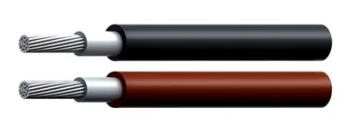 Figure 1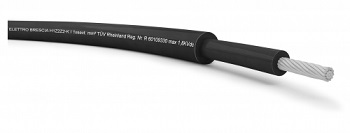



+(39) 347 051 5328
Italy - Kazakhstan


09.00am to 18.00pm
About
We offer the best and economical solutions, backed by 27+ years of experience and international standards knowledge, echnological changes, and industrial systems.
Our Services
Marketing Materials


Marketing Materials1


