
Summary with automatic calculation To calculate the Total Power (Wp - Watt Peak) of a Photovoltaic System, use the automatic calculator here. For the power size of the Charge Controller, follow the instructions on the page here.
For Inverter size, see the appropriate page here. We have described how to start independently producing a small solar energy self-production. These autonomous photovoltaic systems, even if limited in energy availability, are a personal experience that will still contribute to improving the environment by producing less CO2. These clarifications on small battery-powered photovoltaic systems should not be perceived as a waste of time and money or a whim but as a motivation to continuously and constantly improve energy "performance" and save in terms of money. For the future, as you will see in the following examples, you will be able to increase the number of solar panels and batteries, increase the power of the inverter and charge controller with the result that will decrease the dependence on the national grid, and also supply them with unnecessary energy, and also reducing more the environmental impact due to the use of energy produced from polluting sources by the national company. Hybrid inverter for stand-alone photovoltaic systems The hybrid inverter is an "expanded" photovoltaic inverter that converts direct current into alternating current and manages and coordinates electricity flows from the photovoltaic, battery, national grid or UPS. This computer handles just about everything in a solar energy system. It provides any data about solar panels, including issues if they exist.
There are different types of hybrid inverters for off-grid photovoltaic systems. Let's see some of them.
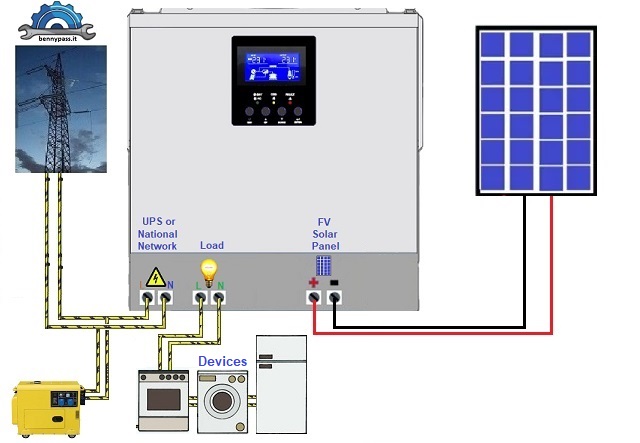
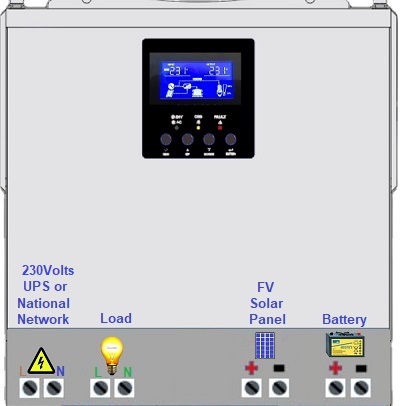
All-in-one hybrid inverter They are pure wave inverters with an Inverter, charge controller (PVM or MPPT), mains battery charger, and UPS function. This inverter can connect the Solar panels, the batteries, the load, and the power grid or the UPS, all on a single machine. Example: The hybrid inverter can power the loads by drawing the energy directly from the photovoltaic system and in the event that the electricity coming from the photovoltaic system is not sufficient, the inverter will take it from the batteries, or switch to the electricity grid, or to a generator. For more details see the figure below.
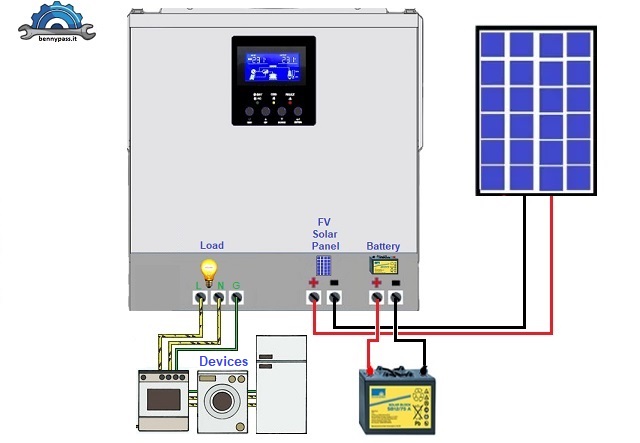
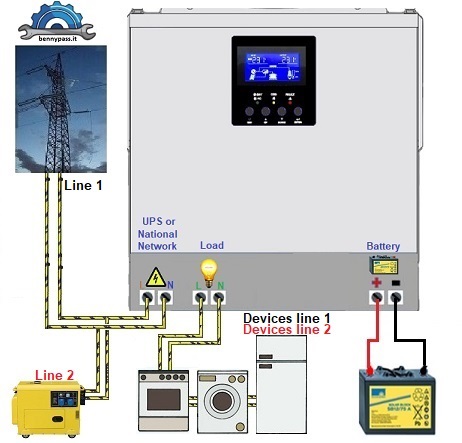
Off-grid operation The hybrid inverter is one of the best solutions for building an off-grid photovoltaic system in areas with no national grid. This device contains the inverter and the charge controller inside. In this mode, it is necessary to connect the batteries to the inverter in order to provide energy when it is not generated by the photovoltaic. See Figure 4 below
Hybrid inverter without battery The peculiarity of this solar hybrid inverter is that it can work even without BATTERY, but it is essential that both the photovoltaic solar panels and the national grid or a generator are connected to the inverter. See Figure 5 below
Operation as a backup of the line To avoid disruption due to an interruption of the power line, you can program the inverter as a UPS. Switching from the mains to the batteries takes a few milliseconds, thus avoiding switching off the loads. See figure 6 below.
Sizing of our project with the hybrid inverter
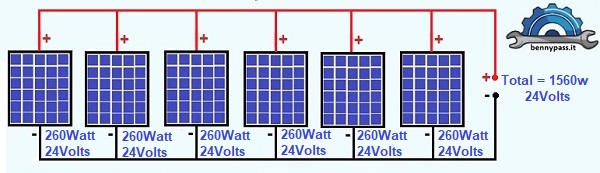
The same project seen above will be carried out with a hybrid inverter. The values will be the same:
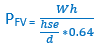
We calculate the power of the photovoltaic panels with the following formula:
Hybrid Inverter Sizing In general, the rated power of the hybrid inverter must be consistent with the number of panels and strings that you want to install. For example, if we had six panels, each one with 100 watts, the nominal power of the photovoltaic system would be 600 Watts, so we should choose an inverter that supports a nominal DC power from the photovoltaic at least 800 Watts. General criteria for choosing the photovoltaic modules to be connected to the inverter:
The efficiency of the photovoltaic panels is enhanced if the voltage of the photovoltaic system approaches the optimal Vmp of the charge controller inside the hybrid inverter. To calculate the size of the photovoltaic field, this method could be used: A maximum number of panels per string:
Where: Vmp PV panel = Maximum power voltage (nameplate value of the photovoltaic panel); Optimal inverter Vmp = Inverter working voltage. To know the maximum number of strings in parallel:
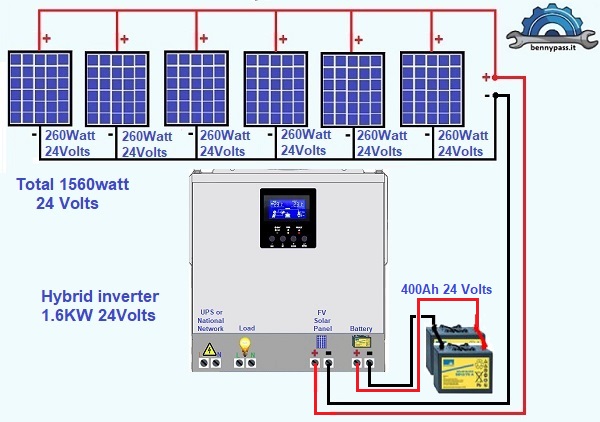
Where: Imp = current at a maximum power of the PV panel. Example: if we had a 1.6 kW inverter; Max input current = 50 A; Nominal voltage = 24 Volt; Working voltage = from 30 to 32 Vdc; Voc = 60 Vdc. Therefore the Voc of the photovoltaic field should not exceed 60 Vdc, while the Vpm of the photovoltaic field must be between 30 Vdc and 32 Vdc, the panel having the characteristics as below: Photovoltaic panel of: 260 Wp; Imp = 8.42; Vmp = 30.9; Isc = 8.89; Voc = 37.7 The maximum number of panels per string will be:
The maximum number of strings in parallel will be:
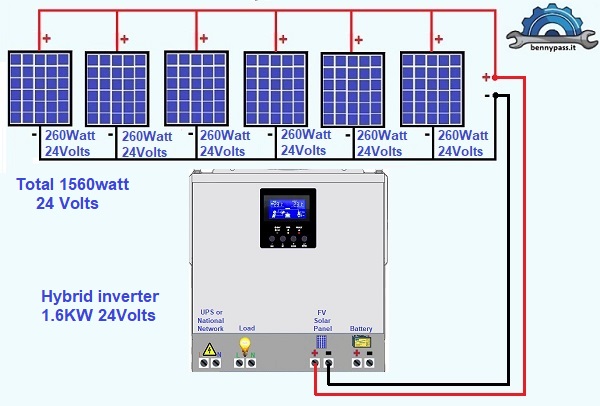
So the sizing should be:
The panels will be connected to the hybrid inverter.
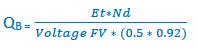
Now we will have to calculate the capacity of the batteries and use the following formula:
Where: QB = battery capacity in Ah; Et = consumption in Wh; Nd = number days of use; Photovoltaic voltage; 0.5 = depth of discharge; 0.92 = efficiency So I will insert as Et = 1700 Wh, as photovoltaic voltage: 24Volt, and days 3, 0.5: since the batteries are lead-acid or lead gel batteries, they will be discharged to 50%, 0.92 = 92% efficiency.
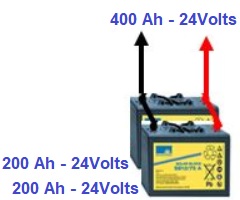
462 Ah, which we will increase to 400 Ah by paralleling two lead gel batteries of 200 Ah-24 Volt.
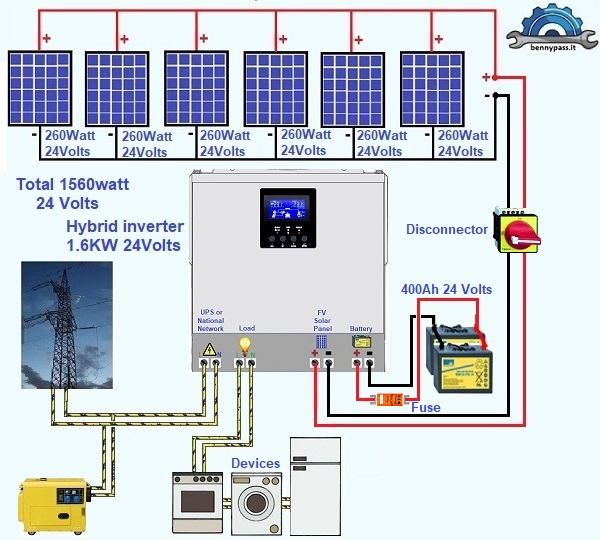
Connection batteries to the inverter:
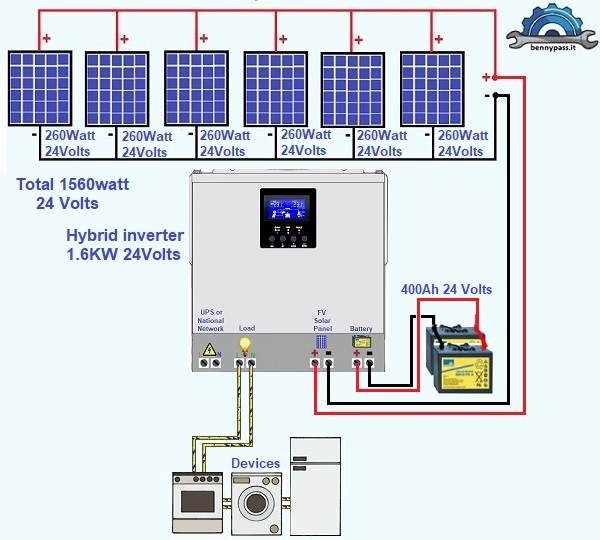
Hybrid inverter with the load connected:
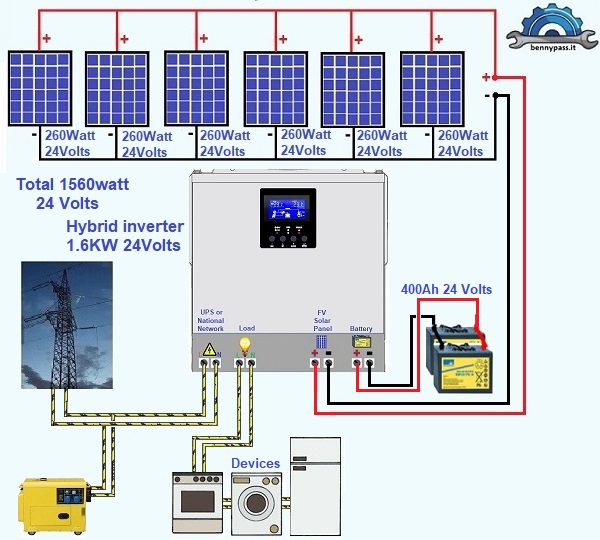
Hybrid inverter with backup on the generating set or with the electricity grid:
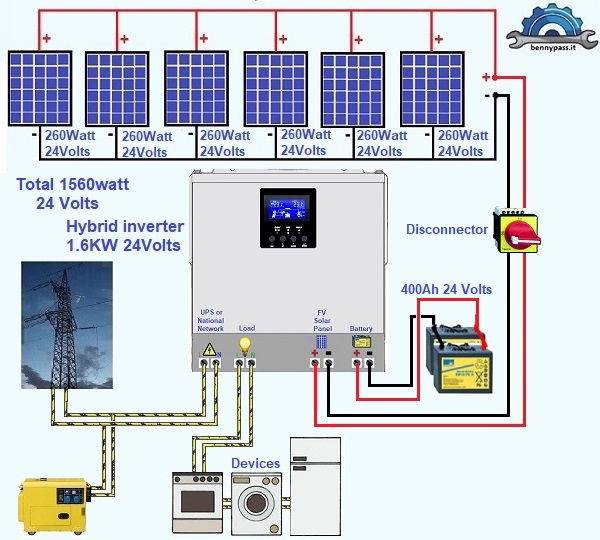
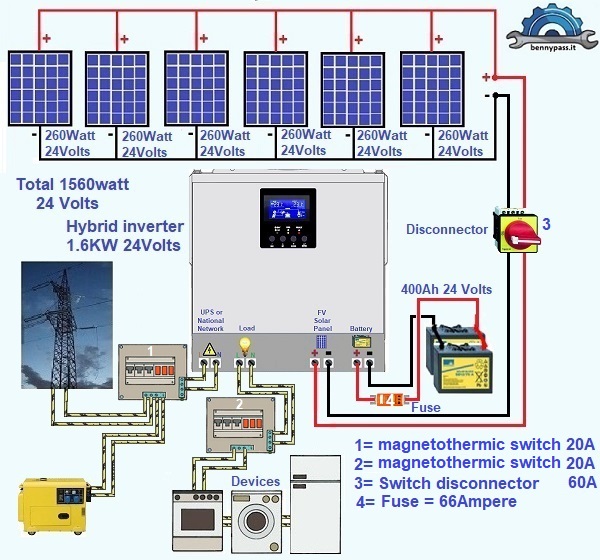
Protections
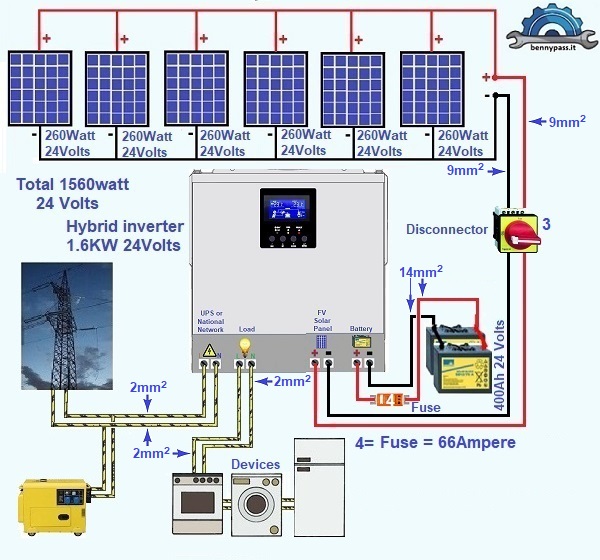
Cable size The cables size that connects the inverter to the battery is recommended at least 14 mm²; the cables between the photovoltaic and inverter should be 9 mm² to cover a current of 50A; the cable connection to the national grid should be at least a size of 2 mm². For Automatic Cable Size Calculator click here.
Another essential thing is the current and voltage discharger in the event of an overload. SPD (Surge Protective Device). This is another crucial thing. For more details, click here
|
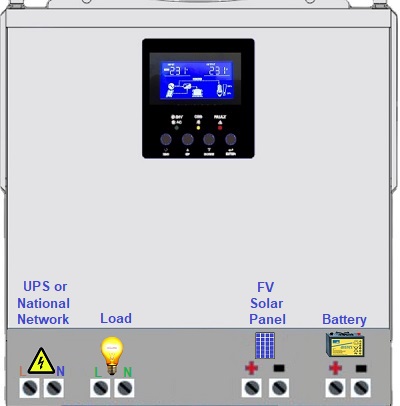 Figure 2 - Hybrid Inverter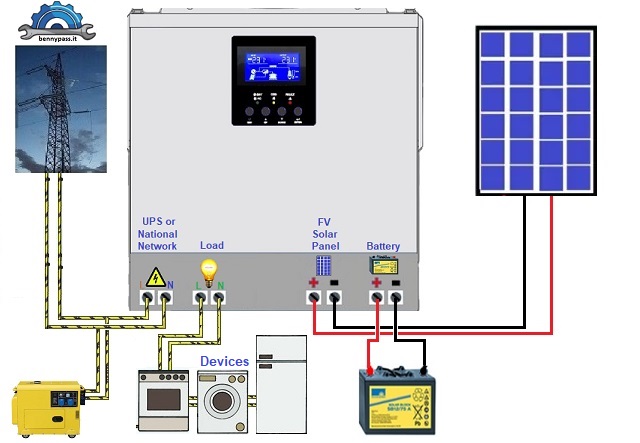








+(39) 347 051 5328
Italy - Kazakhstan


09.00am to 18.00pm
About
We offer the best and economical solutions, backed by 27+ years of experience and international standards knowledge, echnological changes, and industrial systems.
Our Services
Marketing Materials


Marketing Materials1


