
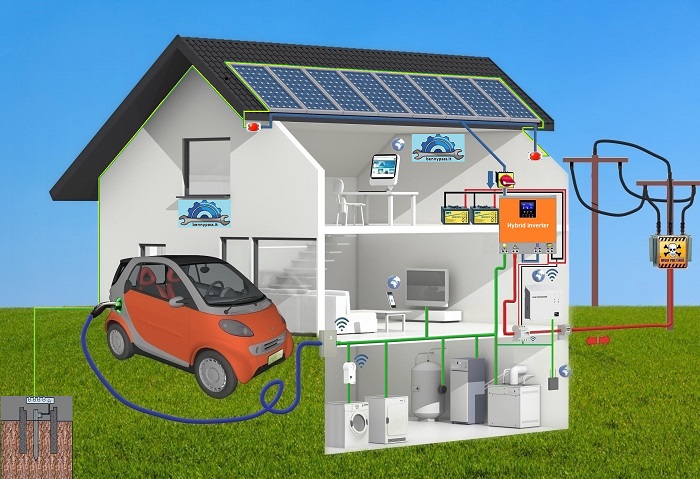
Management of the photovoltaic system with different orders of priority The energy produced by the solar panels will be managed with different orders of priority:
Figure 1
Connecting the FV panels installation to the electricity grid to sell electricity By following my instructions step by step, you will be able to design a photovoltaic system and, if you want, could independently purchase the photovoltaic panels, the support structures, the inverter, the Charge Controller (if with accumulation), and the wiring, which you will make available to the technician who will carry out the installation, reducing the overall cost without sacrificing quality, or create a comparison with the quote that the companies offer you. I always recommend that you install the hybrid inverter. For any help, send an email on the website here Before moving on to the configuration and calculation of the photovoltaic system in self-consumption, I would like to clarify. There are at least three reasons for changing the energy with PV panels
To get an idea of the years needed to balance the energy used and cost, you can see the examples below: Energy gain point (payback) = Energy produced / Energy saved (years) Generally:
Another data is the amount of energy that a photovoltaic system produces compared to the energy used in the production phase.
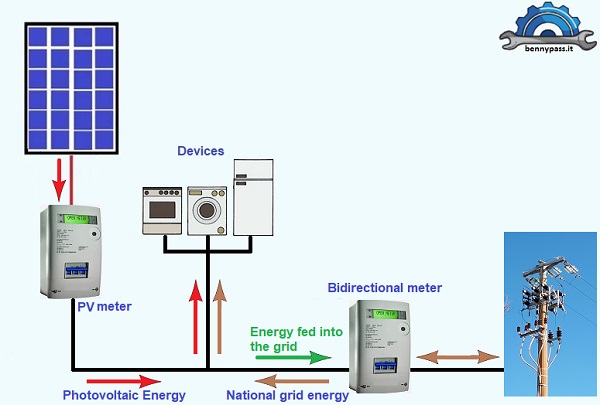
Therefore, self-consumption should always be convenient. I say that because if it does not happen, it could be due to incorrect installation. An FV system made satisfactorily should be at first the immediate use of self-produced electricity, and only the one which one not needed should be placed on the network, but if, for example, all the energy produced was mistakenly put on the network and then take it back instantly when is required from the devices, this would be counted by the bidirectional meter in both direction input and output. Since the one withdrawn from the electrical network costs is more than the one placed on the network, it could nullify the savings. Therefore, as mentioned above, the user must consume first of all the self-produced energy, and only when it is not available from FV panels, withdraw it from the national grid, while when the user does not need to use power or is in abundance: then it's possible to send it Network. Figure 2 above shows the correct layout of the system, as it allows the self-consumption of self-produced energy before it is fed into the grid, and the correct positioning of the electricity meters (photovoltaic energy meter and bidirectional meter) which allows the correct count of self-consumed energy, the fed into the network, and energy which is taken from the network. How to calculate self-consumption Self-consumption = total energy produced by photovoltaics - energy fed into the grid Formula to calculate the savings on your bill: Bill savings (€) = self-consumption in kWh x 0.25 (€) (0.25 is an average gross price of energy in the bill which I have taken as reference). Example:
For more information click here www.bennypass.it
|

+(39) 347 051 5328
Italy - Kazakhstan


09.00am to 18.00pm
About
We offer the best and economical solutions, backed by 27+ years of experience and international standards knowledge, echnological changes, and industrial systems.
Our Services
Marketing Materials


Marketing Materials1


