
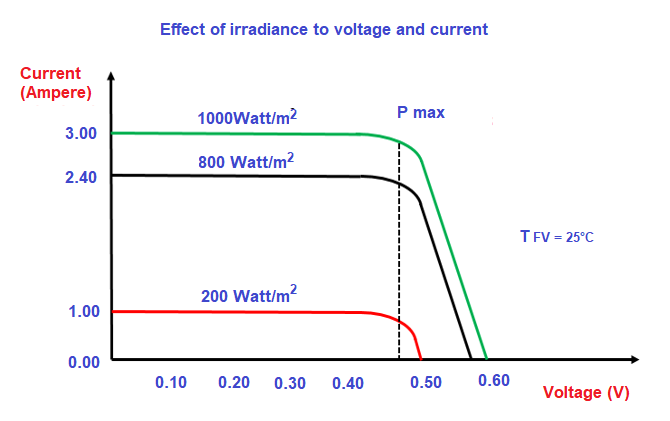
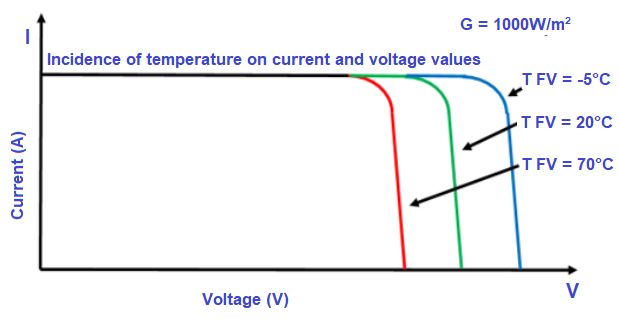
Characteristics of the photovoltaic cell and performance In general, the characteristic of a photovoltaic cell is a function of three variables: intensity of solar radiation, temperature, and cell area, while the physical quantities are: the voltage, measured in Volts, the current measured in Amperes, and the irradiance measured in W / m². The maximum power of the device is determined by the product of voltage and current (P = V * I).
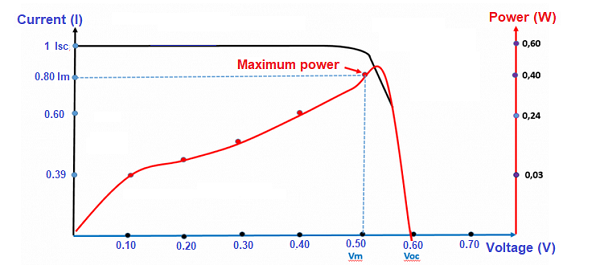
In short circuit conditions (Isc), the current is maximum, while in open circuit conditions, the voltage (Voc) is maximum. Therefore, in the conditions of Voc and Isc the Power is zero (P = V x I) since, in one case or another, one of the factors is zero.
In the other section, as the voltage increases, the power increases, reaching the maximum and drastically decreasing when it reaches the Voc
STC (Standard Test Condition) In order to have identical references for all manufacturers, the power of the photovoltaic panels is calculated under the STC conditions (Standard Test Condition), i.e. an irradiance of 1000W / m², with a temperature of 25 ° C, spectral distribution = 1.5. VOC (Voltage with Open Circuit) This means the maximum voltage of a device under certain light and temperature conditions, corresponding to the maximum potential voltage (when the circuit is open). ISC (Short-circuit current) This means the maximum current produced by a device under certain light and temperature conditions. VPM (Voltage at maximum power) This means voltage which translates into maximum power under certain light and temperature conditions. The Maximum Power in a photovoltaic system is given by: Pmax = Imp x Vmp (Wp) Where: Imp = Current resulting at maximum power; Vmp = the Voltage which translates into Maximum Power. In short circuit conditions, the generated current is maximum (Isc) while the voltage is maximum with the open circuit (Voc). Therefore, in the open or short circuit conditions, the power is zero, as P = V * I the current in the first case and the voltage in the second will be zero. In summary, once the operating voltage and current values are known, it is possible to know the power which delivers the generator by using the equation P = V (Volt) * I (Ampere) = Watt Nominal, or maximum, or peak, or plate power of a photovoltaic panel The Nominal, or Maximum, or Peak, or Plate Power (Wp) of the photovoltaic system is the system's electrical power, determined by adding the individual nominal, or maximum, or peak, or plate powers of each photovoltaic module belonging to the same system, measured under Standard Conditions (temperature equal to 25 ° C and radiation equal to 1,000 W / m², and with Air Mas AM1). AM - Air Mass: The solar radiation, which reaches the earth's ground, must pass through an atmospheric air mass that is minimal when the sun is at its Zenith and as it increases as the sun lowers on the horizon. AM0 (Air Mass 0) is the density of solar radiation beyond the atmosphere (1.353kW / m²). AM1 is the density of solar radiation on the earth's soil at noon, at perfectly clear day (1kW / m2). AM1.5 indicates the radiation density in the STC tests (Standard Test Condition). In order to have identical references for all manufacturers, the power of the photovoltaic panels is calculated at the STC conditions (Standard Test Condition), which means irradiation of 1000W / m², the temperature of 25 ° C, AM1 = 1.5. The Nominal or Maximum, or Peak, or plate Power, is the point of maximum power, which we will indicate with Pmax = Imp x Vmp (Wp) where: Imp = Current resulting at maximum power Vmp = the voltage at maximum power. Another parameter is the Filling Factor (FF), defined as the ratio between the maximum extractable power from the cell and the product between Voc and Isc (FF = Pmax / Voc * Isc) Irradiance: the global average horizontal value found on the ground in Central Italy is equal to 180 W / m², 160 W / m² in Nord, and 200 W / m² in South Italy). The Nominal or Maximum, or Peak, or Target Power is in peak Watts (Wp). Pmax = Voc * Isc * FF η = Voc x Isc x FF / Pin (input power) η (%) = efficiency of the photovoltaic cell in STC conditions which vary according to the different types. The Nominal or Maximum Power, or Peak (measured in Wp), at SCT conditions is difficult to achieve in real operating conditions, so is measured in the laboratory. Performance of the photovoltaic panel The performance of a photovoltaic panel is the amount of solar energy that a panel is able to convert into electricity per unit of surface, and it is always the maximum yield under the STC conditions mentioned above. Calculating the efficiency of a photovoltaic panel is relatively simple, knowing the peak power and the dimensions (the maximum size of the module). For the simplified calculation, the following formula can be used: Efficiency% = (Power / Surface / 1000) * 100 Power: means the peak power Wp expressed in Watts, the surface is the panel's surface in m² including the frame (base * height), 1000 is the irradiation of 1000W / m², 100 is used to obtain the efficiency in percentage. If the peak efficiency of the panel is 19%, this means during daylight with ground irradiation of 1000W / m2 and a temperature of 25 ° C, our panel will convert 19% of solar radiation into electricity. You can find the dimensions and peak power you can be found on technical datasheets of solar panels, or the labels themselves. Note: We are only talking about the peak efficiency at STC conditions (Standard Test Condition) and how to calculate it. We are not talking about the productivity of photovoltaic systems, which depends on more complex calculations. We can also say that if there are no space problems, the panel's efficiency is important data, while it must be considered much more important when it is necessary to create systems with the maximum possible power in the available surface. In this case, the peak power per unit cannot be neglected.
www.bennypass.it
|

+(39) 347 051 5328
Italy - Kazakhstan


09.00am to 18.00pm
About
We offer the best and economical solutions, backed by 27+ years of experience and international standards knowledge, echnological changes, and industrial systems.
Our Services
Marketing Materials


Marketing Materials1


