
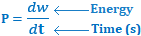
Electric power in direct current Power measures the speed of energy emission at a specific time and is measured in Watts. P=dw/dt Where: dw is the Energy (joule); dt is the time in seconds Now let's see how we arrive at the formula of power: The intensity of the electric current is an indication with the symbol "I", and its unit of measurement is the Ampere (A). From it, we obtain the unit of measure of electric charge: the Coulomb, which corresponds to the electric charge carried from a current of 1 ampere per unit of time. One Ampere corresponds to the charge of 6 billion of billion electrons (1 Coulomb) that pass through a conductor wire in 1 second. 1A=1C/1s
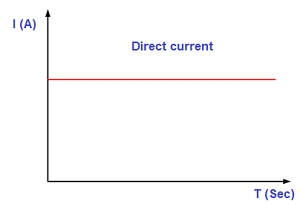
Remember: P = W / t P = dW / dt Power = work/time W = ΔV q and I = q / t P = I V There are two types of current below the details: Direct current DC Direct current is a type of electric current characterized by a flow of constant intensity and direction in time.
In a direct current, electrons always flow in the same direction within the circuit, so they will continuously rotate/circulate in the same direction. In a direct current system, unlike an alternating one, it is essential to respect the direction of the current, that is, the polarity. In fact, there is a positive and a negative pole in the batteries, which must be correctly connected to the load.
Direct current is more used at low voltage in electronics, especially in equipment powered by cells and batteries, which are capable of generating only direct current (Ohm's law).
The direct current (DC) whose curve is constant in time.
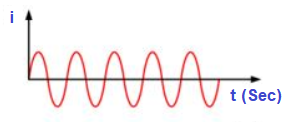
Alternating current AC The second is "alternating current" (AC), whose curve is an elementary sinusoid with a particular oscillation frequency in time.
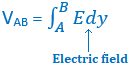
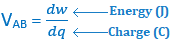
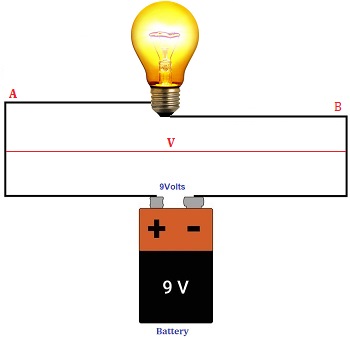
The Voltage The voltage or potential difference is the energy per unit of charge. It is measured in Volts (V) 1V=1J/1C
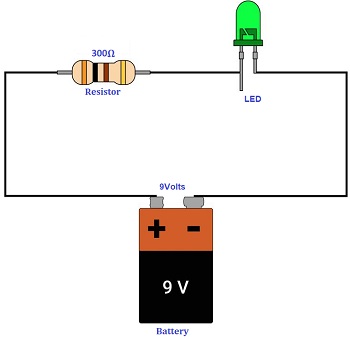
The work is provided by an external source of electromotive force (emf) represented by a battery.
Figure 3
If we operate on the formula P = dw / dt and the definitions are seen above (I = dq / dt and V = dw / dq) we obtain the formula that relates the Power to the quantities V and I: P = dw / dt = (dw / dq) * (dq / dt) = V * I = Watt
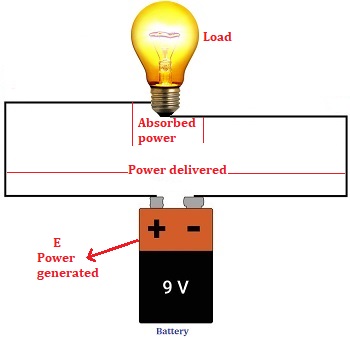
How is it calculate The Power of an electrical device is the product of its Voltage and Current and is indicated with the letter "P" and is calculated using the formula: P = V * I Where: P mean Watts (W), V is measured in Volts, and I is measured in Ampere (A). For the principle of energy conservation: the sum of all the powers delivered is equal to the sum of all the absorbed powers plus the dissipated powers. Convention means: the electrical power produced inside a generator is called power generated; the power at the generator output terminals is called the power delivered, and the power at the user terminals (load) is called the power absorbed.
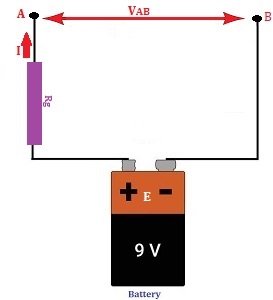
performance The generator's efficiency: is the ratio between the generator's power delivered at its terminals and generated.
Rg = internal resistance of the generator (E) and it is calculated with the following formulas Power Delivered = PD = VAB * I = Watt Power Generated = PG = E * I = Watt We will have that the Return is equal to: ηg = PE / PG = VAB * I / E * I = VAB / E
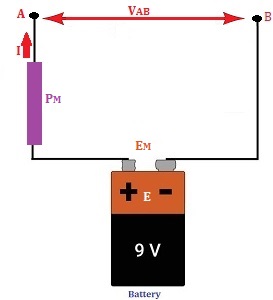
By carrying out similar reasoning, the efficiency of an engine is given by the ratio between the electrical power used and that absorbed. ηm = P / Pm = Em * I / VAB * I = Em / VAB Therefore the efficiency of a line is given by the ratio between the power available at the end of the line and that supplied at its beginning.
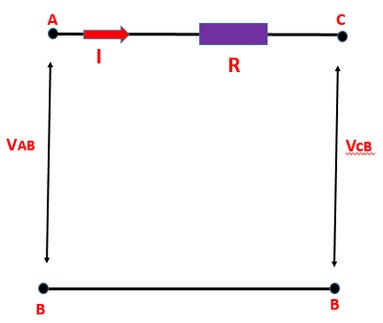
ηm = VCB * I / VAB * I = VCB / VAB The power transfer efficiency from a generator to a user is given by the ratio between the power transferred to the user Pu and that generated Pg by the generator: η = Pu / Pg Joule effect In summary, the Joule effect is the obstacle that faces the current when it crosses a conductor. The electrical connections constantly absorb power and transform it into heat due to the Joule effect. This is the lost power or dissipated power. If the current and resistance in a conductor are known, it is possible to calculate the power dissipated in heat by the Joule effect with the formula: Pj = R * I2 Resistance: the absorbed electrical energy is transformed into heat. The most used unit of thermal energy is the Kilocalorie (kcal) which represents the energy that must use in order to raise 1 kg of water the temperature by 1 ° C (from 14 ° to 15 °). The kilocalorie corresponds to 4185 J. Formula: 1kW = 3.6 * 10⁶ J / 4185 = 860 Kcal Energy The Energy absorbed by a device or delivered by a generator results from the Power (P) in time (t). If the power is calculated in watts and the time in seconds, the Energy is calculated in joules (J). Therebefore, Energy is almost always calculated in multiples of the joule, and the most used is the kWh (kilowatt-hour) which represents the power of 1 kW delivered for the time of one hour. Below formula how to calculate it: E = P * t (kWh) 1 kWh = 1000 Watt; 1 hour = 3600 sec; so: 1 kWh = 1000 W * 3600 sec = 3.6 * 10⁶ J
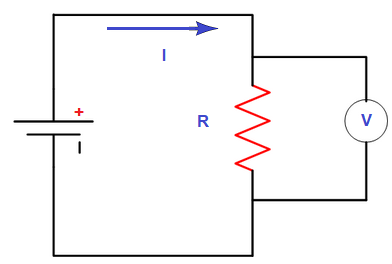
Ohm LAW (Direct Current) At constant temperature, the potential difference (V) applied to two ends of a metal conductor is directly proportional to the intensity of the current (I) which flows through the conductor.
According to Ohm's law, if R is the resistance of the conductor, V is the potential difference at the extremes of the resistance and I is the intensity of the current: the following relationships apply.
Summary table P = POWER (Watt) P = V * I (W) if I replace V with R * I we will have P = R * I² if I replace I in the formula with V / R we will have P = V² / R
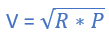
V = VOLTAGE (Volt) V = R * I (Volt) if I replace I with P / V we would have V² = R * P =
If I replace R with V / I in the formula, we will have that V = V / I * I = P / I since P = V * I
R = Resistance (OHM = Ω) R = V / I if I replace V with P / I we will have R = P / I² if instead I replace I with P / V we will have R = V / P / V and finally R = V² / P I = Current (Ampere) I = V / R if I replace R with V / I we will have V / V / I and since V * I = P we will have I = P / V; if I replace the V with R * I in the formula I = P / V we will have that: I² = P / R so:
www.bennypass.it |



+(39) 347 051 5328
Italy - Kazakhstan


09.00am to 18.00pm
About
We offer the best and economical solutions, backed by 27+ years of experience and international standards knowledge, echnological changes, and industrial systems.
Our Services
Marketing Materials


Marketing Materials1


