
Photovoltaic system connection with storage and national grid The system with storage for EU laws is a set of devices capable of absorbing and releasing electrical energy that operates continuously in parallel to the distribution network or is able to produce an alteration of the exchange profiles with the network itself, such as input and withdrawal even if it is determined by voluntary disconnections/reconnections of a part; or the whole system. The main components in a system with electrochemical storage are; the batteries, the mono or bi-directional energy conversion equipment, the protections, interruptions and disconnection in direct and alternating current, the battery control systems, and the converters. Types of photovoltaic systems admitted by the EU laws The production side storage system Monodirectional (the batteries are charged only with photovoltaics) is connected only to the direct current side. This configuration can be installed on the existing photovoltaic or a new one. The production side storage systems are located between solar panels and inverters, although the new inverters are available in the market with integrated battery control.
Bidirectional accumulation system. The storage system can absorb energy from both directions (from the inverter or the national grid). Can recharge the batteries via the photovoltaic system or the national grid. In this case, the storage system is installed in the alternating current part. It can use on existing systems without modifying the solar system or the existing inverter. In this example, there are two different inverters: one connected to the photovoltaic and a bidirectional inverter connected to the batteries. In this case, the theoretical sum of the photovoltaic would be the sum of the two generators. Figure 2 below shows exactly this. Production side accumulation system. The storage system is installed between the photovoltaic system and the energy meter produced. It can be installed in the direct current part of the system. The production meter must be bidirectional (see Figure 3 below).
Post-production accumulation system. The storage system is installed between the energy meter produced and the energy exchanged. If the recognition of economic incentives is needed, an additional meter (3) must be installed, and meters 1, 2, and 3 must be bidirectional (see Figure 4 below)
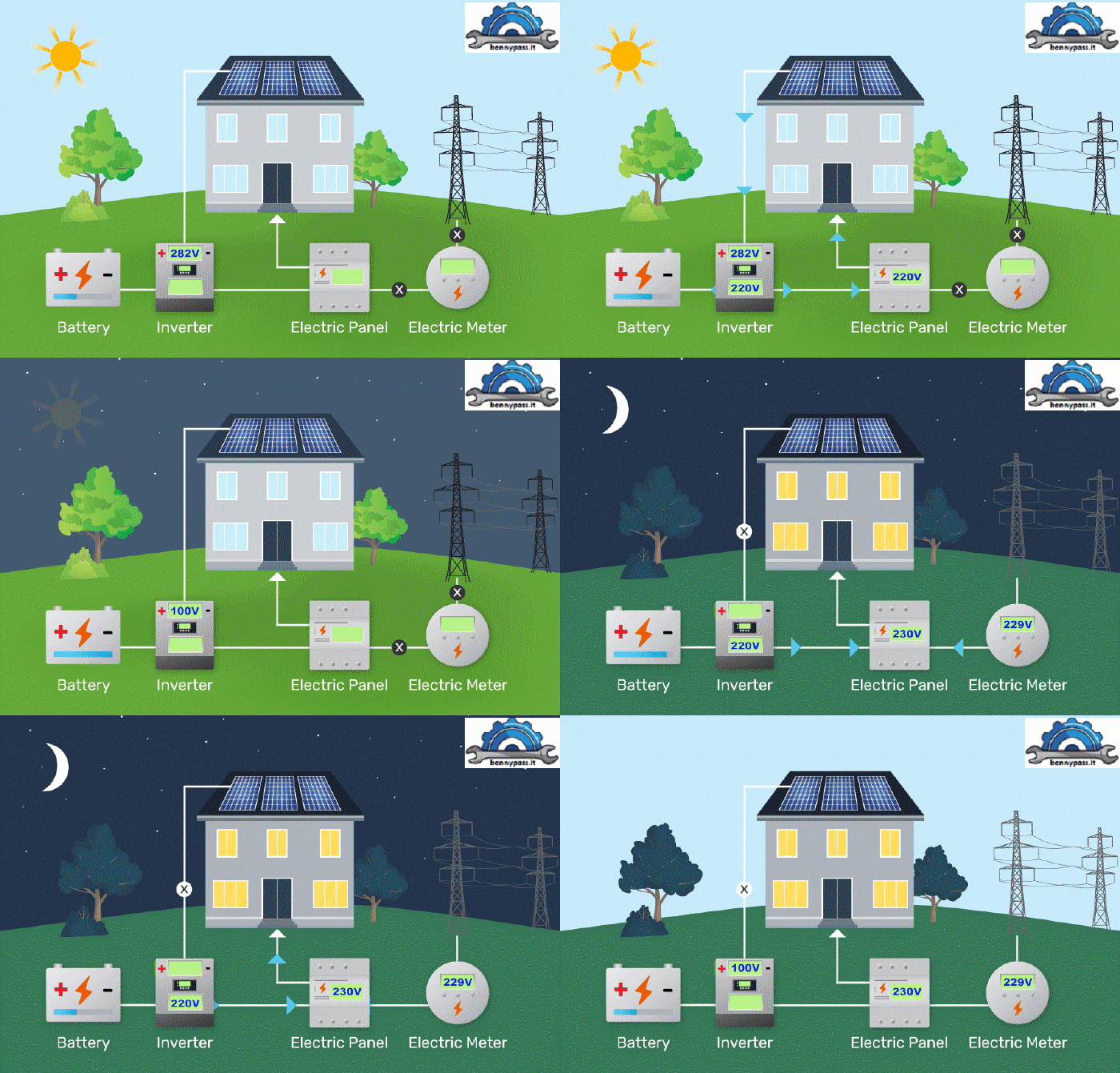
There are integrated systems on the market that can add to the existing system without significantly modifying it, and the batteries are recharged by the current coming from the inverter. The disadvantage is that working on the AC side, so requires a double conversion (AC to DC and DC to AC), lowering the system's overall efficiency. The various systems The systems with storage that can be found on the market, in general, are of three types: on-grid, which is always connected downstream of the production side; on-grid, always connected before the production side network; and off-grid (island), which are not connected to the electricity grid. On-grid on the Production side (upstream of the production meter) Those always connected to the production side network (on-grid) have the inverter that controls the batteries pack and privileges the energy produced by the photovoltaic to power the utilities (TV, router, refrigerator, etc.) also charge the batteries when the energy produced is in excess. Usually, follow this logic: During the day, the energy produced is sent towards the loads active at that moment (TV, router, refrigerator, etc.). Figure 5 below shows this
The excess energy production is used to charge the batteries (see Figure 6 below).
When the batteries are charged, if there is still excess energy, the inverter feeds it into the grid (see Figure 6 below).
When the system no longer produces energy due to a lack of sun (for example, at the end of the day), the inverter automatically takes the energy from the batteries pack and directs it to the device active at that moment (see Figure 8 below)
When the batteries are flat and the user needs additional energy, it takes it from the national grid (see Figure 9 below)
This system uses every kWh produced by the photovoltaic system and feeds only the excess energy into the grid. This system is the most advantageous of all. On-grid (downstream of production meter) They are used in traditional photovoltaic systems (modules + inverters), a new installation or already installed, where another inverter with different characteristics forms an apparatus. The battery pack is connected downstream of the production meter. As a system, it is less effective than the on-grid one as the energy used by the loads undergoes a first transformation from the photovoltaic inverter: from DC to AC, then sent to the battery pack through the second inverter, which transforms the AC into DC, and finally made available to devices with a new transformation from direct to alternating (see figure 10)
Off-grid systems (Island) They are "island" systems not connected to the electricity grid, as seen above previously (see Figure 11 below).
Accumulation systems Two storage systems can be used in On-Grid systems:
Batteries Photovoltaic batteries are distinguished by the material used, efficiency, and costs; and we could divide them like this:
To choose the one that best suits our system must be considered three elements:
In photovoltaic systems, the most used categories are lead-acid and lithium. Accumulation on the existing system (on-grid) production side To increase the self-consumption of solar electricity generated by a residential photovoltaic system is to have a storage system. As the "Exchange on the spot", that is the mechanism that transforms the energy fed into the grid into an economic value that can be estimated between 50 and 70% of the gross cost of electricity taken from the national grid (Italy), which ranges from 0, 20 to 0.30 euro / kwh, so it guarantees a much lower economic value than that absorbed by the photovoltaic system, for this reason, it is important to reduce as much as possible the exchanges of electricity to and from the grid. The accumulation of energy can be an effective solution. Suppose there is a surplus in the production (photovoltaic side). In that case, a battery system can store the solar energy produced that is not consumed during the day, including the energy used for household appliances in operation. The inverter charges the batteries with unused energy immediately, and this can be used when needed, for example, in the evening or early morning.
Let's take the photovoltaic system as a reference in figure 14, which is connected to the electricity grid without storage (batteries). I decided to add the battery pack on the DC side. We need to calculate the nominal power of the new system as the minimum value between the inverter power and the sum between the value of the STC photovoltaic and the nominal power of the storage, which must refer to the Europe law (in Italy is CEI 0-21). The connection can remain single-phase as the PIR (Power Input required) will not be changed. It must be reviewed if should be replaced the existing inverter because it does not match European law or CEI 0-21 Italian Standard (purposes of grid services). To be sure that the emission power requested by the distributor has not been exceeded, the monthly data of the maximum power recorded in emission should be analyzed or through the installation of an automatic power limiter inserted in the meter. From a regulatory point of view, it can be accepted that the total emission power temporarily exceeds the available emission power value (equal to the PIR), possibly causing the intervention of the automatic emission power limiter inserted in the meter. Example of energy balance on an existing photovoltaic system Choice of the storage system: to size a storage system, it is always to start from the total electricity consumption by consulting the bills of the last 12 months, considering the different consumption time bands: F1, F2-F3, and then to outline the profile of the own consumption. Generally, the annual electricity consumption per person for domestic use is about 1000 kW. If you have difficulties, we recommend the help of a specialized technician to evaluate, or you can contact us via email here, and somebody will answer you If you already have a photovoltaic system, must be analyzed the following data:
Sizing From figure 15 below, we can see that the part that exceeds the energy produced by photovoltaics during the hours of sunshine can be stored and then used during the evening and night hours, in this case minimizing the energy exchanged with the grid.
Note: Figure 15 represented a theoretical and not a real scenario. The monthly and daily consumption trend of a home is very different from a regular curve but instead presents peaks that vary from day to day which is difficult to predict. The solar source is also theoretical: sunny days alternate with cloudy or rainy ones, with variations even on the same day. There is also a seasonal problem. For example, a photovoltaic system with 2.5 kW of power can produce in northern Italy in a year, about 2800 kWh, as seen above about 2400 kWh per year, so even more than the requirement. Unfortunately, it is not like this, as the energy produced by the PV system in the summer months is higher than that generated by the same system in December or January. Suppose we assume that the monthly electricity consumption is stable (during the year) and increasing in the winter and summer months. In that case, we would almost always find ourselves managing abundant production in summer and insufficient in winter. Real example In an apartment with two people without heat pumps for heating and cooling, the average consumption can be estimated at a good approximation of 2500 kWh / year. If I want to opt for a photovoltaic system, I will use the formula:
Now let's see the actual monthly consumption and the production of the photovoltaic system as a function of solar radiation (Northern Italy as reference) Solar radiation on a 30 ° inclined surface in northern Italy
Annual global radiation on the inclined surface: 1562KWh/m2 (Conventional year of 365.25 days) These are the starting values for building a perfect photovoltaic system. To derive the monthly photovoltaic plant production, I will use an "empirically" but reliable formula for calculating the photovoltaic power. KWh / month = PPV * h (monthly radiation = equivalent days) * 30 days * K (0.8 = system losses) Example: Month of January: kWh / month = 2.5 * 2.54 * 30 * 0.8 = 152.4
Figure 16 below shows the graphic with all details
Suppose we can record the annual consumption with photovoltaic power, 2.5 kW. In that case, you can see that the production is slightly higher than the requirement. At the same time, on a monthly basis, things are different: from October to February, the requirement is higher than the production and it becomes more evident we consider a daily basis. For example, let's look at February 27th. The photovoltaic production is 10 kWh, while the consumption is about 9 kWh. The exchange between users and the network:
Therefore, it is clear that during the day, probably evening and morning, it is necessary to use the energy of the external network ( see Figure 17 below)
To prevent or minimize the withdrawal of energy from the grid, an accumulation system (batteries) can be installed that exploits the available energy of the photovoltaic system and makes the energy stored in the evening and morning hours. We insert in the system an accumulation slightly higher than the self-produced net energy: 2.7 kWh. The production of the photovoltaic system recharges the accumulation in the hours of higher production (e.g. from 10 to 14). Release the energy accumulated in the evening when it is most significant demand, the exchange with the grid takes place in emission, so when the storage is charged. This means when the Photovoltaic production is higher than consumption. In summary, the balance sheet is:
Energy Balance Production: 10 kWh = at 100%, Instant self-consumption: 5.6 kWh = at 56%, Energy input: 2.8 or at 28%, Storage (batteries): 2.7 kwh = at 16%, Withdrawal from the grid - 2.7 kWh, SELF-SUFFICIENCY: 8.3 kWh = 83%. In summary, with the installation of batteries, the energy fed into the grid went from 45% to 28%, making it available for periods of low photovoltaic production. However, to save the battery life (capacity), the consumption should be more significant when the photovoltaic will not produce. Otherwise, the system would produce only for self-consumption and making accumulation superfluous. So the capacity is proportional to the consumption F2 and F3 In general, every 1000 kWh of F2 and F3 consumption corresponds to 1.2 kWh of lithium storage with 80% discharge and 1.6 kWh for lead storage with 50% deep discharge. The 2.7 kWh storage can practically eliminate, or almost zero injected into the grid from November to February and reduces exchanges in the remaining months. Figure 19 below shows all that's said so far.
Figure 20 below shows the Operation of a photovoltaic system.
|
|||||||||||||||||||||||||||||||||||||||||||||||||||||||||||||||||||||||||||||||||||||||||||||||||||||||||||




+(39) 347 051 5328
Italy - Kazakhstan


09.00am to 18.00pm
About
We offer the best and economical solutions, backed by 27+ years of experience and international standards knowledge, echnological changes, and industrial systems.
Our Services
Marketing Materials


Marketing Materials1


