
The Basics of Pressure Regulators
Introduction A pressure regulator is a valve that controls the pressure of a fluid or gas to the desired value, using negative feedback from the controlled pressure. Regulators are used for gases and liquids and can be an integral device with a pressure setting, a restrictor and a sensor all in one body, or consist of a separate pressure sensor, controller and flow valve. The basic components of every regulator comprise a spring, a thin flexible rubber or metal disc called a diaphragm, and a valve. There are many different kinds of regulators, but they all work on the same principle. The simplest type is the single-stage regulator, which reduces the gas pressure from the cylinder to the level required by the appliance in one go. Three primary operating components work together to regulate the pressure within the valve. The loading mechanism determines the delivery pressure. Most often, it is spring. The sensing element, or diaphragm, senses the force against the spring. Finally, the control element reduces the inlet pressure through to the outlet pressure. When choosing a pressure regulator, many factors must be considered. Important considerations include: operating pressure ranges for the inlet and outlet, flow requirements, the fluid (Is it a gas, a liquid, toxic, or flammable?), expected operating temperature range, material selection for the regulator components including seals, as well as size and weight constraints. There are many types on the market, each with different characteristics but working principles remain the same. Let's see the differences Pressure Regulators in Operation A pressure regulator is comprised of three functional elements
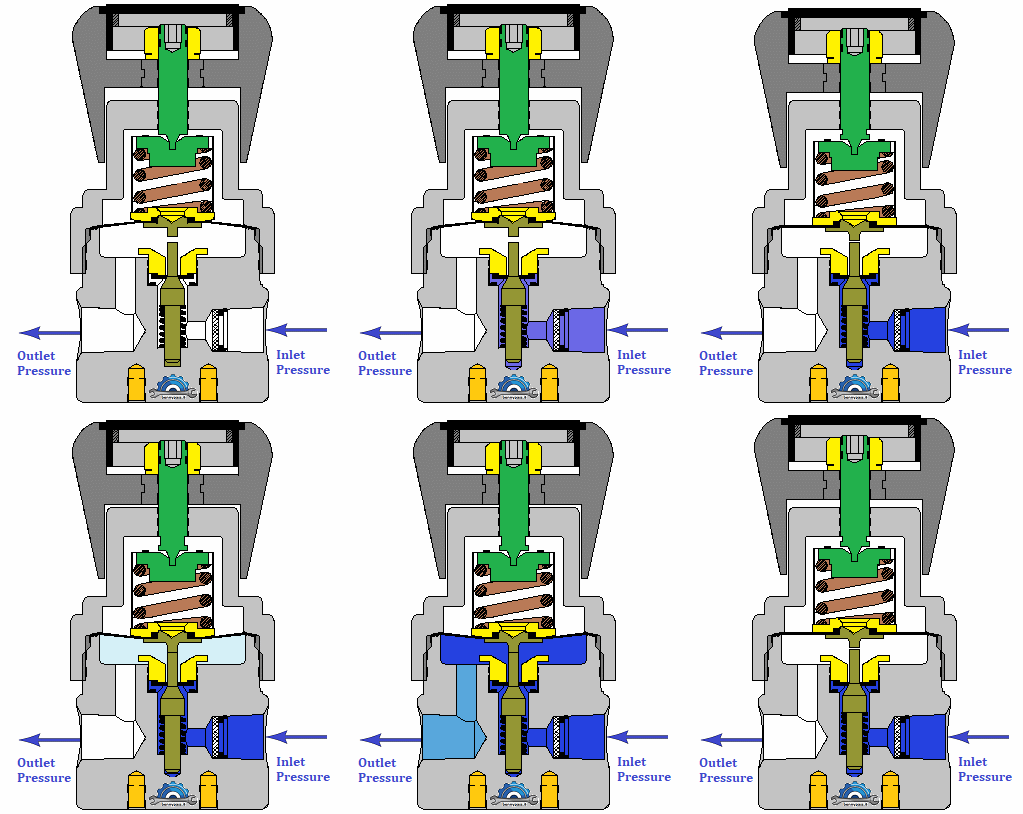
In operation, the reference force generated by the spring opens the valve. The opening of the valve applies pressure to the sensing element which in turn closes the valve until it is open just enough to maintain the set pressure. The simplified schematic “Pressure Regulator Schematic” illustrates this force balance arrangement (see Figure 1 below)
To isolate the spring from the process, there is a diaphragm which usually is made of rubber. The diaphragm flexes according to the spring pressure, and with the reverse force of the processor to the spring it tries to go back. The diaphragm pressure regulator comprises a screw, a spring, a valve, nozzle, and a diaphragm (as in photo one above). The operating principle is based on the balance between the forces which act on both sides of the diaphragm. The force exerted by the spring is compressed by the screw or a knob from one side, while the output pressure pushes from the other side. Slight variations in outlet pressure are corrected immediately by the regulator. When the outlet pressure drops, the balance between the two forces acting on the membrane is broken. If the force of the spring exceeds the force exerted by the pressure of the fluid, the valve opens, the outlet pressure increases and the balance between forces is re-established. If the outlet pressure increases, the force exerted by the fluid against the diaphragm compresses the spring and closes the valve, thus reducing the pressure. With this type of regulator, fluctuations in the inlet pressure do not affect the outlet pressure. How to choose the correct pressure regulator Unlike the pressure reducer, which only reduces the outlet pressure, the pressure regulator can compensate and stabilize it. Depending on the pressure in the system, in this case, it may be necessary to install a pressure reducer, including the regulator.
We also remind you that pressure regulators are generally sold pre-set, although they can be adjusted. Some options and accessories can be added to the device:
There are a lot of pressure regulators on the market, each with its characteristics. Unfortunately, choosing a good quality pressure regulator that lasts over time is difficult to find. The pressure regulator is crucial because a failure in its operation can cause significant damage to other equipment and system components. For this reason, it is advisable to regularly check (periodically) the status of the pressure regulators, including good quality choice Recommendation
|


+(39) 347 051 5328
Italy - Kazakhstan


09.00am to 18.00pm
About
We offer the best and economical solutions, backed by 27+ years of experience and international standards knowledge, echnological changes, and industrial systems.
Our Services
Marketing Materials


Marketing Materials1


