
Flexible cryogenic tubes
In the various types of bunkering configurations and fixed piping systems, many additional components are required to ensure the transfer of LNG. These include flexible cryogenic tubes, loading arms and swivel joints. The flexible cryogenic tubes (Figure 2) are available in different types and are mainly used in STS bunkering and the transfer of LNG from tankers to satellite stations. The flexible pipes are also considered an advantage in terms of safety. For example: if the ship is supplied from a fixed structure, it is possible to maintain a certain safety distance from the supply unit. These pipes were made with solutions that did not provide for their use in contact with water in the past. They believed that the same was a more straightforward configuration; however, they also floated and submerged hoses (see Figure 2).
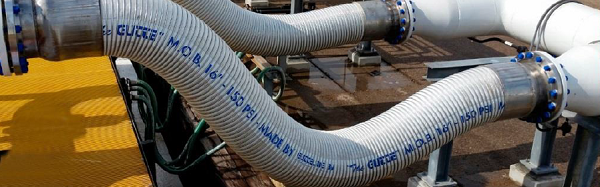
In this type of pipe design, it is necessary to consider that not only LNG must flow inside them. Before starting the LNG bunkering, all pipes (including cryogenic tubes) are subjected to nitrogen purification to avoid the possible formation of explosive mixtures of air and gas. These pipes, therefore, are subjected to significant thermal variations and are also crossed by chemicals of different types. Their design, therefore, must be such as to guarantee the minimum quantity of boil gas (BOG), and this parameter is considered in the phase of choosing the materials. Therefore, the pipes must be subjected to "inerting" and "purging" procedures to eliminate traces of air and must be cooled before introducing LNG into them. It is possible to connect several pipes in parallel to increase the flow of natural gas (transfer) or if a steam return system is envisaged. This type of pipe must have considerable resistance if compared with axial loads, and, generally, they are tested at 20 bar and are subjected to a burst test at 100 bar and can allow a transfer of LNG equal to 1,250 m3 / h. A first relatively consolidated technology is that Guttering (Figure 3) proposed, which follows a similar logic to the tubes made by Cryoflex7 and Dantec. This technology makes use of a multilayer tube made of 316 stainless steel (i.e. an austenitic alloy with 16-18% Cr, 11-14% Ni, 2-3% Mo8) for the inner wire and the outer wire, a coating of polyamide, a carcass of polyamide fabrics and polyester film. The whole is subsequently covered with polyamide. Note
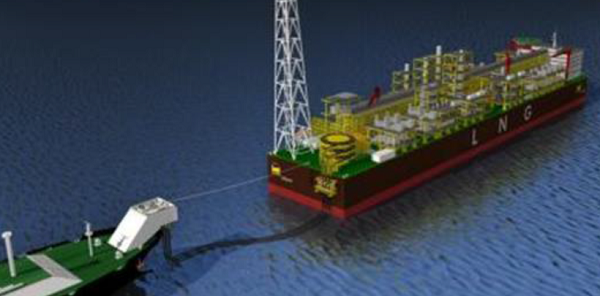
Figure 3 below shows a typical connection between ship and field site
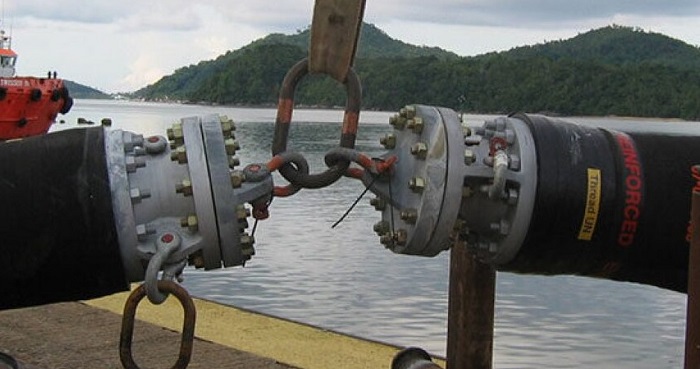
Source: Mauriès et al., 2013 ("Qualification of an innovative offshore LNG tandem offloading system using cryogenic floating hoses "). Thanks to polyamide, it is possible to obtain good properties in terms of specific weight, impact and wear resistance, and high elastic recovery. The connections at the ends of the pipes are made using simple flanges. The ends can be connected directly with ERC and QCQD systems (Quick Connection / Quick Disconnection System, see note 1) (see Figure 4 below).
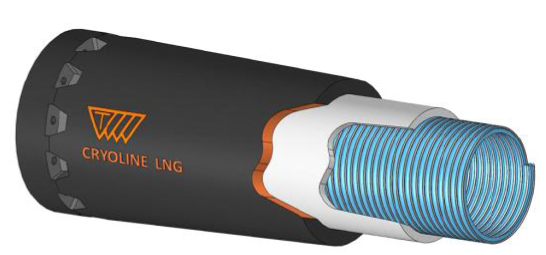
An alternative technology for producing this type of pipe is that adopted by the company Trelleborg, which has designed cryogenic pipes with a "hose in hose" design (see note 2). This configuration is characterized by an inner tube formed by multiple layers of polymeric films and fabrics trapped within two wires wrapped in stainless steel
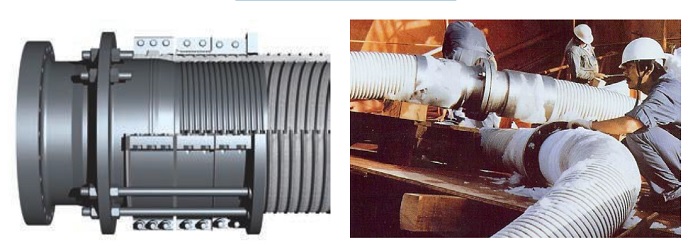
The film is useful as a barrier for the fluid, while the fabrics provide the right resistance to the tube. The outer tube is based on the technology of bonded rubber tubes and consists of rubber, steel rings, reinforcement layers in steel cables and end joints. Such outer tube allows a good resistance to corrosion, high thermal insulation and adequate fatigue resistance. Furthermore, the developed design is characterized by an integrated system inside the rubber pipes capable of discharging the stresses present on the flanges (Figure 5). Figure 5 below shows one of them
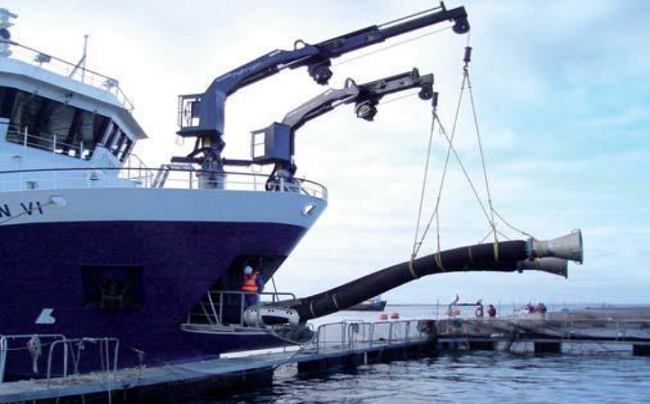
To consider the dimensions and profiles relevant to the health and safety assessment of the bunkering system adopted, it is also necessary to examine the adaptation and handling of this type of pipe during refuelling operations. The handling and management of the pipes in question, in particular, usually takes place through the use of cranes, which are located:
This type of operation (handling the pipes) is risky. If not carried out correctly, it can cause the formation of sparks and the consequent ignition of the load (LNG). However, the use of the crane is necessary to position the end of the supply pipe on the receiving vessel and keep it in position during the bunkering operation (Figure 6).
The type of crane used depends on the chosen bunkering configuration and the different number of pipes used simultaneously to carry out the related operations. If one pipe at a time is to be installed, jib cranes or boom cranes are used, while, if a greater number of pipes simultaneously need to move, gantry cranes or telescopic cranes usually will be used. A single pipe is suitable if the quantities of LNG to be transferred are limited (as occurs in tanker-ship configurations or some STS solutions). In the management of flexible hoses, to ensure an adequate level of safety & security and guarantee a longer useful life of the systems, reducing extraordinary maintenance operations (too expensive), it is necessary to consider some fundamental technical and operational parameters such as:
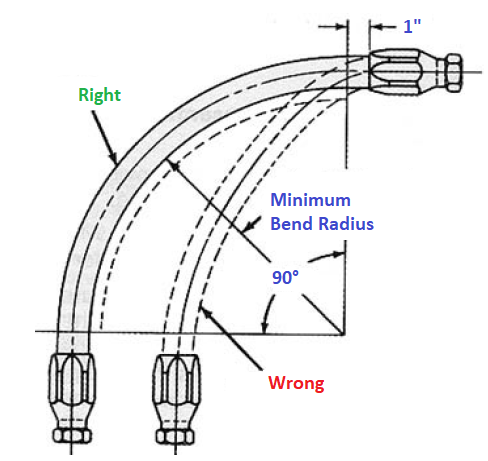
The bending radius is measured from the centre of the pipe section up to the centre of the circumference (Figure 7). It is an important parameter as it represents the maximum value of bend pipe without changing its eccentricity and without itself suffering irreversible damage.
The minimum bending radius constitutes the value below which it is not possible to bend the pipe. Less this threshold, and greater the flexibility of the tube. Using a bending radius value higher than the minimum is usually recommended to avoid continuous replacement of the pipes used. Furthermore, regarding the operating pressure, it is always recommended to maintain values significantly below the threshold for which the pipes have been designed during refuelling operations.
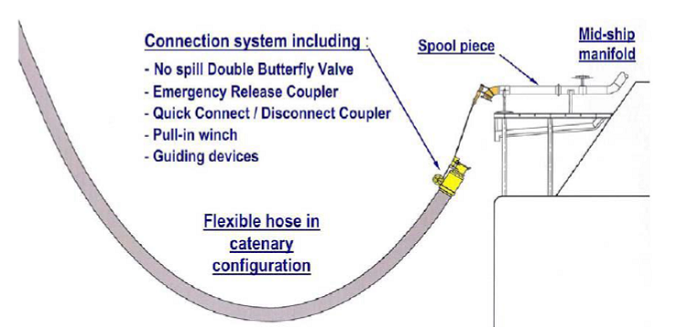
Overall, we can say that the use of dedicated cranes constitutes the best possible technology for handling pipes and keeping them in the right position during bunkering procedures. The crane, in fact, guarantees a safe positioning of the pipes and the persistence of a bending radius greater than the minimum required. This avoids critical stresses in the extreme points where the connection with the supplying and receiving units occurs. Therefore, the definition of the procedures to be followed in the context of bunkering operations in the port area must be such as to exclude the use of winches, and it must be forbidden to leave the pipes suspended freely along their entire length. In common practice, it is usual to adopt solutions similar to that shown in Figure 8, only the central part of the pipe is left free, while the ends are constrained and fixed.
|


+(39) 347 051 5328
Italy - Kazakhstan


09.00am to 18.00pm
About
We offer the best and economical solutions, backed by 27+ years of experience and international standards knowledge, echnological changes, and industrial systems.
Our Services
Marketing Materials


Marketing Materials1


