
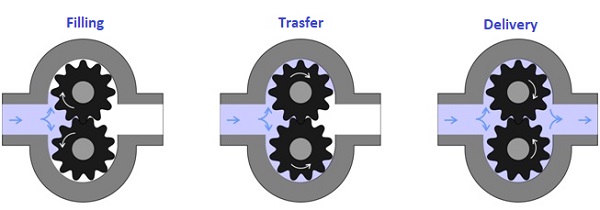
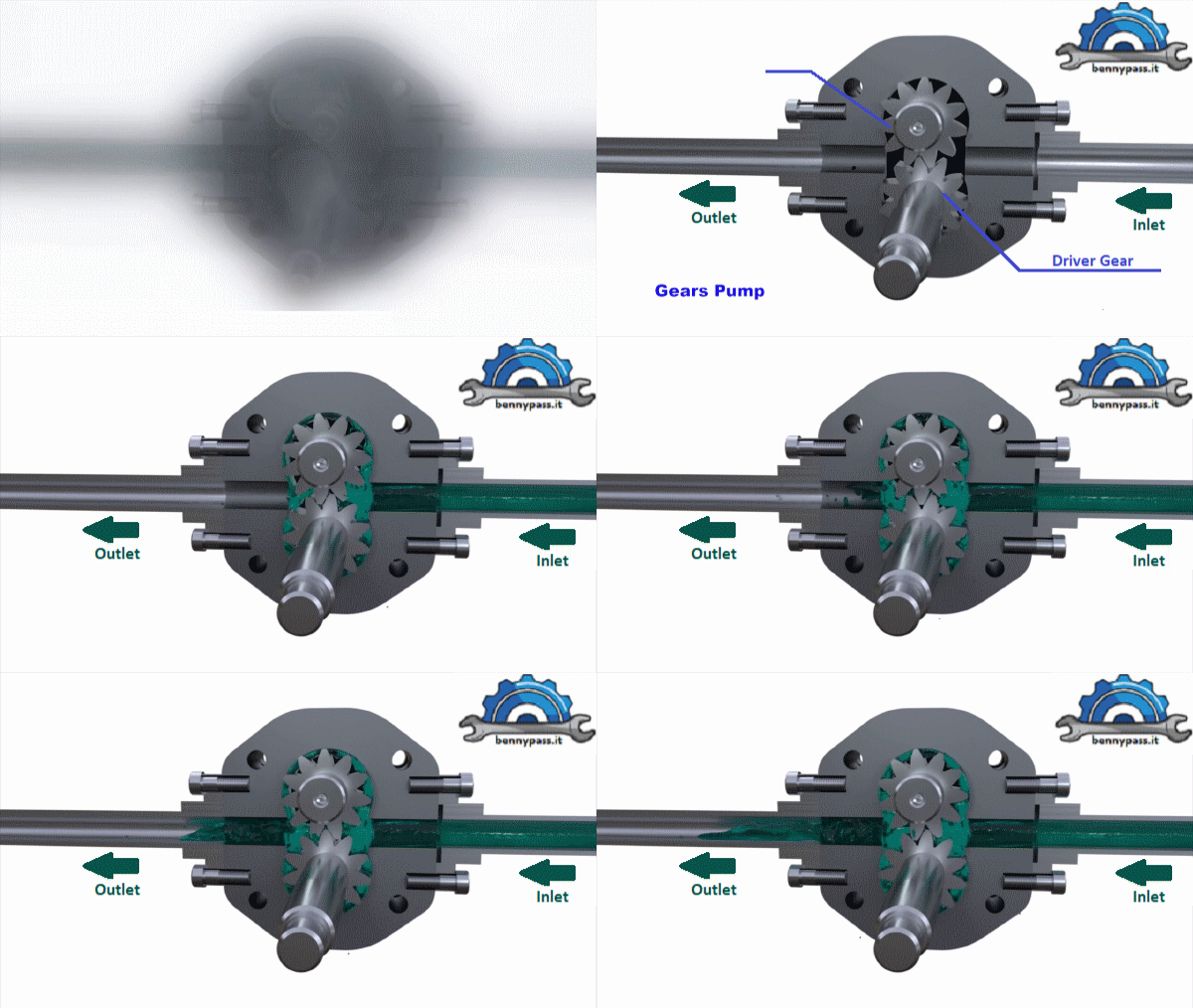
Working principle of Rotary Gear Pumps Gear Pump is one type of positive displacement rotary pump. In a gear pump, a fluid moves by enclosing a fixed fluid volume using the interlocking gears and then transferring it as the gear rotates. This pump delivers a pulse-free flow that is directly proportional to the rotational speed of the gears. Mainly, the Gear Pump is suitable for high pressure (where required). The gear pump is a positive displacement pump and a fixed displacement pump. A positive displacement pump means that this pump provides a constant flow at a fixed speed regardless of the change in pressure and a fixed displacement pump means that it ejects a fixed quantity of fluid per revolution of the shaft. The inventor of the gear pump has been Johannes Kepler around 1600. In a gear pump, there are generally two gears. One gear is the driver gear or the power gear, and the other is driven or the idle gear. The driver gear connects to some prime movers or any mechanical energy source. The driver gear is also known as master gear, and the driven gear is also known as slave gear. The driver gear is rotated using an electric motor, an IC Engine, or manually. Usually, we divide gear pumps into internal gear pumps and external gear pumps. Do you know the differences between these two types of gear pumps? let's see where the differences are Internal Gear Pump The Internal Gear Pump is a new kind of positive displacement gear pump. Internal gear pumps use gears with an external rotor to generate flow and mesh with the internal rotor. When the gear comes out of the mesh on the inlet side, the liquid will suck by the pump. The liquid will discharge through the engagement of gears. Some include a crescent-shaped baffle separating the inlet and outlet volumes between the two gears. Figure 1 below shows the internal parts of an Internal Gear Pump
Figure 2 shows internal parts with all details
External Gear Pumps The External Gear Pumps use two sets of the same gears with external teeth to create flow. The gears' rotation causes the liquid comes in the inlet port and around the outer of the two rotating gears. As the liquid comes around the periphery, it will discharge to the outlet port. External gear pumps also have a safety valve to protect the pipeline. Figure 3 below shows the internal parts of an External Gear Pump
Figure 4 shows internal parts with all details
Figure 4. External Gear Pump
A simple comparison between Internal & External gear Pump
Design benefits High pressures - High viscosity fluids can be pumped over long distances using external gear pumps, thanks to their ability to handle high-pressure applications. Self-priming capabilities - Gear pumps benefit from excelling self-priming capabilities thanks to their rotating gears evacuating any air in the suction line and forcing the liquid into the pump inlet. This gear pump makes it suitable for applications with difficult suction conditions where the pump may be located considerably above the liquid. Bi-directional - Internal gear pumps have spur gears, which enable flow in either direction. It makes them ideal for filling and emptying containers or applications that require an excess fluid return to prevent it from sitting in the pipework. External gear pumps are usually available with spur gears, making them bi-directional or herringbone gears for viscous fluids, but do not allow reversible flow. Steady and pulse-less flow - Both types, particularly internal gear pumps, provide a smooth, constant flow as their gears roll in the same direction without interrupting the liquid flow. The tight internal clearances between the gear teeth and the pump casing allow exact fluid volumes to pass for each gear revolution, guaranteeing a reliable, steady fluid output, which requires accurate metering. Typical applications of a gear pump Gear pumps are among the most common pump types for handling clean oil and other self-lubricating, high viscosity liquids such as paints and soaps in relatively high-pressure installations. Thanks to tight internal clearances and positive displacement operation, external gear pumps benefit from a more reliable measure of the fluid that has passed through, making them ideal for batching applications. Internal gear pumps can handle high-temperature fluids such as thermal oil and can be supplied with an external jacket to maintain the temperature level. Below is the list of the applications where gear pumps usually are used:
Whilst suitable for relatively thick oils, they are typically only suited to clean, non-abrasive liquids free of solids due to the meshing gears. If solids make it into the tight clearances between the gears, they can result in immediate wear and a reduced pump lifespan. Low viscosity fluids should also generally be avoided, particularly with internal gear pumps. They can cause the fluid to leak backwards or “slip” through the tight spaces from the high-pressure discharge side back to the lower pressure suction side, practically can cause reduced flow and efficiency. Operation guidance Do not run dry - If a gear pump is run dry, the unlubricated gears will rub together, causing friction. The heat generated by this friction will cause the gears to expand and wear against the pump casing resulting in damage to the internals. It can also result in the tight tolerances lost if the gear teeth effectively become chewed up, resulting in backwards flow and lost efficiency. Operate at maximum speed - Gear pumps struggle to maintain performance at low speeds and flow rates due to their weak volumetric efficiency. Therefore to get the best from the output, they need to operate as close to their maximum rated speeds. Inspect bearings - Each gear is supported by a shaft with bearings on either side of the gear; an external gear pump has four bearings, and an internal gear pump has two. These need to be regularly checked for wear as they maintain the balance of the gears. Check gear clearance -The operation of a gear pump relies on the tight clearances between the teeth and the chamber. A standard test to see if there has been wearing is to try and put a piece of paper between the permissions; if it quickly passes, there is evidence to suspect wear. Advantages of Rotary Gear Pump
Disadvantages of Rotary Gear Pump
|





+(39) 347 051 5328
Italy - Kazakhstan


09.00am to 18.00pm
About
We offer the best and economical solutions, backed by 27+ years of experience and international standards knowledge, echnological changes, and industrial systems.
Our Services
Marketing Materials


Marketing Materials1


