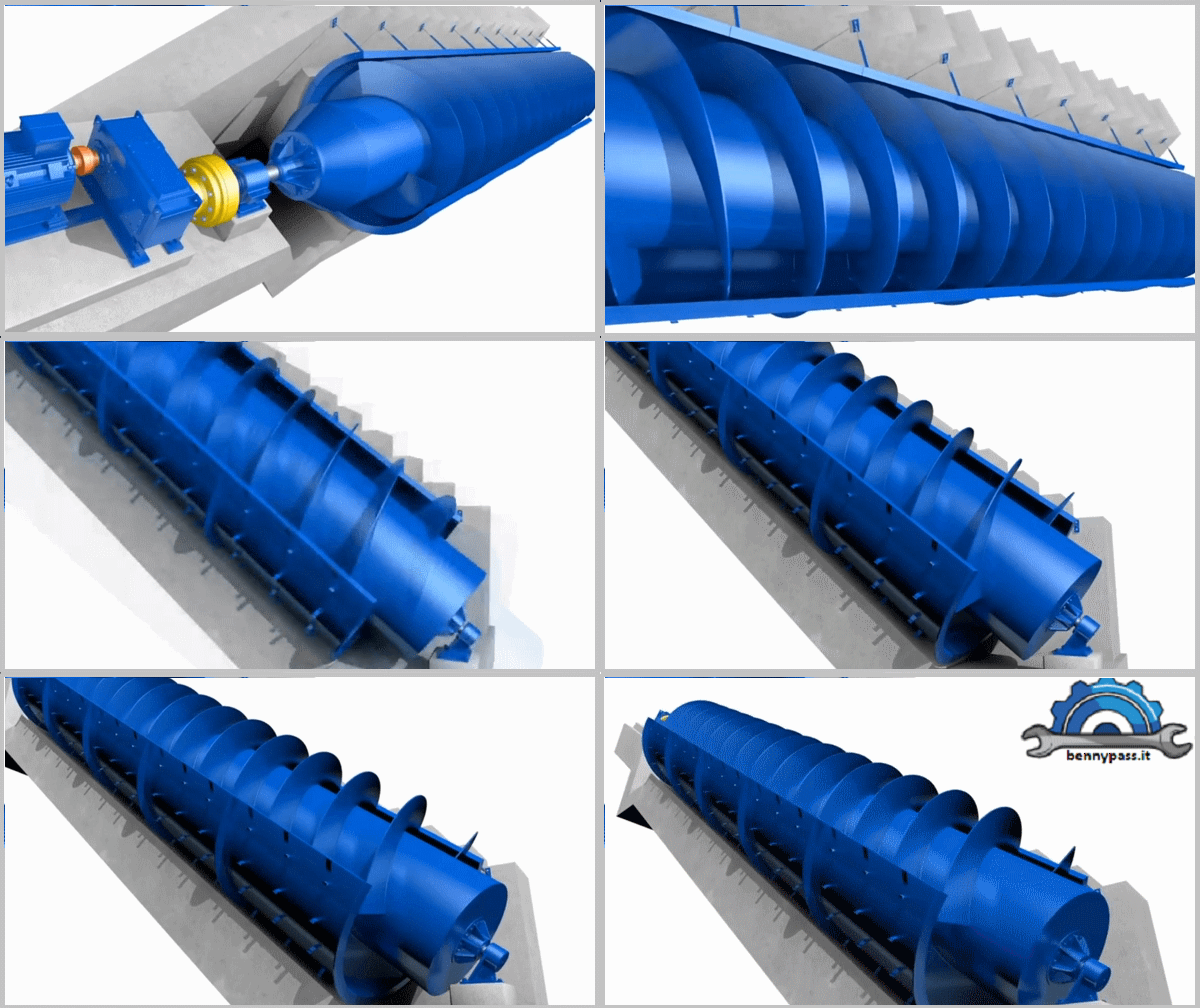
Working principle of Rotary Screw Pump

Introduction

Compared to centrifugal pumps, positive displacement pumps are the most effective ones, and screw pumps come under this classification. It came to know that conventional kinds of screw pumps were in availability in the ancient period itself. Then after Archimedes pioneered the screw pump. The initially invented pumps consist of a cylinder, a revolving unit, and a spiral tube. With the advancements in technology, the operating methodologies also changed, and now they are serving wide applications in many industries. So, this article explains the concepts of the screw pump, the operating principle, and the advantages of this apparatus. For more details, see Figure 1 below

screw pump1a

Figure 1. Screw Pump

For applications involving the transfer of fuels, oils and other lubricating fluids, screw pumps and gear pumps are usually the pumping technology selected. Unlike water-based liquids, changes in the temperature often result in a difference in the viscosity of these fluids. As fluctuations in fluid thickness affect the performance of a centrifugal pump much more than a positive displacement pump, screw pumps and gear pumps are generally the most efficient solutions for oils and fuels.

What is a Screw Pump?

Definition: Has been considered the subcategory of a positive displacement pump that operates either with one or more screws to function pump activity in its spindle direction. This pumping machine functions effectively for the liquids with minimal turbulence and less vibration, is self-primed and can function with a more petite air pocket and less functioning noise. The invention of a screw pump has directed numerous multiple axis machinery where screws revolve in the opposite axis or continue to be in a static position internal to the cavity.

The cavity might be profiled to avoid cavities formation in the pumping equipment and consequently damage the system pumping. Fluid moves into the pump from the suction side and has a linear movement alongside intermeshing screws and from there moves towards the pump discharge side. As the space between the liner and the screws is very minimal, the pressure levels of the liquid increase at the time of movement.

Screw pumps have various application ranges such as

  • Flow rate ranges vary between 50 – 15,000 per minute
  • Total head ranges vary between 50 – 4500 psi
  • Horsepower ranges vary between 5 – 5000

Screw Pump Working Principle

The pressure will be generated by adding axial acceleration to the liquid mode internal to the clearance section. The working principle of the screw pump varies entirely from that gear pump. Here the driver screws and the driver revolves in line with the utilisation of the timing gear. The screws function through a satisfactory clearance pull in air, trapping internal to the fine clearance of interlocking screw strings.

Applying force to the air in the direction of output creates differential pressure that assists in drawing in the fluid to the pumped medium. Now the revolution of the shaft pushes liquid towards the outer side because of axial acceleration of the screw movement. Based on the pump construction, the liquid might be trapped either into multiple or one screw.

The crucial functionality is that the absorbed water moves towards the outer section and the center internal to the pump casing. Through this mechanism, water moves towards space, thus invalidating the impacts of directional thrust, offering hydraulic stability to the whole pump construction. This working principle shows pump functionality, output deviations, efficiency and bearing life.

Because of the inclination to produce an extended vacuum pressure level, this pump does not need any priming, so they are self-primed. In general, screw pumps operated in 800-2600 rotations per minute. The output flow range will decrease when the shaft’s revolution speed increases.

Design

These pumps can be of many types based on the number of screws, constructional change, and percentage share. Irrespective of all these factors, a general screw pump design is constructed with the below parts:

  • Driver Screw -  The revolving part of the screw pump assists in pumping the liquid at the constant volumetric level at any location of the revolution. The crucial functionality of this part is to propel the driven screw through the timing gear.
  • Driven Screw - To be sure of the hydraulic stability, both driven and driver screws have opposing directions, and this position allows the fluid to move axially to generate the non-pulsating results.
  • Timing Gear - When the driver and driven screws are unchecked, it might lead to some unexpected situations. In that case, the timing gear is installed to verify these situations. There will be no metal connection between the driver and driven gears through the timing gear.
  • Discharge and Suction Ports - These ports provide starting liquid medium to the screw pump, thus preventing the pump from drying.
  • Bearing - There are mainly two kinds of bearings:

    • Upper bearings are subject to heavy loads and axial and radial pressures at the pump operation time.
    • Lower bearings are subject to minimal load, and they manage the organisation of pump components.
  • Driving Shaft - This portion connects the pump assembly with the driving motor. Adaptable couplings can achieve this.

While a gear pump is more than an acceptable option for handling lubricating fluids, the design of the screw pump has several advantages. We have constructed a comparison table below to make these features as clear as possible.

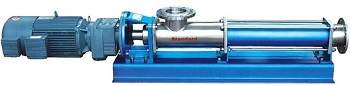
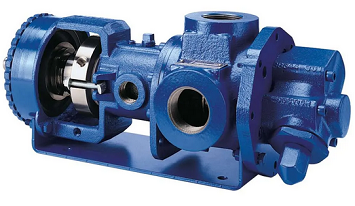
 Screw Pumps  Gear Pumps
 screw pump2  gear pump1
Screw pumps have a better suction capability and work much better in a long pipeline, for more viscous oils and when air is present in the fluid. A gear pump's suction capacity is usually less than an equivalent screw pump, making it less efficient under difficult suction. 
The screw elements inside the pump have a smaller diameter than gears (for the same capacity), producing less turbulence in the fluid for smoother pumping. Gears need a large diameter for the requested capacity and therefore produce more pulsations in the fluid discharge.
Screw pumps can work at a higher motor speed (3000-3500 RPM). Due to the larger gears, the rotation speed is limited. If you increase the RPM, the pump loses suction. 
The screw pump design has better mechanical efficiency as it uses less power for the same capacity relative to a gear pump, thus saving energy costs. The motor in gear pumps uses higher power for the same capacity as a screw pump, resulting in increased energy costs and a larger motor required. 
The operation of a screw pump is much softer with fewer pulsations, less noise and fewer vibrations, meaning a longer lifespan. Gear pumps are noisier, more turbulent and cause more vibrations for the pump and pipework to withstand, causing a lower working life. 
Screw pumps typically have a smaller footprint, making them better when space is an issue. As they generally have a larger footprint, they aren't as good for installations where the room is limited.
Internal components such as the screws generally need to be replaced simultaneously to ensure efficient operation, making them quite expensive to maintain. Internal components are often cheaper than those in a screw pump. However, as bushes and bearings are in the pumped liquid, they are more subject to wear.


Screw Pump Types

Based on various factors, these pumps are essentially classified into five types, and they are:

  • One Screw Pump – Also termed as progressive cavity pumps. Practically, these types are not mainly screwed pumps as the rotor is not in the form of a screw but like a crumpled round shaft.
  • Two Screw Pump – Also termed as twin-screw pump mainly employed for high range of power applications.
  • Three Screw Pump – Here, one gear receives power from the source, which drives the other two gears.
  • Four Screw Pump – This is, in general, a two-screw pump having two screws per rotor. It has timing gears to drive the next one.
  • Five Screw Pump – It is similar to that of five screw pumps whereas, in the place of 3 screws, this has 5. A single driving rotor drives all the other four screws.


Screw Pump Applications

  • Many hydraulic and lubrication techniques use screw pumps to supply lube oil to huge machinery or for the operation of lifts in buildings.
  • For pumping heavy oils, screw pumps are more helpful. They even hold the ability to pump higher flow and higher viscous liquids.
  • These pumping devices are also suitable for pumping both gas and liquid simultaneously, as this is the most critical situation to be handled by many pumping industries. Screw pumps operate efficiently.
  • Also used a lot in the oil and gas industry, mining, and manufacturing.

Driving Shaft

This portion connects the pump assembly with the driving motor. Adaptable couplings can achieve this.

Advantages

  • These are used in any type of liquid medium
  • Most effective to generate non-pulsating and constant results
  • It holds the benefit to provide steady flow with varying back force
  • The pump is completely noise-free also at extended pressure and rpm levels
  • It holds the advantage of generating extended volumetric efficiency
  • Regulated output, minimal maintenance and fewer vibrations too

Disadvantages

  • Too costly to be implemented in small industries

FAQs

  1. Who invented the screw pump? A screw pump was invented by Archimedes and initially used for irrigation and out ship purposes.
  2. How does a screw compressor work? When the driven and driver gears work in opposite directions, the compressor pulls air between the space of these gears.
  3. How does a twin-screw pump work? The pump operates in the condition which transferred to the corresponding fluid volume. Based on the pitch and speed of the screws.
  4. What is a positive displacement pump? It has suction and discharge ports where the liquid enters from the suction side when it is expanded and flows out from the discharge side when it collapses.

So, this is the concept of what is a screw pump and all other theories of it. There are many different concepts to be known in a screw pump, like how they pump fluids and what is a power zone screw pump. Depending on the industry requirement, various kinds of screw pumps are available in the market. So, choosing the best one yields the best results.


favicon bacd

+(39) 347 051 5328

Italy - Kazakhstan

09.00am to 18.00pm

About

We offer the best and economical solutions, backed by 27+ years of experience and international standards knowledge, echnological changes, and industrial systems.

Marketing Materials

Spring Renovation
Industry
US Gas Company
Construct
Plus Project
Vam Drilling Service
X Project
X Project
Cabrrus Training

Marketing Materials1

Spring Renovation
Industry
US Gas Company
Construct
Plus Project
Vam Drilling Service
ultrasonic sensor
ultrasonic sensor
Cabrrus Training