
|
Offline/Standby UPS working principle
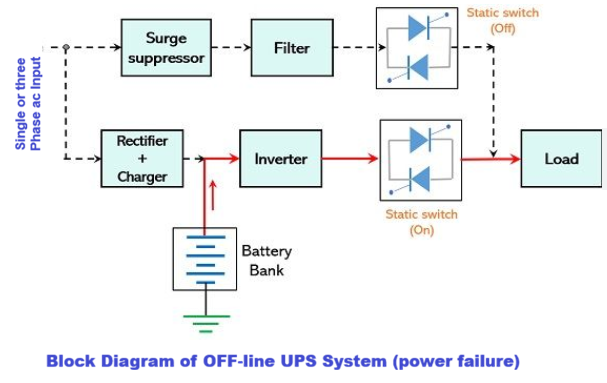
An offline/standby UPS (Uninterruptible Power Supply) works by feeding raw utility power directly to the connected load while charging its battery in the background. If the voltage fails or goes outside safe limits, a transfer switch engages the internal DC-AC inverter to supply battery power within 2-10 milliseconds Key Operating Principles
Components
Characteristics
An Offline UPS (also known as a Standby UPS) is the most basic and cost-effective type of power protection. Its primary principle is that it remains "passive" or in standby mode during normal operation, only engaging when a power failure is detected. Working Principle The operation is divided into two main modes:
Key Characteristics
For more advanced needs, brands like Vertiv or Eaton provide detailed guides on comparing these to Line-Interactive or Online models. |
|
UPS Uninterruptible Power Supply Types
There are three main types of Uninterruptible Power Supply (UPS) systems, classified by how they handle power: Offline/Standby,Line-Interactive, and Online Double-Conversion. They differ in cost, efficiency, and the level of protection provided for equipment ranging from home PCs to critical data center infrastructure Three Main Types of UPS
Other Specialized Types
These systems are generally used in either static (no moving parts) or rotary configurations to ensure continuous, reliable power supply There are three main categories of Uninterruptible Power Supply (UPS), classified based on the way power flows through the unit and the level of protection it offers. Offline / Standby (Protezione Base) This is the simplest and cheapest type. The load is powered directly from the mains until an outage occurs.
Line-Interactive (Protezione Intermedia) This technology includes an automatic voltage regulator (AVR) that corrects fluctuations without draining the battery.
Online Double Conversion (Maximum Protection)
There are also less common or specialized variants such as Delta Conversion (a more efficient hybrid version of the online system) and Modular Systems, which allow you to add power modules as your needs grow. |

|
Resonant Grounding (Petersen Coil)
Resonant grounding, or Petersen coil grounding, is a technique where a variable iron-core reactor is connected between a power system's neutral and earth to suppress ground fault currents. By tuning the reactor's inductance (\(L\)) to match the system's capacitance (\(C\)), the inductive fault current neutralizes the capacitive fault current, causing arcs to self-extinguish and enabling continuous operation during single-line-to-ground faults. Key Features and Benefits
Applications
Disadvantages
Resonant grounding, also known as Petersen coil or arc suppression coil, is a neutral grounding method used primarily in medium-voltage transmission and distribution networks. Concept and Operation The system consists of connecting the neutral point of a three-phase transformer to earth via a variable inductor (the Petersen coil).
Advantages and Disadvantages
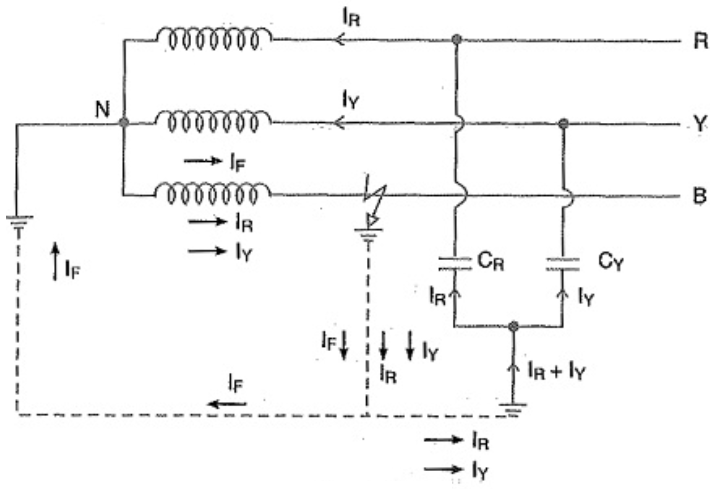
Common Applications It is an extremely popular solution in Europe and Scandinavia for medium-voltage overhead lines (6 kV - 110 kV), where 80% of faults are transient. It is less effective for underground cables, where faults tend to be permanent and require immediate intervention by protection devices. Working Principle of Petersen Coil To better understand the working principle and need of Petersen Coil, let us have a look at the arcing ground phenomenon. We know that arcing ground phenomenon is observed in ungrounded 3 phase system. During arcing ground the voltage of healthy phase rises from phase voltage to line voltage i.e. it becomes √3Vph. Also, arcing in such phenomena is due to heavy capacitive charging current which is 3IC where IC = Vph / XC. Thus if there were any way to reduce this charging current then arcing ground phenomena could have been eliminated. Isn’t it? Well, you will say that we can connect a resistor in ground of system to minimize the capacitive charging current. Then why do we connect inductor in ground? Why Inductor is used to eliminate Arcing Ground?To answer this question, let us consider a single line to ground fault and its phasor diagram for an ungrounded system as shown below. From the phasor diagram it is can be easily observed that, the voltage of neutral point shifts from ground potential to phase voltage Vph but in opposite direction. This is the reason the direction of VC is reverse in figure above and shown by V’C. The fault current IC (IC = IA+IB) is perpendicular to the V’C. Thus if we want to eliminate the fault current then we must connect an element which will take current in a direction opposite to IC. Carefully observe that IC is leading V’C by 90°.
Now as we are connecting an element in between the neutral point N and ground, therefore the voltage drop across that element will be VC. Thus that element must take current equal to IC and shall lag from VC by 90°. As inductor takes lagging current, therefore an inductor is connected in between neutral and ground to eliminate arcing ground. What is Petersen Coil? Petersen Coil is nothing but an inductor used to connect ground of three phase system to the earth. In other words, the neutral of three phase system is grounded through Peterson Coil. Basically, such grounding is adopted to minimize the capacitive charging current during fault in the lines. This also eliminates the arcing ground. The inductor connected in figure above is Petersen Coil. This type of grounding is also known as Resonant Grounding. How does Petersen Coil Work? As discussed earlier in this post, Petersen Coil must take current equal to the fault current IC so that it neutralizes the fault current. This is the reason, it is also known as fault neutralizer. Let us consider the figure shown above. The current through the Petersen Coil IL = Vph / ωL But the fault current IC = 3Vph / XC (how? Please read Arcing Ground) Therefore to neutralize the fault current, IL = IC Hence, Vph / ωL = 3Vph / XC ⇒1/ωL = 3ωC ⇒L = 1/3ω2C Thus to neutralize the capacitive charging current, the value of inductance of Petersen coil shall be 1/3ω2C. Advantages of Resonant Grounding
|
.png)
.png)
.png)
Resistor Earthing (NGR/NGR) - Working Principle
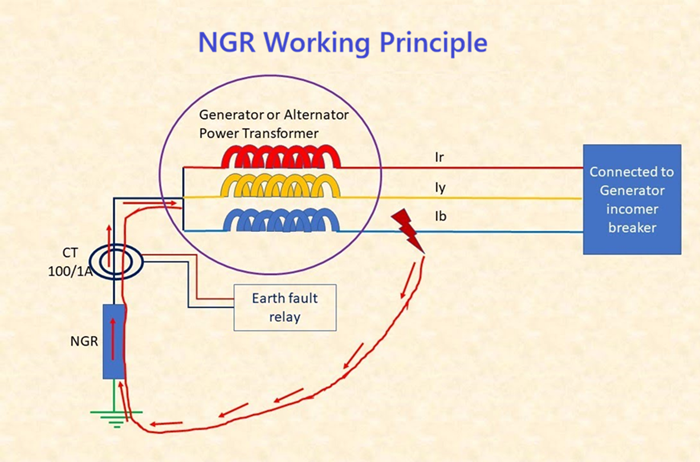
A Neutral Grounding Resistor (NGR) or Neutral Earthing Resistor (NER) protects power systems by limiting ground-fault current to safe, pre-determined levels. Connected between the transformer/generator neutral and ground, it uses resistance to restrict fault current, reducing equipment damage, preventing arc flash, and enabling protective relays to detect faults. Core Working Principle
This ensures fault currents are kept well below the levels of solid grounding, protecting sensitive equipment.
Key Benefits
Applications NGRs are essential in medium-voltage and high-voltage systems, particularly in industrial facilities, mining, solar/wind farms, and power generation where limiting ground fault damage is critical. The Neutral Grounding Resistor (NGR), also known as the Neutral Earthing Resistor (NER), is an electrical component used to limit ground fault current in three-phase power systems (transformers and generators).
Working Principle
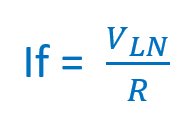
The operating principle is based on Ohm's Law (I=V/R):
Main Types
Key Benefits
Need details on thermal sizing (second ratings) or the difference between NGR and Zig-Zag Transformers for delta systems? |
Super User
|
Solid earthing (or grounding) Working Principle
Solid earthing (or grounding) works by directly connecting the neutral point of a generator or transformer to the earth using a conductor with negligible resistance and reactance. This creates a low-impedance path that keeps the neutral at earth potential, prevents transient overvoltages, and allows for rapid, high-magnitude fault current detection, which ensures swift protection device operation. Key Working Principles and Characteristics
Applications
The operating principle of solid (or "effective") earthing consists of directly connecting the neutral point of a three-phase system (such as a transformer or generator) to earth via a conductor with negligible impedance. How It Works
Advantages and Disadvantages
Common Applications
Conclusion The solid grounding of neutral point has the following advantages:
ApplicationsSolid grounding is usually employed where the circuit impedance is sufficiently high so as to keep the earth fault current within safe limits. This system of grounding is used for voltages upto 33 kV with total power capacity not exceeding 5000 kVA. Calculation Low-reactance Grounding ased on network constant ratios, the criteria to qualify as reactance grounded is: Xₒ/X1 > 3 as seen at fault, but less than the value necessary for resonant grounding. Inserting a low-reactance such that Xₒ/X1 ≤ 3 at fault, is not reactance grounding. Xₒ/X1 > 3 and the system is deemed reactance grounded. Recommendations It is not proper to endanger a generator winding with fault currents higher than the three-phase current at the terminals. In generators, the ground-fault currents are higher than the three-phase fault currents because the internal impedance seen by the ground-fault is less than the impedance to three-phase faults. The high current produces excessive heating and mechanical forces. A suitable current limiting impedance, like a low-reactance reactor, should be installed in the neutral to avoid generator damage. In transmission and distribution systems, without directly connected rotating machines, the neutrals of the transformers are usually effectively grounded and reactors are not typical. The phase-to-ground fault current should range from 25% to 100% of the three-phase fault current. Less than 25% may cause damaging transient overvoltages. Choose the value of reactance needed to limit the ground-fault current to the preferred amount. The ratio is
Limiting the ground-fault current to 60% of the three-phase fault current is the borderline between effective grounding and reactance grounding. Low-resistance Grounding In the USA, low-resistance grounding is the most popular method utilized to limit ground-fault current. The value of resistance is much lower than the high-resistance method and ranges from 5% to 20% of the three-phase fault current. Some applications limit the ground current to around 50A to 600A. |

+(39) 347 051 5328
Italy - Kazakhstan


09.00am to 18.00pm
About
We offer the best and economical solutions, backed by 27+ years of experience and international standards knowledge, echnological changes, and industrial systems.
Our Services
Marketing Materials


Marketing Materials1


