
|
Motor Operator in a circuit breaker - Working Principle A motor operator in a circuit breaker uses an electric motor to automatically charge a stored-energy spring mechanism, enabling remote, high-speed closing and opening of electrical contacts. The motor compresses a closing spring via a gear system, allowing the breaker to be toggled remotely, enhancing safety and supporting automated control systems. Key Working Principles
Benefits:
Motor operators allow for remote, automated control and quick reclosing in industrial and high-voltage applications, removing operators from high-voltage hazards. This video explains how the spring mechanism works in circuit breakers:
In a circuit breaker, a Motor Operator is an electromechanical accessory that automates the physical opening, closing, and resetting of the breaker's contacts. It acts as the "muscles" for the breaker, allowing for remote or automated control that would otherwise require manual effort.
Core Working Principle
The motor operator functions through a stored-energy mechanism:
Key Components & Safety
Primary Applications
|
|
Alarm Switch/Signal Contact in a circuit breaker - Working Principle An alarm switch (or signal contact) in a circuit breaker is a specialized accessory that changes state only when the breaker trips due to a fault (overload, short circuit, or shunt trip). It distinguishes fault trips from manual ON/OFF operations, sending a signal to remote indicators or SCADA systems. Key Aspects of Alarm Switches
Difference from Auxiliary Contact (AX)
In a circuit breaker, an alarm switch (also known as a signal or fault contact) is an auxiliary device that provides a remote electrical signal only when the breaker trips due to an electrical fault. Function and Operation
The primary purpose of an alarm switch is to distinguish between a manual operation and a fault condition.
Comparison: Alarm Switch vs. Auxiliary Switch
Practical Applications
|
|
Auxiliary Switch/Contact of a circuit breaker - Working Principle An auxiliary switch/contact in a circuit breaker is a mechanically linked, secondary switching device that operates simultaneously with the main contacts to monitor the breaker's status (ON/OFF/Tripped). It sends feedback signals (via Normally Open or Closed contacts) to control circuits, enabling remote monitoring, interlocking, or triggering alarms, without handling the main power circuit.
These contacts do not handle high power, they are designed to handle low-voltage control signals.
An auxiliary switch (or contact) in a circuit breaker is a secondary switch that mechanically mimics the state of the primary contacts to provide remote feedback or logic control.
Working Principle
Contact Types
The switch usually contains multiple contacts configured in two primary ways:
Primary Functions
Crucial Note: Auxiliary contacts are designed for low-current signaling only. They are electrically isolated from the main power circuit and cannot be used to carry the actual load.
|
|
Undervoltage Release (UVR) is a safety accessory for circuit breakers - Working Principle An Undervoltage Release (UVR) is a safety accessory for circuit breakers that automatically trips (opens) the breaker when the monitored supply voltage drops below a specific threshold, typically 35–70% of rated voltage, protecting connected equipment from damage caused by low voltage. It works on the principle of electromagnetic force holding a spring-loaded plunger; when voltage drops, the spring overcomes the weakened magnetic force, releasing the plunger to trip the mechanism. Key Working Principles and Details
Common Applications
The Undervoltage Release (UVR) is a failsafe accessory for circuit breakers that automatically trips the breaker if the supply voltage drops below a certain threshold.
Core Working Principle
Unlike a shunt trip (which requires a pulse of energy to trip), a UVR requires continuous power to keep the breaker closed.
Key Technical Specifications
Why Use a UVR?
|
|
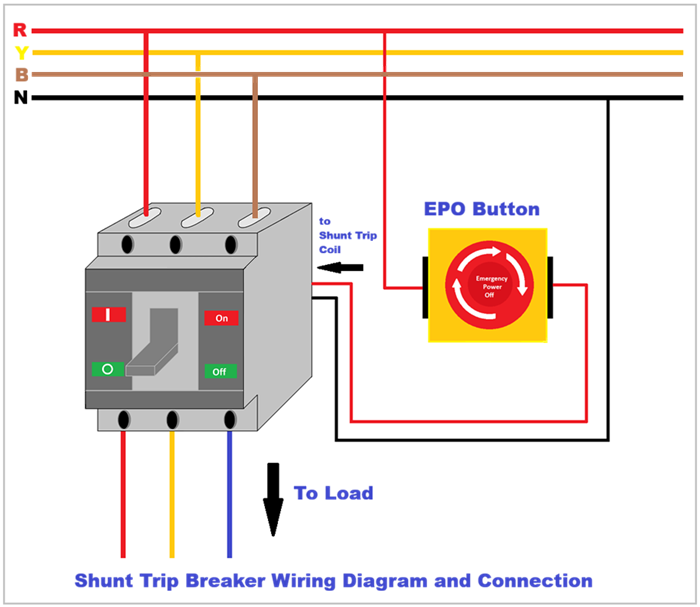
Shunt trip circuit breaker operation
A shunt trip circuit breaker operates by using an internal electromagnetic coil (solenoid) to mechanically trip the breaker when an external voltage signal is applied, allowing for remote or automatic, instantaneous power disconnection. It acts as a safety accessory, enabling emergency shutdowns via smoke detectors, fire alarms, or manual buttons. Key Principles and Components
Applications Emergency Shutdowns: Remotely shutting down machinery via a panic button. Unlike an undervoltage release, a shunt trip requires voltage to be applied to trip the breaker, rather than losing voltage to trigger it. A shunt trip is an accessory that adds remote control to a standard circuit breaker. While normal breakers trip automatically due to internal faults like overloads, a shunt trip allows you to force the breaker open using an external signal. Core Working Principle The mechanism functions as an electromechanical "remote control" for the breaker's internal latch.
Key Technical Details
Common Applications
|

+(39) 347 051 5328
Italy - Kazakhstan


09.00am to 18.00pm
About
We offer the best and economical solutions, backed by 27+ years of experience and international standards knowledge, echnological changes, and industrial systems.
Our Services
Marketing Materials


Marketing Materials1


