
|
Communication Capabilities of a Circuit Breakers - Working Principle Circuit breakers with communication capabilities monitor, control, and report electrical data in real-time, functioning as intelligent, connected nodes in power systems. Through internal sensors and networking modules (e.g., Modbus, Ethernet), they send status updates (open/closed/tripped) and power metrics to remote systems. The core mechanism uses sensors to detect faults, while an intelligent module commands the breaker to trip and communicates the event to managers. Key Communication Functions and Features
Working Principle of Communication
This functionality reduces operational costs, improves safety through remote maintenance, and enables advanced energy management.
Communication-enabled circuit breakers (often called smart or intelligent circuit breakers) transform traditional passive safety devices into active, data-driven nodes within a power network.
Working Principle
The core principle involves the integration of three distinct layers into the traditional breaker structure:
Key Capabilities
Industrial Protocols For integration into professional SCADA (Supervisory Control and Data Acquisition) systems, communicating breakers typically use standardized industrial protocols like Modbus, Profibus, or TCP/IP. |
|
Monitoring and Measurement of a Circuit Breakers - Working Principle Circuit breakers operate by automatically interrupting circuit current via contact separation when overload or fault occurs, using thermal (biometallic strip) or electromagnetic (coil) mechanisms to trip. Monitoring involves tracking trip coil current, contact wear, operating mechanism spring tension, gas pressure (SF6), and temperature to predict failures. Working Principle
Monitoring and Measurement Parameters
Key Measurements
Regular monitoring helps transition from time-based maintenance to predictive, condition-based maintenance, reducing failures.
Monitoring and measurement of circuit breakers rely on non-intrusive sensors to capture electrical, mechanical, and environmental data without disrupting the high-voltage power flow. This process transforms extreme physical quantities into measurable digital signals to evaluate the "health" of the breaker in real-time.
Systems use specialized hardware to monitor three primary domains:
The captured data undergoes several stages of evaluation:
The final stage involves communicating insights to operators:
Modern systems integrate with SCADA or IoT platforms via protocols like Modbus, IEC 61850, or MQTT. This allows operators to:
|
|
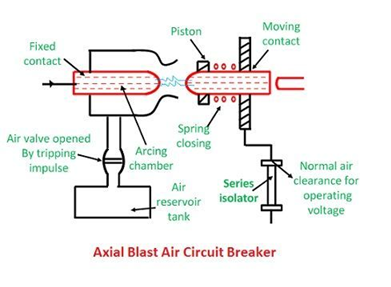
Air Blast Circuit Breakers - Working Principle
Air blast circuit breakers (ABCB) use a high-pressure air blast (typically 20-30 kg/cm²) to extinguish electrical arcs formed during contact separation, acting within ~40 ms. When a fault occurs, compressed air from a reservoir is released through nozzles, cooling and sweeping away ionized gases, forcing the arc to extinguish at current zero. Key Working Principles
Advantages:
Disadvantages:
Air blast circuit breakers are generally replaced by SF6 circuit breakers in modern, high-voltage applications.
The working principle of an Air Blast Circuit Breaker (ABCB) centers on using a high-velocity jet of compressed air to rapidly extinguish the electric arc formed when contacts separate during a fault.
Core Working Principle
Main Types by Blast Direction
Key Components
|
|
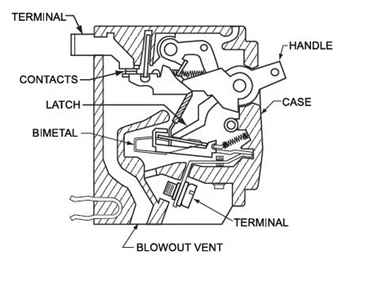
Protection Functions of a Circuit Breakers - Working Principle
Circuit breakers are electromechanical safety devices that protect electrical circuits from damage by automatically interrupting current flow during overloads or short circuits. They function as automatic switches using thermal (bimetallic strip) for long-term overloads and magnetic (electromagnetic coil) principles for instant, high-current short circuit protection. Key Protection Functions & Working Principles
Working Mechanism
Under normal conditions, contacts are held closed by springs. When a fault occurs (overload/short), the thermal or magnetic mechanism trips the operating mechanism, separating the contacts and extinguishing the arc to stop the current flow. Unlike fuses, they can be reset. Circuit breakers act as automatic switches that protect electrical systems by interrupting power flow when a fault occurs. Modern breakers typically utilize a thermomagnetic design to provide two distinct types of protection.
Some specialized breakers provide additional safety features:
Would you like to see a comparison between residential MCBs and industrial MCCBs regarding their adjustable trip settings?
|
|
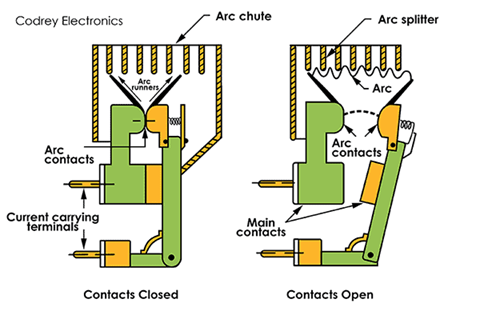
Air Chute Air Circuit Breakers (ACBs) - Working Principle
Air Chute Air Circuit Breakers (ACBs) work by extinguishing electric arcs formed during contact separation in low or medium voltage circuits using surrounding air. When contacts open, an arc is formed and pushed by magnetic force into arc chutes—metallic splitter plates—which divide, elongate, cool, and extinguish the arc in milliseconds. Core Working Principle
Components and Mechanisms
These breakers are widely used for low-voltage power distribution, providing a safe way to interrupt, break, and protect electrical circuits.
The working principle of an Air Chute Air Circuit Breaker (ACB) centers on using atmospheric air to increase the electrical resistance of an arc until the system's voltage can no longer maintain it. Unlike oil or vacuum breakers, these devices operate by physically manipulating the arc to cool and dissipate its energy.
Core Working Mechanism
When a fault (such as an overload or short circuit) is detected by the trip unit, the operating mechanism triggers the separation of the contacts.
Typical Applications
|

+(39) 347 051 5328
Italy - Kazakhstan


09.00am to 18.00pm
About
We offer the best and economical solutions, backed by 27+ years of experience and international standards knowledge, echnological changes, and industrial systems.
Our Services
Marketing Materials


Marketing Materials1


