
|
Drawer-Type ACB Operating Positions - Working Principle
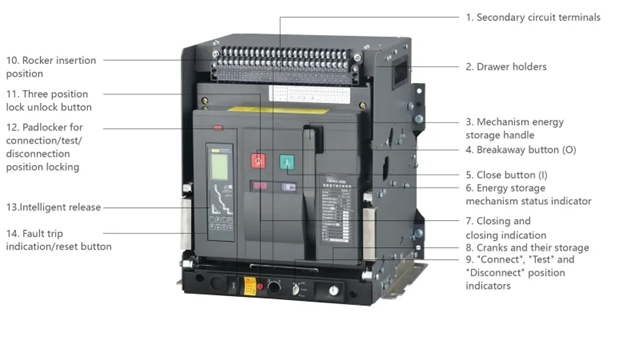
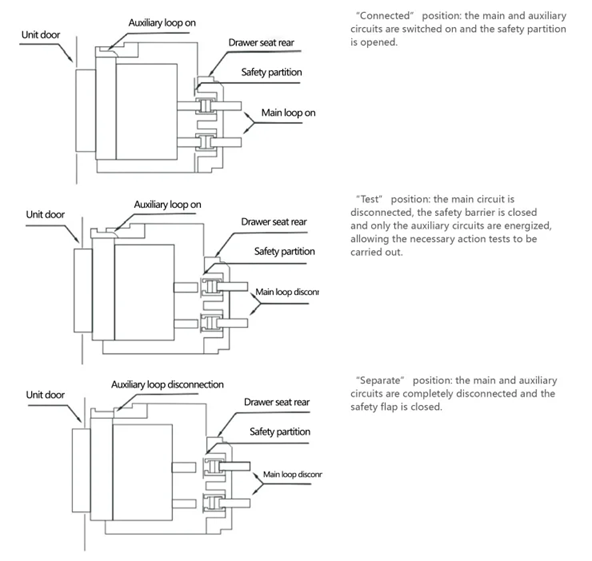
Drawer-type ACBs operate in three distinct positions—Connect, Test, and Disconnect—within their cradle, allowing for safe maintenance and testing without disconnecting main conductors. These positions, including a full withdrawal option, enable fast, 15-30 minute replacements without opening the panel, enhancing safety and minimizing downtime. Key Operating Positions
Benefits of Draw-out Design
A Drawer-Type (or Draw-out) Air Circuit Breaker (ACB) typically features three standard operating positions, with some models offering a fourth for maintenance. These positions describe the connection status of the main (power) circuit and the control (auxiliary) circuit relative to the chassis or cradle.
Summary Table
How to move between positions: To change positions, a racking handle is inserted into the draw-out mechanism and rotated (clockwise to "rack in" or anticlockwise to "rack out"). Modern ACBs like those from Schneider Electric or Mitsubishi include mechanical indicators on the front face to show the current position. |
|
Drawer-Type ACB Operating Positions of a circuit breaker - Working Principle
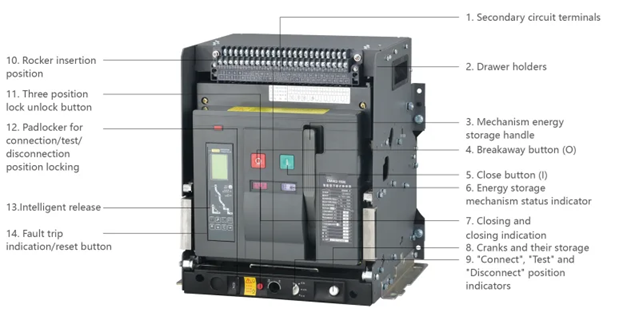
Drawer-type Air Circuit Breakers (ACBs) operate by racking the breaker body into different positions within a cradle (CONNECTED, TEST, DISCONNECTED) to isolate, test, or connect the unit from the main busbar. They utilize air at atmospheric pressure to extinguish arcs between separating contacts using arc chutes. Drawer-Type ACB Operating Positions
Working Principle of ACB Arc Extinction
A Drawer-Type Air Circuit Breaker (ACB)—also known as a draw-out type—operates on a racking mechanism that allows the breaker unit to slide in and out of a fixed cradle or chassis. This design enables safe maintenance and testing without de-energizing the entire switchboard. Core Operating Positions The racking mechanism moves the breaker between three primary electrical states, usually controlled by a racking handle:
Working Principle of the Mechanism
|
|
Safety Interlocks of a circuit breaker - Working Principle
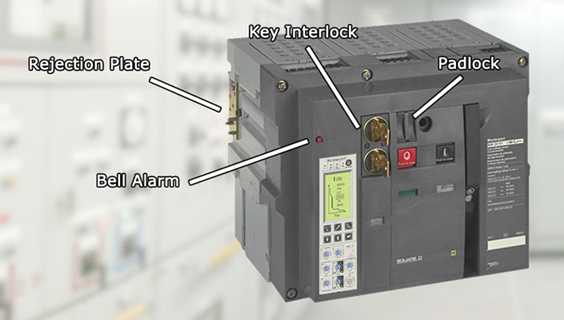
Safety interlocks for circuit breakers are mechanical or electrical, often NC (Normally Closed) systems designed to prevent hazardous situations, such as racking in a closed breaker or accessing live components. They ensure safety by enforcing a strict, correct sequence of operations (e.g., Open Disconnect Ground). Key Working Principles & Types
Common Safety Rules Enforced
Benefits These interlocks ensure personnel safety by eliminating human error, preventing arc flash hazards, and protecting equipment during maintenance.
Safety interlocks for circuit breakers are critical mechanisms designed to prevent incorrect operations that could lead to equipment damage or severe personnel injury. They function by ensuring a mandatory sequence of operations based on the status of the equipment.
Core Working Principles
Safety interlocks generally operate through three primary methods:
Standard Circuit Breaker Interlocks
Operational Safety Rules Standard safety protocols, often mandated by IEC 62271-200, include:
|
|
Position Indicators of a circuit breaker - Working Principle Circuit breaker position indicators are mechanical or electrical devices (flags/LEDs) that provide immediate, visual status of a circuit breaker’s main contacts (Open, Closed, or Tripped) and the operating mechanism's energy state (Charged or Discharged). They ensure safety by indicating if power is connected or disconnected. Key Position Indicators and Working Principles
These indicators are crucial for maintenance, preventing "blind" operation of high-voltage equipment, and ensuring the stored energy is available for safe, rapid switching.
Circuit breaker position indicators provide real-time status of the device's internal contacts—ON (closed), OFF (open), or TRIPPED. Their primary working principle relies on a mechanical linkage connected to the breaker's operating shaft; as the contacts move, they physically shift a flag, handle, or auxiliary switch to reflect the new state.
Types of Position Indicators
Core Working Principles
For high-voltage systems, indicators also track the Racking Position (Connected, Test, or Disconnected) to ensure safety during maintenance.
|
|
Secondary Circuit Terminals of a circuit breaker - Working Principle
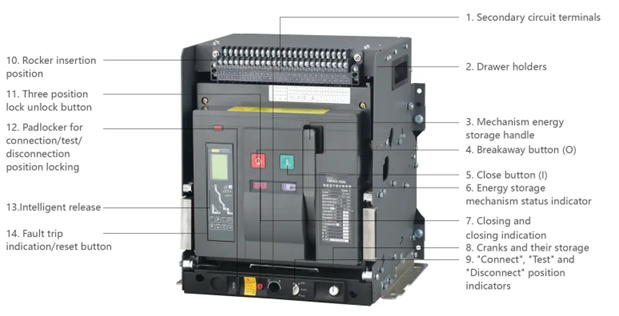
Secondary circuit terminals on a circuit breaker, often found as a secondary disconnect plug or terminal block, serve low-voltage control, monitoring, and protection functions (e.g., signaling, tripping, status indication). They facilitate communication between the breaker's internal mechanisms and external control systems, such as relay protections. Working Principle and Key Functions
These terminals typically operate in the range of 120V AC or low-voltage DC, acting as a link between high-voltage power components and low-voltage control, protection, or measurement devices. In a circuit breaker, Secondary Circuit Terminals (often called the secondary disconnects) are the interface points between the breaker’s internal control components and the external low-voltage control system. Unlike the primary terminals that carry high-voltage power to the load, secondary terminals handle the "intelligence" of the breaker. Working Principle
The secondary terminals operate on the principle of electrical isolation and feedback loops. They allow low-voltage control signals (typically 24V-250V AC/DC) to manage high-voltage operations without direct physical contact between the two power levels.
Practical Application
|

+(39) 347 051 5328
Italy - Kazakhstan


09.00am to 18.00pm
About
We offer the best and economical solutions, backed by 27+ years of experience and international standards knowledge, echnological changes, and industrial systems.
Our Services
Marketing Materials


Marketing Materials1


