
|
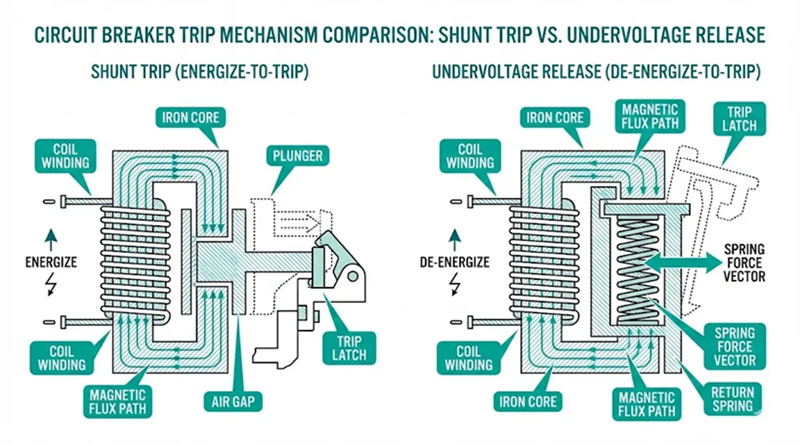
Undervoltage Release of a circuit breaker An undervoltage release (UVR) is a protective accessory in a circuit breaker that trips the breaker when supply voltage drops below a safe threshold, typically 70%–35% of rated voltage. It works by using an continuously energized electromagnet to hold a plunger against a spring; when voltage drops, the spring forces the plunger to trip the mechanism. Key Working Principles
Unlike a shunt trip (which sends a signal to trip), the undervoltage release is a fail-safe device that trips if it loses power, protecting machinery from operating at harmful, reduced power levels.
An Undervoltage Release (UVR) is a safety accessory for circuit breakers that automatically trips the device when the supply voltage drops below a specific threshold. Unlike standard protection that reacts to too much current, the UVR protects against too little voltage.
Working Principle
The UVR operates using a continuous-rated solenoid (electromagnetic coil) and a spring-loaded mechanical assembly.
Key Features
Why It's Used
Check your specific breaker's datasheet (e.g., Eaton F-Frame or Schneider Electric MN) for exact tripping percentages and installation guides. |
|
Current Transformers (CTs) in circuit breakers - Working Principle
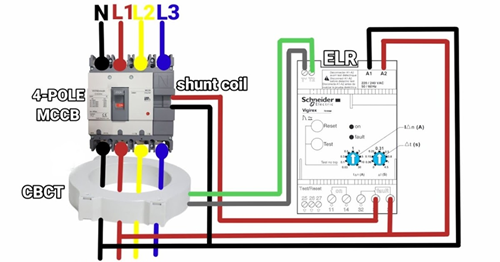
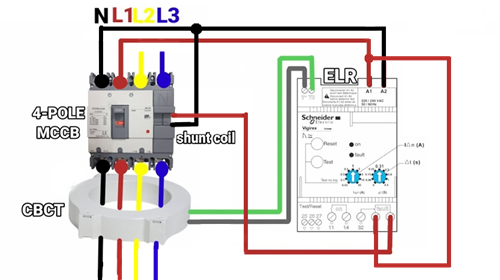
Current Transformers (CTs) in circuit breakers work on the principle of electromagnetic induction. They step down high-magnitude line currents (primary) to a low, safe, and measurable standard (1A or 5A secondary). A magnetic core, connected in series, transforms the current proportionally based on a fixed turns ratio to drive protection relays. Key Aspects of CT Operation in Circuit Breakers:
In a circuit breaker system, a Current Transformer (CT) acts as the "eyes" of the protective relay, accurately scaling down high primary currents to a safe, manageable level (typically 1A or 5A) for monitoring and tripping. Working Principle A CT operates on the principle of Electromagnetic Induction (Faraday’s Law).
Key Component Roles
Critical Safety Warning
Never leave a CT’s secondary circuit open while current is flowing in the primary. Without a closed secondary loop, the primary magnetic force is unopposed, causing the magnetic flux to skyrocket. This can induce dangerously high voltage spikes (thousands of volts), leading to insulation failure or fatal electric shock.
Provide the [System Voltage Level] and [Desired Protection Type] (e.g., Overcurrent or Differential) to determine the specific CT accuracy class required for your application.
|
|
Intelligent Controller of a circuit breaker - working principle in english
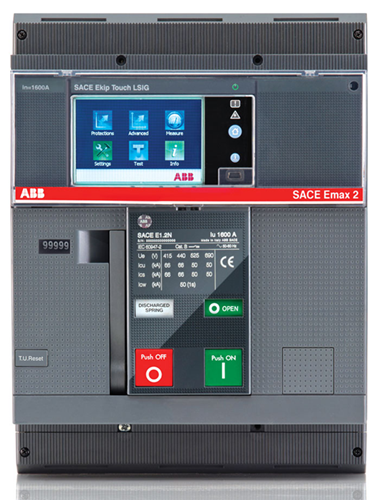
An intelligent controller (smart breaker) functions by integrating sensors with a microprocessor to continuously monitor electrical parameters like current, voltage, and temperature. Upon detecting faults (overload/short-circuit) or receiving remote commands, the microprocessor immediately triggers the operating mechanism to open the circuit. It provides real-time data, remote control, and predictive maintenance capabilities via IoT protocols. Key Components & Working Principle
Key Benefits
The intelligent controller (often called an intelligent trip unit) serves as the "brain" of a modern circuit breaker. Unlike traditional mechanical breakers that rely solely on physical heat or magnetic force to trip, an intelligent controller uses microprocessors and sensors to monitor, analyze, and control the electrical circuit with high precision. Core Working Principle The operation follows a continuous loop of four key stages:
Key Intelligent Functions
Summary Table: Traditional vs. Intelligent Controller
|
|
The five-link free release mechanism in a circuit breaker - Working Principle The five-link free release mechanism in a circuit breaker utilizes a system of five interconnected links to toggle contacts between open and closed positions, ensuring the breaker trips instantly during a fault even if the close command remains active. It separates tripping and closing functions, allowing the mechanism to "free trip" via electromagnetic or thermal triggers Key Working Principles
This mechanism ensures that the safety of the circuit (opening) takes precedence over the manual or automatic command to close.
The Five-link Free Release Mechanism (often referred to as a five-bar linkage trip-free mechanism) is a mechanical system in a circuit breaker that ensures the contacts will open immediately upon a fault, even if the closing handle is held in the "ON" position or a closing signal is maintained.
Core Working Principle
The mechanism operates on the principle of mechanical decoupling. Under normal conditions, the five links act as a rigid "toggle" to hold the contacts closed against spring pressure. When a trip signal is received, the linkage "collapses," breaking the mechanical connection between the operating handle and the contacts.
For a visual breakdown of how these components are housed, you can view the Eaton Circuit Breaker Fundamentals or RealPars Technical Guide. |
|
Electric Energy Storage Mechanism of a circuit breaker - Working Principle The electric energy storage mechanism in a circuit breaker uses a motor or manual handle to compress springs, or build up pneumatic/hydraulic pressure, storing potential energy to rapidly separate contacts during a fault. When a fault is detected, the latch holding this energy is released, allowing the stored energy to instantly open or close the circuit breaker, ensuring quick arc extinction. Core Operating Principle & Mechanism
Types of Energy Storage Mechanisms
This mechanism ensures the circuit breaker can operate independently of the available control power during the actual instant of interruption.
The electric energy storage mechanism in a circuit breaker is an electro-mechanical system that stores the physical energy required to open or close the breaker’s contacts rapidly. It typically uses an electric motor to compress a heavy-duty spring, transforming electrical energy into elastic potential energy.
Working Principle
The mechanism operates in a cyclical "charge-and-release" process to ensure the breaker can operate even if external power is lost.
Key Components
Charging Motor: An Electric Motor that provides the torque needed to compress high-tension springs.
Closing & Opening Springs: Store the potential energy 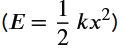 required for high-speed contact movement. required for high-speed contact movement.Gear Train & Cam: Multiplies motor torque and converts rotary motion into linear spring compression. Limit Switches: Sensors that detect when the spring is fully charged and disconnect the motor to prevent overcharging. Latch/Trigger Mechanism: Holds the energy in "standby" until a signal is received from Protective Relays. Provide the specific voltage rating (e.g., 12kV, 220kV) of your circuit breaker to receive a more detailed component list.
Key Advantages
|

+(39) 347 051 5328
Italy - Kazakhstan


09.00am to 18.00pm
About
We offer the best and economical solutions, backed by 27+ years of experience and international standards knowledge, echnological changes, and industrial systems.
Our Services
Marketing Materials


Marketing Materials1


