
|
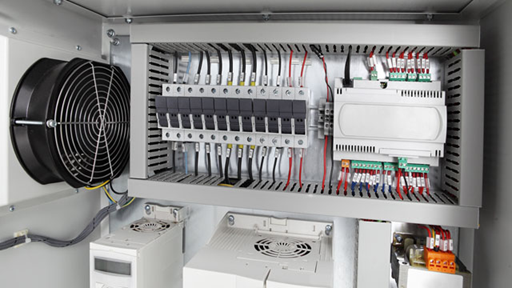
Enclosure Accessories Cooling fans, heaters Panel, Terminal blocks, Wiring ducts - working principle
Enclosure accessories like fans and heaters manage thermal loads, while terminal blocks and wiring ducts organize connections. Cooling fans remove hot air via forced convection, whereas panel heaters use heating elements to prevent condensation. Terminal blocks provide secure electrical connections, and wiring ducts safely manage cable routing. Enclosure Accessories and Working Principles
Working Principles of Key Accessories
Common Enclosure Applications
|
|
Safety Features Interlocks, emergency stop buttons - Working Principle
Emergency stop buttons and interlocks are crucial safety features that immediately halt machinery to prevent injury. E-stops use normally closed (NC) contacts to break control circuits instantly upon manual, latching activation. Interlocks use sensors on guards or doors to automatically cut power when access points are opened. Emergency Stop Button Working Principle
Safety Interlocks Working Principle
These systems often work in conjunction with safety relays to monitor the integrity of the safety circuit and provide redundant protection.
Working Principle of Emergency Stop (E-Stop) Buttons
Working Principle of Emergency Stop (E-Stop) Buttons
An E-stop is a manually operated "kill switch" that serves as a last line of defense in an emergency.
Working Principle of Safety Interlocks
Safety interlocks are automatic devices that monitor the state of machine guards (e.g., doors, gates, or covers) and prevent operation unless all safety conditions are met.
Key Differences
|

| Control Transformers Step down voltage control circuits (e.g. 110V or 24V) - Working Principle |
|
Overload Relays (OLR) Protect motors - Working Principle
Overload Relays (OLR) protect electric motors from overheating by monitoring current consumption and breaking the control circuit when excessive, prolonged current is detected. They commonly use bimetallic strips that bend upon heating, triggering a contactor to stop the motor. This prevents insulation damage, burning out, and prolonged overloading. Key Aspects of Working Principle

Key Features
For more detailed specifications, you can consult technical guides from manufacturers like Schneider Electric or ABB. Core Components & Functions
Common Types & Mechanisms
Why OLR is Essential
|

|
The Top 10 Relay Manufacturers List 1.Omron Omron is a global leader in automation technology, and its relays are synonymous with the quality and precision required in industrial machinery, control panels, and consumer electronics where high reliability is essential.
2.TEConnectivity As an industry titan, TE Connectivity offers an enormous and diverse portfolio of electronic components. Their relays are renowned for robust engineering and are a go-to choice for demanding applications in the automotive, industrial, and aerospace sectors.
3.Phoenix Contact Phoenix Contact is a respected leader in industrial connection technology, offering a wide range of high-quality, pluggable relays and solid-state modules designed for seamless integration into modern control cabinets.
4.Finder Finder is one of Europe’s most well-known relay manufacturers, producing an extensive range of over 14,500 different products. They are highly regarded for their quality general-purpose and industrial relays.
5.Siemens As a powerhouse in industrial automation and digitalization, Siemens provides relays that are an integral part of their broader ecosystem of control and protection systems, trusted for performance in critical infrastructure and factory automation.
6.GEYA GEYA is an expert manufacturer specializing in industrial control and protection components. The company is recognized for its focused and cost-effective product line, particularly in functional relays like timers and monitoring relays for automation systems.
7.Schneider Electric As a global specialist in energy management and automation, Schneider Electric’s relays are a key part of their extensive industrial control offerings. They are known for their reliability in motor control and automation panels worldwide.
8.Panasonic A giant in the electronics industry, Panasonic is highly regarded for its innovative and miniaturized relay solutions. They are a top choice for applications in telecommunications, test equipment, and other space-constrained designs.
9.Zettler Group Zettler Group is a global manufacturer with a strong reputation for producing a wide variety of electromechanical relays. They offer a balance of performance and value, making them a popular choice for home appliances, HVAC, and industrial applications.
|

+(39) 347 051 5328
Italy - Kazakhstan


09.00am to 18.00pm
About
We offer the best and economical solutions, backed by 27+ years of experience and international standards knowledge, echnological changes, and industrial systems.
Our Services
Marketing Materials


Marketing Materials1


