
This product ships globally
SKU
:
15MAP4J4
In Stock
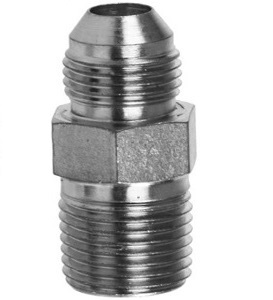
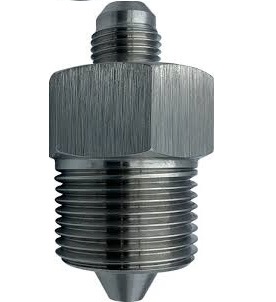
Adapters - JICM (male) x NPTM (male)
$0.00
Connection NPT
:
1/4
Connection JIC
:
(1/4)
Quantity
Social share:
Social share:
You have 30 days to ask for a refund. All things on sale are final sale.
Adapters - JICM (male) x NPTM (male) JIC fittings and adapters are based on the SAE J514 and MIL-DTL-18866 standards, whereas NPT fittings’ guidelines are outlined in the AMSE B1.20.1 standards. Both standards outline the characteristics, tolerances, and sizing variations for their respective components. JIC fittings are often mistaken for other standards like SAE, AN, JIS, and Komatsu; however, subtle differences between them don’t make them interchangeable for use. We’ll get into these differences later on when we look at their characteristics and construction. NPT, or National Pipe Tapered, gives you an indication of the kind of threads you can expect from these fittings. The threads are tapered, meaning they run at an angle of 1O 47’ (measured from the center axis of the NPT fitting). On the other hand, threads on JIC fittings run parallel to each other across the axis of the fitting. NPT threads have flat crests and troughs, containing a 60O angle between each successive thread. JIC thread guidelines are identical to the ones outlined in the SAE – J512 standard. They can come in coarse, fine, or extra-fine thread sizes, each representing the thread count and diameters for the threads on their relevant male and female parts. It may be possible to thread similarly sized male NPT fittings onto female JIC fittings; however, the reverse case is not possible. This practice should not be followed as the taper on male NPT fittings means that deeper threads will not interlock properly (Never mixing).
Description JIC fittings are widely used in fluid applications such as the delivery of fuel or hydraulics, especially when a higher PSI is involved. The JIC fitting uses its 37-degree chamfer seating surface to seal rather than an o-ring that could corrode. This allows them to be connected and disconnected repeatedly, such as in hydraulic applications, without concern for deformation. JIC fittings are very similar to Army-Navy fittings but with a lower tolerance and therefore are produced at a lower cost. Commonly made out of stainless steel, the braided hoses make connecting and disconnecting quick and easy, and the NPT to JIC adapters allow most connections to be easily converted to a JIC system. Maintenance, particularly with stainless steel fittings, is very low, and costs are usually isolated to replacing a damaged component instead of the entire system.
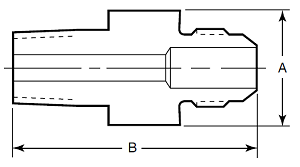
Dimensions and Specifications
|
Frequently Bought

+(39) 347 051 5328
Italy - Kazakhstan


09.00am to 18.00pm
About
We offer the best and economical solutions, backed by 27+ years of experience and international standards knowledge, echnological changes, and industrial systems.
Our Services
Marketing Materials


Marketing Materials1


