
What Makes
us Special?
0
Sucessful Projects
0
Satisfied Clients
0
Awards Won

Overall, hastelloy alloys offer a host of benefits that make them an attractive choice for many industries across the globe. These include corrosion resistance, durability in extreme temperatures, and ease of machining into complex shapes without sacrificing strength or integrity. However, it is important to consider the potential drawbacks before investing in this material; these include difficulty welding due to its high nickel content as well as costliness and limited applications due its innate strength. Ultimately though, if you’re looking for a strong yet versatile material with excellent corrosion resistance properties then hastelloy alloys may just be the perfect fit!
Typical densities of various substances are at atmospheric pressure. Density is defined as the mass per unit volume. It is an intensive property, which is mathematically defined as mass divided by volume: ρ = m/V. In words, the density (ρ) of a substance is the total mass (m) of that substance divided by the total volume (V) occupied by that substance. The standard SI unit is kilograms per cubic meter (kg/m3). The Standard English unit is pounds mass per cubic foot (lbm/ft3).
The density of Hastelloy is 8890 kg/m3.
Example: Density
Calculate the height of a cube made of Hastelloy, which weighs one metric ton.
Solution:
Density is defined as the mass per unit volume. It is mathematically defined as mass divided by volume: ρ = m/V
As the volume of a cube is the third power of its sides (V = a3), the height of this cube can be calculated
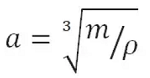
The height of this cube is then a = 0.483 m.
Hastelloy alloys are known for their corrosion resistance and durability—two major benefits that make them an attractive option for many industries. They are also resistant to oxidation, which is essential in high-temperature environments. Furthermore, Hastelloy alloys are also highly resistant to stress corrosion cracking as well as chloride pitting and crevice corrosion. This makes them ideal for use in chemical processing plants, power plants, marine applications, and other industrial settings where there is a risk of corrosion or extreme temperatures. Moreover, Hastelloy alloys can be machined easily into complex shapes with no loss of strength or integrity.
While hastelloy alloys have many advantages, there are some drawbacks to consider as well. One such downside is that these materials can be difficult to weld due to their high nickel content. Additionally, they tend to be more expensive than other materials because they require specialized equipment in order to be machined or formed properly. Furthermore, these materials have limited applications due to their innate strength; they cannot be used in applications where flexibility is important since they can become brittle over time when exposed to extreme temperatures or environmental conditions.
Deal With bennypass and
Get More Valuable Services
Explain to you how all this mistaken ideas of denouncing pleasures
and praising pain was born and I will give you a complete account of
the system.
For Business: For Business inquiry pls fill our feedback form and
Troll Free Number – (+39)347-051-5328.



We offer the best and economical solutions, backed by 27+ years of experience and international standards knowledge, echnological changes, and industrial systems.


