
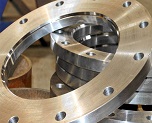
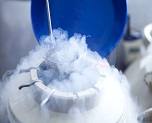
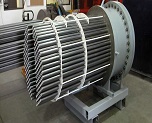
Titanium Feature

  • High strength at cryogenic temperatures
  • This alloy is primarily used for corrosion resistance
  • Excellent strength-to-weight ratio
  • Excellent strength ratio between Pumps, Valve, Pipes, and Fittings
Meet our Experts

Navy ship parts

  • High resistance to marine corrosion
  • Excellent for the Desalination, brine concentration/evaporation
Meet our Experts

Cryogenic Temperature

Hastelloy Valves in Aerospace
Withstands extreme temperatures

Contact us

Special Alloy - Titanium

Titanium is an enormously useful metal. Its unique properties mean it sees widespread usage in an array of critical applications. It is not without fault however and does suffer some disadvantages. It is enormously energy-intensive to produce; titanium used for high-performance applications contributes to its high expense considering its relative abundance in the earth’s crust. Titanium is one of the strongest metals in the periodic table. It has excellent resistance to salt, water, and heat. Because of its lightweight, it has become the material of choice for many industries. In addition, titanium has a low density and is thus easier to work with. There are several types of titanium alloys, Grade 5 (Ti-6Al-4V) is the most widely used titanium alloy grade, and other grades have found their application in the industrial fields, the difference between these types of titanium alloys lies in their strength.

Titanium alloy construction can offer both advantages and disadvantages, helping to make an informed decision that best meets your needs. Whether it’s aerospace components or lightweight structural applications, we’ll look into the marvelous strength-to-weight ratios as well as its ability to resist corrosion. You’ll also get a glimpse into some of the difficulties associated with fabricating these materials and their cost considerations.

Titanium Types

Titanium Grade 1

Titanium Grade 2

Titanium Grade 5 / 6Al4V

Titanium Grade 12

Titanium Density

Titanium is a metal in group IVB of the periodic table with atomic number 22, an atomic weight of 47.90, a density of 4.54 Mg/m3, and a melting point of 1670 C.

The electronic configuration of Titanium is: (Ar)(3d)2(4s)2, and its atomic radius is 0.147 nm.

At room temperature Titanium has the hcp structure (a), it undergoes a polymorphic transition to the bcc structure (b) at 828 C. Alloying elements such as aluminium and vanadium can change the temperature range in which these two forms are stable. The photograph shows an a-b Ti-6Al-4V alloy in which both a and b phases are present at room temperature. The 6-weight % aluminium stabilizes the a phase and the 4-weight % vanadium stabilizes the b phase.

E = 110 GPa, sy = 500 MPa, UTS = 600 MPa, 

K1c = 45 MPa m0.5

Thermal expansion coefficient = 9.1 x 10⁻⁶ /K, and


Titanium Weight Calculator

Advantages of Titanium

  • High strength: High strength to weight ratio and corrosion resistance are some of the properties that make titanium alloys attractive. The density of titanium alloys is usually about 4.51g/cm3, only 60% of that of steel. The strength ratio (strength/density) of titanium alloy allows the production of parts with high unit strength and lightweight. For example, the most commonly used Gr5 alloy has a specific strength of > 200MPa (g/cm3), which is higher than other industrial pure metals and is a good material for the manufacture of load-bearing structural parts. Titanium alloy car parts can not only reduce the mass of the car but also reduce the motion inertia. Titanium alloy is used for engine parts, skeleton, skin, fasteners and landing gear.
  • Good Heat Resistance: Due to its high thermal strength, titanium alloy pipes can work in environments as hot as 450℃ ~ 650℃ for a long time, Gr5 alloy tensile strength can reach 620MPa at 400℃, is used to manufacture part of the aerospace high-temperature structural parts. Compared with aluminium alloy, which is also a “space metal”, titanium alloy can still maintain the required strength at moderate temperature, while aluminium alloy decreases significantly at 150℃.
  • Good Corrosion Resistance: One of the biggest advantages of titanium is that it is non-corrosive. The metal is not affected by high temperatures, and this makes it ideal for oil-field equipment. Titanium alloys are particularly resistant to pitting, acid, and stress corrosion, and it has excellent resistance to alkali, chloride, chlorinated organics, nitric acid and sulfuric acid. The corrosion resistance of titanium and titanium alloy is better than aluminium and magnesium, and even better than stainless steel in some environments. It is a good material for the corrosion of high-temperature exhaust gas containing hydrogen sulfide, is an ideal material for the manufacture of petrochemical pipelines, vehicle exhaust tubing and so on.
  • Power: One of the built-in advantages of Titanium is its strength. It is one of the planet’s most sturdy and durable metals; therefore, it is helpful in various manufacturing applications. Titanium has the highest strength-to-density ratio of any metallic element on the periodic table, attesting to its advantages. Titanium (unalloyed) competes with steel in terms of strength, but it is less dense and is considered the most popular choice for several professionals.


Disadvantages of Titanium

Titanium’s primary disadvantage from a manufacturing and engineering perspective is its high reactivity, which means that it has to be managed differently at all stages of its production. Impurities introduced during the Kroll process, the VAR or the machining process were once almost impossible to remove. It is not suitable for high temperatures that range above 400 degrees Celsius. At this temperature, Titanium loses its strength. Also, Titanium is usually more expensive than other metals such as steel, iron, and aluminium.

  • High Cost: One of the primary disadvantages of titanium is its high cost. Titanium is significantly more expensive than other metals, such as steel, aluminium, and copper. This high cost can make titanium prohibitively expensive for many applications..
  • Difficult to Work With: Titanium is also difficult to work with, due to its hardness and strength. This difficulty can lead to increased production costs and longer production times. Additionally, titanium is difficult to weld, which can limit its use in certain applications.
  • Corrosion Resistance Issues: While titanium is resistant to corrosion, it is not immune to it. Titanium can corrode over time in some environments, such as salt water. This corrosion can weaken the metal and cause it to fail prematurely.
  • Limited Availability: Another disadvantage of titanium is its limited availability. Titanium is not abundant on Earth, making it a scarce resource. This scarcity can lead to higher prices and supply issues.
  • Environmental Concerns: The mining and production of titanium can also have negative environmental impacts. The mining of titanium ore can damage the environment and pollute water supplies. Additionally, the production of titanium dioxide, a common pigment used in paint and cosmetics, can release harmful chemicals into the air

What Makes
us Special?

0
Sucessful Projects
fa fa-cogs
0
Satisfied Clients
fas fa-smile
0
Awards Won
fas fa-shield-alt

Why Choosing Us

30 Years of Experience

We have 27 years of experience in the machining and finishing of precision stainless steel parts.

Award Winning

Complete account of the system, and expound the actual teachings of the great explorer of the truth.

Warranty

Our goal is only one, to always find the best solution for our customers including shipping systems if require.

800+ Sucessful Project

Master builder of human happiness no rejects, dislikes, or avoids pleasure itself consequences .

Honest & Dependable

see our customer feedback

Professional Workers

Know how to pursue pleasure explain tconsequences that are ut extremely seds consequences.

Request for Quote

Deal With bennypass and
Get More Valuable Services

Explain to you how all this mistaken ideas of denouncing pleasures
and praising pain was born and I will give you a complete account of
the system.

For Business: For Business inquiry pls fill our feedback form and
Troll Free Number – (+39)347-051-5328.

favicon bacd

+(39) 347 051 5328

Italy - Kazakhstan

09.00am to 18.00pm

About

We offer the best and economical solutions, backed by 27+ years of experience and international standards knowledge, echnological changes, and industrial systems.

Marketing Materials

Spring Renovation
Industry
US Gas Company
Construct
Plus Project
Vam Drilling Service
X Project
X Project
Cabrrus Training

Marketing Materials1

Spring Renovation
Industry
US Gas Company
Construct
Plus Project
Vam Drilling Service
ultrasonic sensor
ultrasonic sensor
Cabrrus Training