
Back-up O-Rings
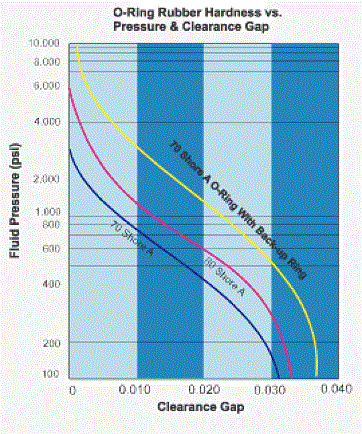
Back-up Rings are flat, split, spiral or contoured washer type fittings used to protect an O-Ring seal from extrusion at higher pressures and temperatures. A Back-up Ring works by blocking or reducing the extrusion gap, thus preventing the o-ring from extruding. The use of a back-up ring increases the pressure and temperature capability of o-rings. Back-up Rings can be solid, split, spiral or contoured. The split and spiral back-up rings are easier to install, especially in small diameters. The chart to the right depicts the higher pressure capabilities of using Back-up Rings for a given clearance gap dimension. Back-up Rings can be used on both sides of the O-Ring if pressure is bidirectional. Gland widths should be widened to accommodate one or two Back-up Rings. Please contact us for selection and design assistance. For more details please see figure below
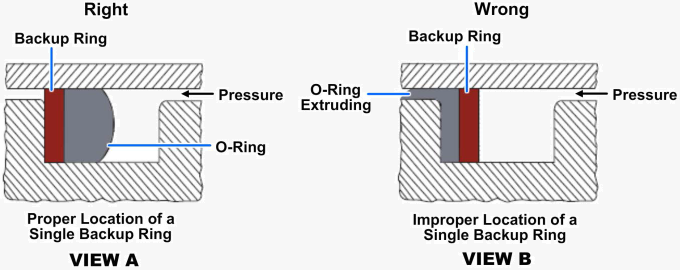
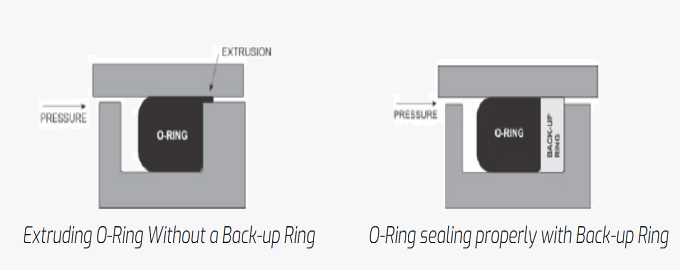
Explore Back-Up O-Rings Designed for Higher-Pressure Applications
- Back-Up Rings used with O-Rings at pressures > 1500 psi or big extrusion gaps
- Back-Up Rings are designed to limit O-Ring clearance gap extrusion.
- Available in elastomeric compounds and PTFE Back-Up Rings.
- PTFE Back-up rings can be solid, split, spiral, or custom for ease of install.
- PTFE Back-up Ring size standards AN6244, AN6246, MS27595, MS28774, MS28782 and MS28783.
- Elastomer Back-up Rings are typically contoured to conform to an O-Ring.
- Elastomer Back-up Rings fit standard USA and custom O-Ring sizes.
- Back-up Rings require wider glands to accommodate.
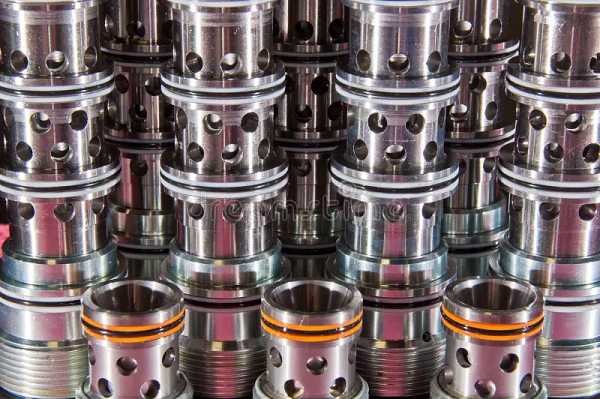
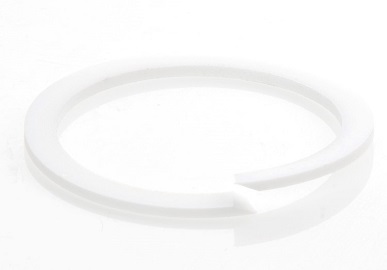
SPLIT TEFLON BACKUP RING
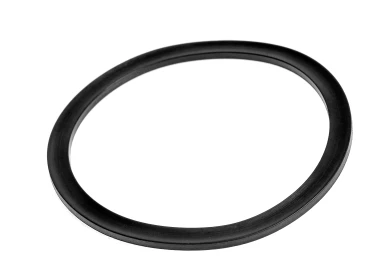
Solid Back-up Rings
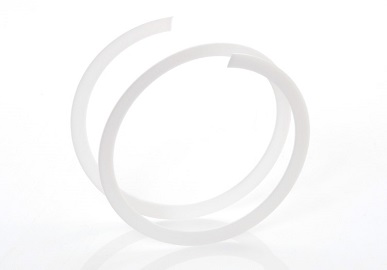
Spiral Back-up Rings
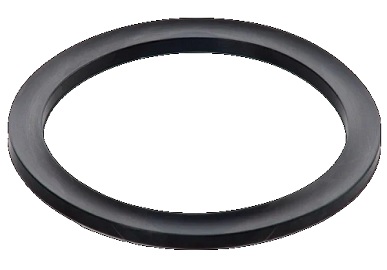
Contoured Rubber Back-up Rings
Solid Rings
Solid or uncut rings find a wide range of use due to their ease of installation. They are especially used in rods and pistons. Despite being uncut, they do have the ability to stretch over surfaces and are found in hydraulic cylinders, high-pressure valves, and hydraulic systems.
Split Rings
The scarf cut or the split ring has a cut in it at a 30 or 45-degree angle and is widely used in high-pressure hydraulic systems. It is often made with materials having a high modulus of elasticity and tensile strength making it useful in all kinds of applications. The split in the rings allows it to stretch in high-pressure systems which fills the extrusion gaps. However, back-up rings made with high-modulus materials can cause nibbling of the o-ring in extreme pressures so a softer ring should be installed in between the scarf-cut ring and the o-ring to avoid this sealant failure from occurring.
Spiral Wound
Overlapping, coil-shaped material makes up spiral back-up rings. When there is increased pressure, the overlapping coil comes in contact with more surface area hence they offer additional support. However, the cost and availability of these rings ensures that they are used for specific functions only.
There are several kinds of back-up rings available in the market which are utilized in hydraulic functions depending upon the temperature, pressure, and extrusion gaps generated in the system.
Choose your Backup Ring here
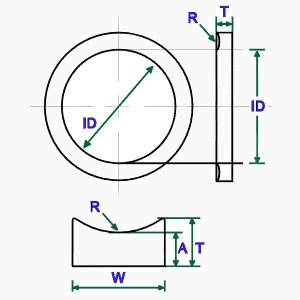
NOTE: The “A” dimension, or Axial Height, applies only to the rubber contoured backup rings. PTFE backup rings are flat, so they do not have this contour.
The right choice of backup ring is of fundamental importance to save the life of the main O-ring.
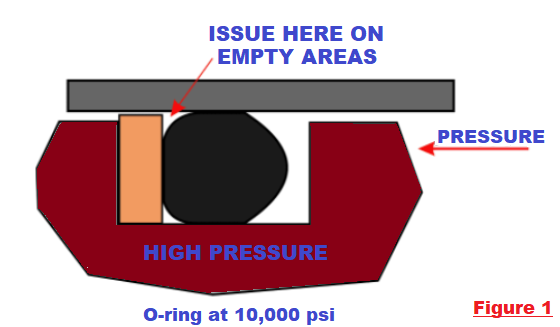
Figure 1 on the side shows an example with standard configuration which include an durometer O-Ring and Backup Ring, and all pressurized at 10,000 psi.
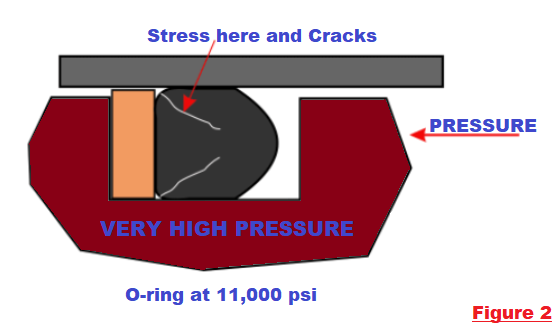
As soon as the pressure reaches 11,000 psi as shows in Figure 2, the O-Ring covered the empty space which was free with 10,000 psi of pressure with consequence that the o-ring material could no longer stretch and deform to fill that gap behind the o-ring. The result will be the O-ring damages (cracks).
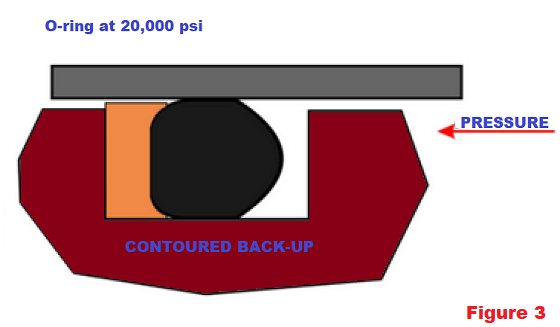
To solve this problem the back-up ring was replaced with another type called Contouring backup. Figure 3 on side shows this type of backup. The result that gap behind the o-ring has been eliminated and removed extra stress on it (Overstretching)
If you have a high-pressure application or even an application that may occasionally be subjected to higher pressures, it’s critical to have the right seal for the job. Standard and cheap seals are costly in more ways than one. That’s why the expert team here they will try to help you
Backup rings are essential components in the world of sealing technology. These rings are designed to prevent extrusion and deformation of O-rings and other types of gaskets when exposed to high pressures, temperatures and aggressive chemicals. Backup rings play a vital role for longevity and reliability of gaskets, ensuring the efficiency and safety of mechanical systems. If you have any questions, please do not hesitate to contact us, our team is always ready to help.
Question and Answer: Submit Your Question Below!
For Business: For Business: For any questions regarding Backup Ring, please fill out our feedback below.
Calculating O-Ring Cord Cut-Length
How to calculate O-Ring cord length needed: ( ( OD + ID ) / 2 ) x Pi = length Pi=3.14159 Inside Diameter (ID) = Outside Diameter (OD) - twice the cross section (C/S) ID = OD - (2 x C/S)