
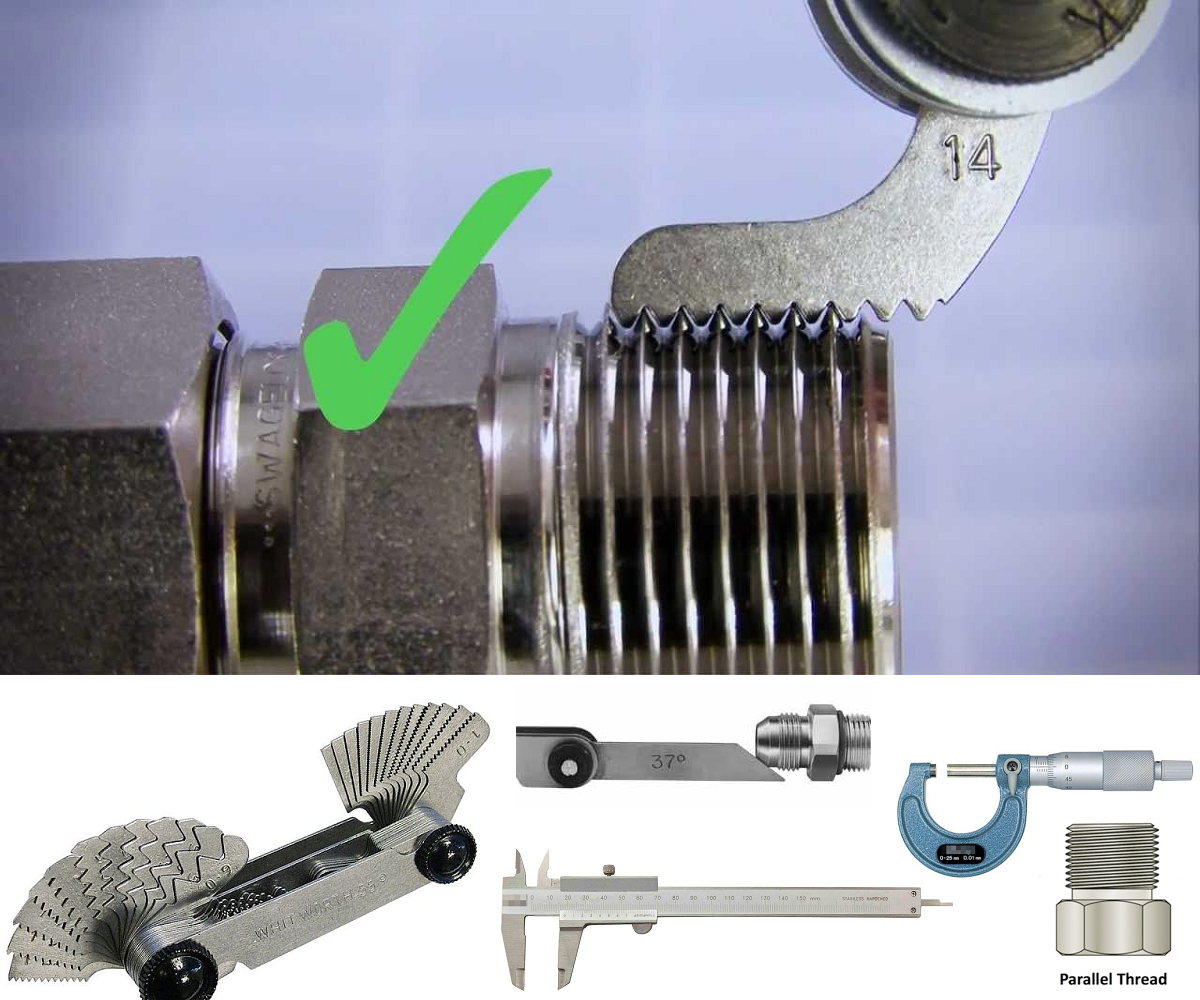
Thread Identification
Threads have always been a very common and popular manufacturing requirement. There are many different types of thread callouts and an equal amount of ways to manufacture them. However, understanding the basic principles will go a long in assisting manufacturing personnel and engineers on how a thread is made.
Threads are typically made on either a mill or a lathe. In order to make threads you need to understand a few basic principles:
- Thread Geometry
- Types of thread-cutting tools
- How different materials affect threads
- Thread engagement
Threads consist of a handful of definitions, but there are a few in particular that are important to understand. The most common aspects of a thread to know are major and minor diameter, pitch, threads per inch and pitch diameter. Explanations of these definitions can be found here. Familiarity with these definitions will give you a better understanding of what tools to use to create your desired thread.
Thread Geometry
Threads consist of a handful of definitions, but there are a few in particular that are important to understand. The most common aspects of a thread to know are: major and minor diameter, pitch, threads per inch and pitch diameter. Familiarity with these definitions will give you a better understanding of what tools to use to create your desired thread.
Types of cutting tools
There are a few different types of thread-cutting tools, depending on the job you may be using inserts, forming taps, cutting taps, high helix taps or a thread milling tool. There are obviously some more exotic or rare tools that can be used depending on the application. However, the majority of thread cutting revolves around using one of the previously mentioned tools. Each tool has different benefits, but the most commonly used threading tool is a roll (forming) tap. The reason for its popularity largely relies on its ease of use, inherent thread strength, and the lack of chips produced during use.
Material
The material will greatly impact what types of tools you are allowed to use. Harder materials such as high-grade stainless steel may require the use of a thread mill or make it difficult to run roll or cut taps. Steel with low to medium amounts of carbon can be tapped without too much difficulty. However, steel with a high concentration of chromium can be difficult to tap, and can easily result in tool wear or taps breaking.
Thread Engagement
Roll taps form the thread into the material, hence why they are sometimes referred to as forming taps. Whereas cut taps will actually cut the thread into the material. Both of these techniques require the use of a drilled-out hole (through or blind) prior to utilizing either tap. Deciding which size drill to use can be difficult, but luckily there are plenty of online calculators, tables and even formulas to justify what size drill to use. Tests have shown that 55-60 percent of thread engagement is satisfactory, but 75 percent of thread engagement has become an industry standard. However, if the length of the thread is more than 1.5 times the nominal diameter a 50-55 percent thread is fine. Tap drill tables are usually based on 75 percent thread engagement, and below is a formula demonstrating how the calculations are made:
Hole Size = Basic Major Diameter – 1.08253 Percent of thread engagement number of threads per inch
Example of 4-40 thread:
.0917 = .1120 – ((1.08253 * .75 / 40)
A .0917 drill corresponds to a number 43 (.0890) drill since it is the closest option available. However, depending on your material, type of thread and the depth of your thread, you may want to adjust your thread engagement percentage.
A .0917 drill corresponds to a number 43 (.0890) drill since it is the closest option available. However, depending on your material, type of thread and the depth of your thread, you may want to adjust your thread engagement percentage.

+(39) 347 051 5328
Italy - Kazakhstan


09.00am to 18.00pm
About
We offer the best and economical solutions, backed by 27+ years of experience and international standards knowledge, echnological changes, and industrial systems.
Our Services
Marketing Materials


Marketing Materials1


