
Production Separation Unit
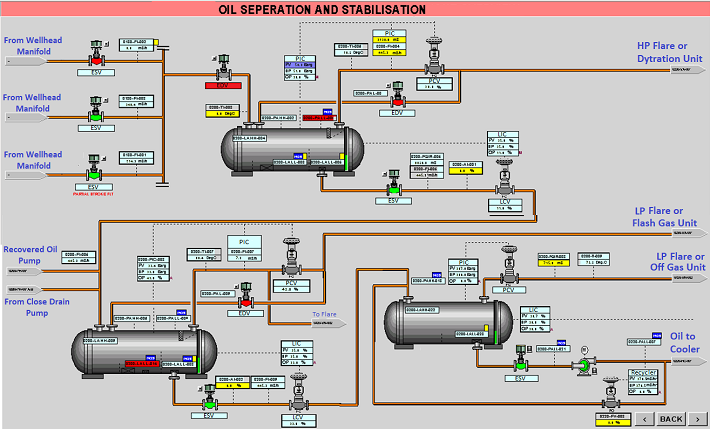
Separation unit Separation units normally mean a set of equipment called separators where the first treatment of the oil is carried out (see CRUDE OIL TREATMENT). Normally, a separator is a cylindrical container where the incoming fluid undergoes a speed slowdown due to the enlargement of the section between the pipe and the separator. For each separator, a series of devices are installed inside it (bulkheads, demisters, obligatory paths) in order which to improve the separation process. For any Crude Oil Plant, the separation has two main objectives: obtaining the maximum recovery of oil during the separation, and complete removal (as much as possible) of water where present. A decrease in temperature (with constant pressure) generally has the effect of increasing liquid recovery, while an increase in temperature has the reverse effect. An increase in pressure (with constant temperature) usually has a positive effect on liquid recovery. However, the maximum possible recovery must always consider the stabilization conditions required for the oil. For these reasons it is often preferred to use a series of Separators that work at decreasing pressures, this allows to optimize the recovery of liquids, including to have at the same time stabilized oil (see Fig.13).
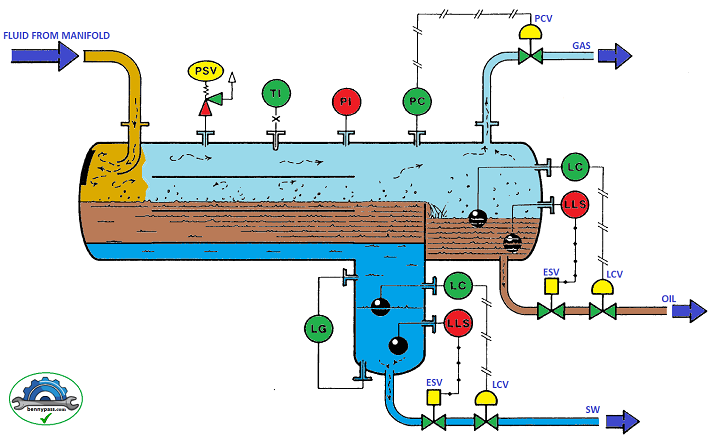
Vertical separators Vertical separators are more used where you have a G.O.R. (Gas Oil Ratio) rather low, anyway always as two-phase separators (e.g. gas/oil, gas/water). They can also be used as inlet separators in an oil or gas condensate system, then followed by other suitable separators for subsequent treatment. Two-phase and three-phase horizontal separators Horizontal separators are the most used in oil fields, because for the same volume they have a greater separation capacity than vertical separators. Consider also that require sometimes to separate large quantities of free water and the Horizontal separator remains the best for this. Fig. 14 shows a cross-section of a three-phase horizontal separator which is generally used in Oil&Gas Fields. The first section is where the gas/oil separation takes place and at the same time the liquid (water or oil), flowing through the horizontal plates, takes on an almost laminar motion which favours the water/oil separation. The bulkhead guarantees the presence of only oil in the oil discharge section. To avoid the carryover of particles liquid in the Gas line, the Gas must pass through a demister before going out in pressure control.
Figure 14- Three-Phase Horizontal Separator
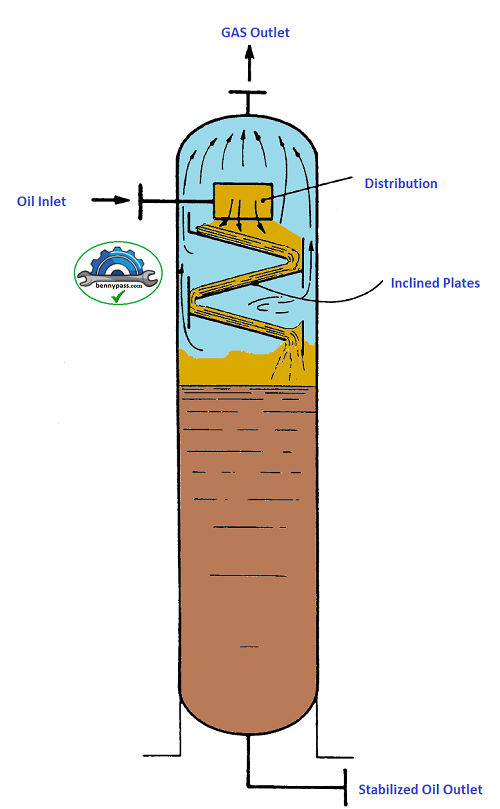
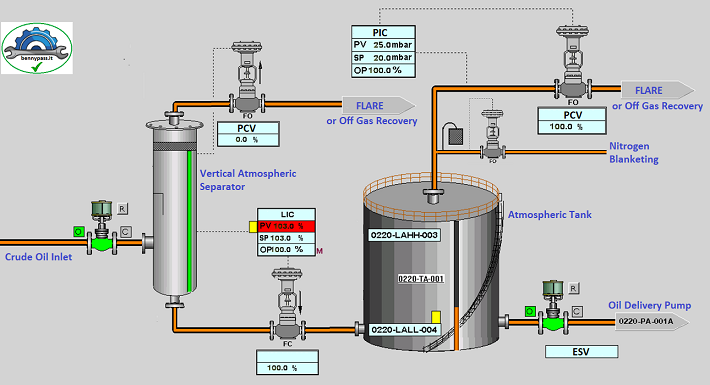
Gas Boot It is essentially a two-phase vertical atmospheric separator, Fig.15, usually placed as the last separation stage before atmospheric tanks, in case missing these, before booster pumps for oil shipment. It works at the minimum possible pressure to guarantee the arrival of the separated gas to the torch and at the same time the maximum degassing of the oil. Fig.16 shows a typical installation diagram of a Gas Boot before a tank.
|


+(39) 347 051 5328
Italy - Kazakhstan


09.00am to 18.00pm
About
We offer the best and economical solutions, backed by 27+ years of experience and international standards knowledge, echnological changes, and industrial systems.
Our Services
Marketing Materials


Marketing Materials1


