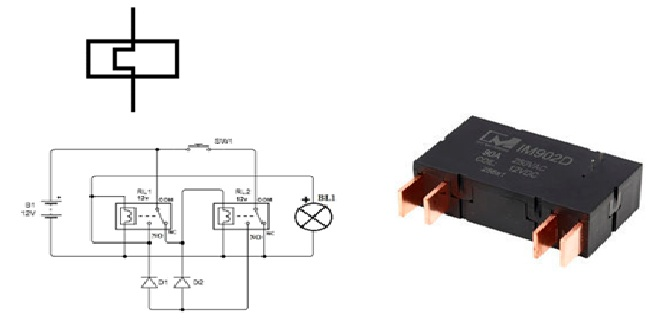
Magnetic latching relays work by using a brief electrical pulse to create a magnetic field that shifts internal contacts, which are then held in place by a permanent magnet or magnetic latching element, eliminating the need for continuous power to maintain the state, thus saving energy and reducing heat. A second, reversed pulse (or sometimes a mechanical action) is needed to switch them back, providing a memory function for the last position
This video provides a basic introduction to how a latching relay works:
Working Principle Steps
Energize to Switch (Set/Reset):
A short pulse of current flows through the relay's coil (or one of two coils).
This creates a temporary magnetic field that interacts with a permanent magnet, either reinforcing or opposing its field, forcing the internal armature/contacts to move to a new position (set or reset)
Watch this video to see how a latching relay works with a pulse:
Latching (Holding the Position):
When the pulse is removed, the coil's field disappears, but the permanent magnet retains the armature in its new position, keeping the contacts closed or open.
This "latching" action means no continuous power is needed to hold the state, unlike conventional relays.
This video demonstrates the working principle of a latching relay in action:
De-energize/Switch Back:
To change the state again, another pulse (often with reversed polarity or through a separate coil) is applied, repeating the process to move the contacts to the opposite position.
Key Components & Concepts
Permanent Magnet: Provides the holding force, allowing the relay to "remember" its last state.
Coil(s): Generates temporary magnetic fields for switching.
Hysteresis: The magnetic material's property to retain some magnetism after the external field is removed, crucial for latching
Benefits
Energy Savings: Only uses power during the brief switching pulse.
Reduced Heat: Minimal continuous power means less heat generation.
Positional Memory: Ideal for applications needing state retention, like smart meters or automated systems.
This video explains the advantages and applications of latching relays:
A magnetic latching relay is a bistable switch that uses a combination of electromagnetism and permanent magnets to maintain its state (ON or OFF) without continuous power. Unlike standard relays that require constant current to hold contacts in place, magnetic latching relays only require a brief electrical pulse to switch positions.
Core Working Principle
The operation depends on the interaction between an internal permanent magnet and an electromagnet (the coil).
Switching (Set): When a short pulse of current is sent through the coil, it generates a temporary magnetic field. This field is strong enough to move an internal metal lever (armature), closing the electrical contacts.
Latching (Retention): Once the current pulse ends, the electromagnet turns off. However, the permanent magnet provides enough force to hold the armature in its new position. The relay remains in this state indefinitely without consuming any further energy.
Unlatching (Reset): To switch the relay back, a second pulse is applied. This pulse creates a magnetic field that opposes the permanent magnet's hold, allowing a spring or the opposing magnetic force to pull the armature back to its original position.
Common Coil Configurations
The method for triggering the reset depends on the relay's coil design:
Single-Coil: Uses a single coil for both set and reset functions. To switch states, you must reverse the polarity of the input pulse.
Dual-Coil: Features two separate coils—one for "Set" and one for "Reset." Applying a pulse to the specific coil triggers the corresponding action without needing to reverse polarity.
Key Advantages
Energy Efficiency: Consumes power only for milliseconds during switching, making it ideal for battery-powered or remote systems.
Low Heat Generation: Because the coil is not constantly energized, the relay does not heat up during long periods of operation.
Memory Function: It "remembers" its last state even after a total power failure, ensuring consistent operation upon power restoration.
Primary Applications
Smart Energy Meters: Disconnecting or reconnecting loads with minimal power waste.
Lighting Control: Allowing lights to be turned on/off from multiple locations with simple push-buttons.
Industrial Automation: Maintaining equipment states during temporary power interruptions.
We offer the best and economical solutions, backed by 27+ years of experience and international standards knowledge, echnological changes, and industrial systems.