UPS Power Factor Correction (PFC) - Working Principle

UPS Power Factor Correction (PFC) - Working Principle

Power Factor Correction

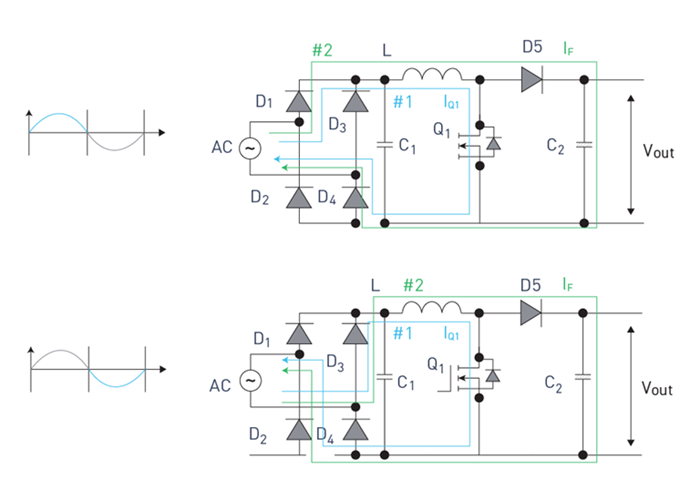
 UPS Power Factor Correction (PFC) works by forcing the input current waveform to mirror the sinusoidal voltage waveform, ideally bringing the power factor (PF) to 1.0 (unity). By minimizing harmonic distortion and phase lag, Active PFC uses switching transistors (usually a boost converter) to manage input power efficiently, reducing strain on the grid and improving UPS efficiency.

Key Working Principles of UPS PFC

  • Active PFC (Common in Modern UPS): This technique uses active switching components (e.g., MOSFETs, IGBTs) controlled by a dedicated IC to continuously modulate the input current. It transforms the distorted, high-harmonic current drawn by rectifiers into a pure, in-phase sine wave, forcing the UPS to behave like a purely resistive load.
  • Active Power Regulation: The PFC circuit works as a boost converter, typically converting the AC input into a stable high-voltage DC bus. This stage actively manages the instantaneous power, making the current drawn proportional to the voltage.
  • Passive PFC (Less Common/Small Loads): Uses passive components, such as inductors and capacitors, to filter harmonics and compensate for lagging current.
  • Benefits: This correction reduces total current draw (RMS), limits harmonic distortion, prevents overload on components, and improves overall energy efficiency.

PFC Implementation in UPS Types

In modern online double-conversion UPS systems, PFC is achieved within the AC-to-DC rectifier stage. It corrects the power factor at the input to ensure a high power factor (often 0.99 or better) is presented to the utility grid, even under partial loads.

In an Uninterruptible Power Supply (UPS), Power Factor Correction (PFC) is the technology used to align the input current with the input voltage to ensure the system behaves like a purely resistive load. This process maximizes energy efficiency by reducing "wasted" reactive power.

Core Working Principles

Modern UPS systems primarily use Active PFC, which utilizes high-frequency electronic switching to reshape the current.

  1. Rectification: The AC input is first passed through a bridge rectifier to convert it into a pulsating DC signal.
  2. Waveform Shaping: A specialized Boost Converter (consisting of an inductor, a switching transistor like a MOSFET, and a diode) is placed between the rectifier and the main storage capacitors.
  3. Active Control: A PFC controller chip (like the UC3854) monitors the instantaneous input voltage and modulates the duty cycle of the switch.
  • During the Switch "ON" Time: Energy is stored in the PFC inductor.
  • During the Switch "OFF" Time: The stored energy is released to the load and output capacitor.
  1. Resulting Waveform: By varying these switching pulses thousands of times per second (typically 20kHz to 100kHz), the circuit "pulls" current in a way that matches the shape and phase of the sine wave voltage.

Why PFC is Essential for UPS

  • Efficiency: It raises the Power Factor (PF) from roughly 0.7 (standard) to above 0.99.
  • Harmonic Reduction: It minimizes Total Harmonic Distortion (THD), which prevents "noise" from polluting the local electrical grid.
  • Cost Savings: High PF reduces the current drawn from the utility, helping businesses avoid low power factor penalties and reducing the required size of cables and breakers.
  • Grid Compatibility: It ensures compliance with international standards like IEC 61000-3-2 for harmonic emissions.

favicon bacd

+(39) 347 051 5328

Italy - Kazakhstan

09.00am to 18.00pm

About

We offer the best and economical solutions, backed by 27+ years of experience and international standards knowledge, echnological changes, and industrial systems.

Marketing Materials

Spring Renovation
Industry
US Gas Company
Construct
Plus Project
Vam Drilling Service
X Project
X Project
Cabrrus Training

Marketing Materials1

Spring Renovation
Industry
US Gas Company
Construct
Plus Project
Vam Drilling Service
ultrasonic sensor
ultrasonic sensor
Cabrrus Training