Miniature Circuit Breaker (MCB) - Working Principle

Miniature Circuit Breaker (MCB) - Working Principle

breaker2

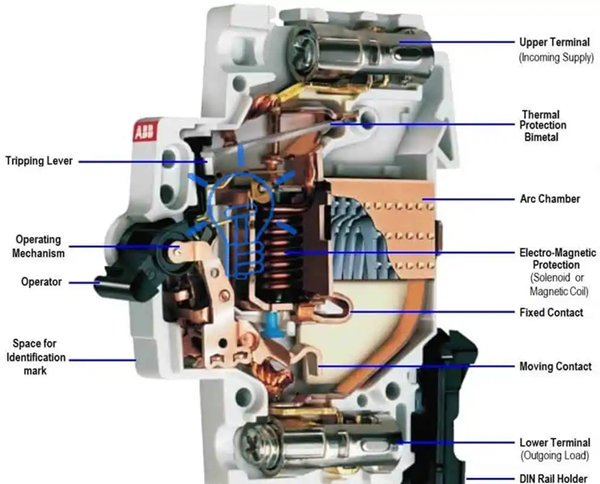
A Miniature Circuit Breaker (MCB) protects electrical circuits from overload and short circuits using a dual thermal-magnetic mechanism. It uses a bimetallic strip that heats and bends to trip the switch during prolonged overloads, and a solenoid coil that creates a magnetic field to instantaneously break the circuit during high-current short circuits.

Core Working Principles

  • Thermal Tripping (Overload Protection): When excess current flows for an extended period, the bimetallic strip heats up, bends, and triggers a latch that opens the contacts. This prevents wires from overheating.
  • Magnetic Tripping (Short Circuit Protection): Upon a sudden, massive surge in current, a solenoid coil generates a strong magnetic field, pulling a plunger that instantly releases the latch to open the contacts.
  • Arc Extinguishing: When contacts separate, an electric arc is formed. The MCB's arc chute (metal plates) cools and splits this arc to extinguish it quickly.

Key Features

  • Manual Reset: The MCB must be manually switched back ON after tripping.
  • Trip-Free Mechanism: The MCB will still trip even if the handle is forced into the ON position.
  • Modular Design: Compact, standardized, and designed for easy installation in consumer units.

A Miniature Circuit Breaker (MCB) is an automatically operated electrical switch designed to protect low-voltage electrical circuits from damage caused by excess current, specifically overloads and short circuits.

Working Principle

The MCB operates using two primary tripping mechanisms to handle different types of electrical faults:

Fault Type Mechanism Working Principle
Overload Thermal (Bimetallic Strip) Continuous overcurrent causes a bimetallic strip to heat up and bend due to different expansion rates of its two metals. This bending physically releases a mechanical latch that opens the contacts.
Short Circuit Magnetic (Solenoid Coil) A sudden, massive surge in current (short circuit) creates a strong magnetic field in a solenoid coil. This field instantly pulls a plunger that strikes the trip lever, opening the contacts in less than 0.1 seconds.


Key Internal Processes

  • Arc Quenching: When contacts separate, an electrical arc (spark) is formed. The MCB directs this arc into an arc chute (a series of metal splitter plates) that divides and cools the arc to safely extinguish it.
  • Manual Reset: Once the fault is cleared, the MCB can be manually reset using the external toggle handle, unlike a fuse which must be replaced.
  • Trip-Free Mechanism: Most modern MCBs are "trip-free," meaning they will trip internally even if the external handle is held in the "ON" position during a fault.

Tripping Characteristics (Trip Curves)

MCBs are classified by their "trip curve," which determines the current level required for an instantaneous magnetic trip:

favicon bacd

+(39) 347 051 5328

Italy - Kazakhstan

09.00am to 18.00pm

About

We offer the best and economical solutions, backed by 27+ years of experience and international standards knowledge, echnological changes, and industrial systems.

Marketing Materials

Spring Renovation
Industry
US Gas Company
Construct
Plus Project
Vam Drilling Service
X Project
X Project
Cabrrus Training

Marketing Materials1

Spring Renovation
Industry
US Gas Company
Construct
Plus Project
Vam Drilling Service
ultrasonic sensor
ultrasonic sensor
Cabrrus Training